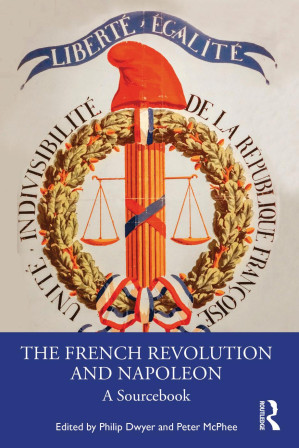
The French Revolution and Napoleon : A Sourcebook 🔍
Philip G. Dwyer; Peter McPhee
Routledge, Taylor & Francis Group, 2, 2024
English [en] · PDF · 39.2MB · 2024 · 📘 Book (non-fiction) · 🚀/lgli/lgrs/zlib · Save
description
The upheavals, terror, and drama of the French Revolutionary and Napoleonic period restructured politics and society on a grand scale, making this the defining moment for modern European history.
This volume collects together a wide selection of primary texts to explain the process behind the enormous changes undergone by France and Europe between 1787 and 1815, from the Terror to the Counter-Revolution and from Marie-Antoinette to Robespierre and Bonaparte. While bringing the impact of historical events to life, Philip Dwyer and Peter McPhee provide a clear outline of the period through key documents and lucid introductory passages and commentary. They illustrate the meaning of the Revolution for peasants, sans-culottes, women, and slaves, as well as placing events within a wider European context..
Students will find this an invaluable source of information on the Revolution as a whole as well as the international significance of the events.
This volume collects together a wide selection of primary texts to explain the process behind the enormous changes undergone by France and Europe between 1787 and 1815, from the Terror to the Counter-Revolution and from Marie-Antoinette to Robespierre and Bonaparte. While bringing the impact of historical events to life, Philip Dwyer and Peter McPhee provide a clear outline of the period through key documents and lucid introductory passages and commentary. They illustrate the meaning of the Revolution for peasants, sans-culottes, women, and slaves, as well as placing events within a wider European context..
Students will find this an invaluable source of information on the Revolution as a whole as well as the international significance of the events.
Alternative filename
lgrsnf/The_French_Revolution_and_Napoleon.sanet.st.pdf
Alternative author
Peter McPhee; Philip G. Dwyer
Alternative publisher
Ashgate Publishing Limited
Alternative publisher
Taylor & Francis Ltd
Alternative publisher
Gower Publishing Ltd
Alternative edition
Transferred to digital printing, London, 2006
Alternative edition
Taylor & Francis (Unlimited), [S.l.], 2024
Alternative edition
Taylor & Francis (Unlimited), London, 2002
Alternative edition
United Kingdom and Ireland, United Kingdom
Alternative edition
Second edition, Abingdon, Oxon
Alternative edition
Second edition, London
Alternative edition
August 23, 2002
Alternative edition
2002-08-23
Alternative edition
PS, 2002
Alternative description
Cover
Half Title
Title Page
Copyright Page
Table of Contents
List of Illustrations
About the Editors
Preface to the Second Edition
Preface
How to Read a Primary Source
What Is a Primary Source?
What Kind of Source Is It?
Interpreting the Source
A Note On the Revolutionary Calendar
Chronology
Maps
1 The Ancien Régime Challenged
1.1 Lamoignon On the Principles of the French Monarchy, 19 November 1787
1.2 ‘Memoir of the Princes of the Blood’, 1788
1.3 Sieyès, What Is the Third Estate?, January 1789
1.4 Cahiers De Doléances, Province of Berry, Spring 1789
1.4.1 The First Estate of Bourges
1.4.2 The Second Estate of Berry
1.4.3 The Third Estate of Berry
1.4.4 The Parish of Levet
1.4.5 The Parish of Marcilly
1.5 Cahier De Doléances, Parisian Flower Sellers, Spring 1789
2 Revolutionary Action
2.1 The Tennis Court Oath, 20 June 1789
2.2 The Storming of the Bastille, 14 July 1789
2.3 The Killing of Bertier and Foulon, 22 July 1789
2.4 Arthur Young in France, July 1789
2.5 The Great Fear: Letter From the Steward of the Duke of Montmorency, 2 August 1789
3 Creating a Regenerated France
3.1 The August 1789 Decrees On Feudalism
3.2 The Declaration of the Rights of Man and of the Citizen, August 1789
3.3 Debating Revolutionary Principles
3.4 The March of Parisian Market-Women On Versailles, October 1789
3.5 Law On Inheritance, March 1790
3.6 The Festival of the Federation, 14 July 1790
3.7 Le Chapelier Law, 14 June 1791
4 Exclusions and Inclusions
4.1 Petition From Jewish Communities, 28 January 1790
4.2 Civil Rights for Free Blacks, 15 May 1791
4.3 Olympe De Gouges On Women’s Rights, 1791
4.4 Talleyrand On the Fate of Minority Languages
5 The Church and the Revolutionary State
5.1 The Debate On Church Reform, May 1790
5.2 Decree On the Civil Constitution of the Clergy, 12 July 1790
5.3 The Clerical Oath
5.3.1 The Decree of 27 November 1790
5.3.2 The Declaration of a Parish Priest, January 1791
5.4 Papal Bull Charitas, 13 April 1791
5.5 Counter-Revolutionary Hostility to Church Reform
6 International Reactions to the Revolution
6.1 George Washington Contemplates the Future
6.2 Edmund Burke Rejects Revolutionary Change
6.3 ‘A Citizen of the World’
6.4 Enthusiasm From the German Rhineland
6.5 The Response From the Ottoman Envoy
7 Monarchy and Revolution
7.1 The King’s Proclamation On His Flight From Paris, 21 June 1791
7.2 Reactions to the King’s Flight
7.2.1 The Abbé Grégoire
7.2.2 A Monarchist Petition From the Provinces
7.3 Barnave On Ending the Revolution, 15 July 1791
7.4 The Massacre On the Champ De Mars, 17 July 1791
7.5 The Constitution of 1791
8 The Revolution At War
8.1 The Renunciation of Foreign Conquests, 22 May 1790
8.2 The Decree Against Émigrés, 9 November 1791
8.3 The Declaration of War, 20 April 1792
8.4 Decree of ‘La Patrie En Danger’, 11 July 1792
8.5 The Deportation of Non-Juring Priests, 26 August 1792
8.6 The September Massacres, 1792
9 The End of the Monarchy
9.1 The Brunswick Manifesto, 25 July 1792
9.2 Decree Concerning the King, 10 August 1792
9.3 Indictment of Louis XVI, 11 December 1792
9.4 Extracts From the Trial of Louis XVI, January 1793
9.5 Louis XVI’s Execution, 21 January 1793
9.6 A Provincial Response
10 The Peasantry and the Rural Environment
10.1 The Freedom to Hunt, August 1789
10.2 The Rural Code, September 1791
10.3 The Abolition of Feudalism, 25 August 1792
10.4 Land Clearances in Southern France, 1793
11 Debating Women’s Role in the Revolution
11.1 Patriotic Women Celebrate 14 July 1790
11.2 Théroigne De Méricourt On the Right to Bear Arms, 1792
11.3 The Demands of Militant Women, 1793
11.4 The Male Politics of Gender
11.4.1 The Official Government View
11.4.2 An Influential Newspaper
12 A New Civic Culture
12.1 Divorce Law, 20 September 1792
12.2 The Celebration of Revolutionary Heroes
12.3 Uniform Weights and Measures, 1 August 1793
12.4 Dechristianisation in the Provinces
12.5 Bouquier Law On Education, 19 December 1793
12.6 Barère On the Language of Liberty
12.7 Choosing Sides in a Divided Society
13 The Republic at War
13.1 Decree Conferring French Citizenship On Foreigners, 26 August 1792
13.2 The Young Republicans of La Rochelle, January 1793
13.3 Decree Conscripting 300,000 Men, 24 February 1793
13.4 The Constitution of 1793
14 Revolt in the Vendée
14.1 The Revolt Breaks Out, 5 March 1793
14.2 Guerrilla Tactics
14.3 The Massacre of Prisoners
14.3.1 A Report to the Department of Maine-Et-Loire, 1793
14.3.2 A Letter From Benaben, 26 December 1793
14.4 Turreau to the Minister of War, 19 January 1794
15 Slavery and Emancipation
15.1 Freeing Slaves in Saint-Domingue, August 1793
15.2 An Attack On the Slave Trade, 12 December 1793
15.3 Notes for Use as Instructions to Be Given to General Leclerc, 31 October 1801
15.4 Two Accounts of Mass Violence On Saint Domingue
15.5 Extract From the Memoirs of Toussaint Louverture
15.6 Haitian Independence, 1 January 1804
16 ‘The Terror’ at Work
16.1 Law of Suspects, 17 September 1793
16.2 Robespierre On Revolutionary Government, 25 December 1793
16.3 Letter By a Condemned Prisoner, 2 March 1794
16.4 The Cult of the Supreme Being, 8 June 1794
16.5 Law of 22 Prairial, 10 June 1794
16.6 The Revolutionary Tribunal at Work, June 1794
16.7 The Fall of Robespierre, July 1794
17 The Thermidorian Reaction
17.1 The Gilded Youth Attack the Jacobin Club, November 1794
17.2 The De-Martyrisation of Marat, February 1795
17.3 The White Terror in the Provinces, 1795
18 The Directory
18.1 Boissy D’Anglas On the Constitution of 1795
18.2 Mme De Staël On the Directory, 1795–7
18.3 The Journées of 12 and 13 Germinal, 1 and 2 April 1795
18.4 A Complaint From the Citizens of Besançon, 4 April 1798
18.5 A Police Report On the Climate of Fear and Uncertainty
19 The Rise of Napoleon
19.1 Proclamation to the Army of Italy, 26 April 1796
19.2 Two Accounts of the Battle of Arcola, November 1796
19.2.1 Letter From Bonaparte’s Aide-De-Camp, Joseph Sulkowski
19.2.2 Louis Bonaparte and the State of the Army of Italy, 24 November 1796
19.3 Proclamation to the People of Egypt, 2 July 1798
19.4 Bonaparte as the Jewish Messiah, 28 February 1799
19.5 The Massacre at Jaffa, 10 March 1799
19.6 Justifying the Coup of Brumaire, 10 November 1799
20 Law and Order
20.1 Crushing the Rebels in the Vendée, 14 January 1800
20.2 Decree Limiting the French Press, 17 January 1800
20.3 Bonaparte’s Speech to the Priests of Milan, 5 June 1800
20.4 Senatus Consultum On the ‘Infernal Machine’ Plot, 5 January 1801
20.5 Report By the Sub-Prefect of Nyons (Drôme), 23 January 1802
21 God, the People and the Empire
21.1 The Concordat, 10 September 1801
21.2 The Consulate for Life, 1802
21.2.1 A Hostile Response From the Aube
21.2.2 A Favourable Response From the Var
21.3 Founding the Empire, 1804
21.3.1 Some Reservations in Paris
21.3.2 A Hostile Response From Troyes
21.4 Justifying the Empire, 31 December 1804
22 Governing the Empire
22.1 The Civil Code, March 1803-March 1804
22.2 Napoleon On Governing Italy, 5 June 1805
22.3 The Imperial Catechism, April 1806
22.4 The Continental Blockade
22.4.1 The Berlin Decrees, 21 November 1806
22.4.2 The Decree of Milan, 17 December 1807
22.5 Imposing the Code Napoléon On the Empire
22.5.1 Napoleon to Louis, King of Holland, 13 November 1807
22.5.2 Napoleon to Jérôme, King of Westphalia, 15 November 1807
22.5.3 Napoleon to Joachim Murat, 27 November 1808
23 The Experience of Warfare
23.1 An Ordinary Soldier On Campaign, 1806
23.2 Two Massacres in Calabria, 1807 and 1808
23.3 A British Rifleman On Bivouacking, 1811
23.4 The French Army in Portugal, 1810
23.5 An English Gunner at the Battle of Waterloo, 1815
24 Living Under the Empire
24.1 The Poor, 1801–1802
24.2 An Epidemic Grips Paris, 1803
24.3 Women and the Civil Code, 1803
24.4 Difficulties Enforcing the Blockade, 1810 and 1811
24.5 Problems With Food Supplies
24.6 A French Town Experiences Invasion, 1814
25 Resistance and Repression
25.1 Conscription Under Napoleon
25.1.1 Conscription Frauds in the Ariège, 5 October 1806
25.1.2 Administrative Corruption, 18 July 1807
25.2 Dealing With the Rebels in Italy, 7 February 1806
25.3 A Response to Pillage in Spain, 12 December 1808
26 The Russian Catastrophe
26.1 Napoleon to Alexander I, 1 July 1812
26.2 Conditions During the Russian Campaign, 1812
26.2.1 The March to Moscow
26.2.2 The Retreat From a Russian Perspective
26.2.3 The Crossing of the Berezina
26.3 29th Bulletin of the Grande Armée: The Retreat From Moscow, 3 December 1812
27 The Anti-Napoleon
27.1 Germaine De Staël On Napoleon, 1797
27.2 The Germans’ Catechism, 1809
27.3 A German Poem
27.4 Benjamin Constant’s Illiberal Napoleon, 1814
27.4 Chateaubriand On Buonaparte, 1814
28 Collapse
28.1 The Malet Affair, October 1812
28.2 The State of Opinion in the Countryside, 30 November 1813
28.3 The Deposition of Napoleon, 3 April 1814
28.4 Abdication of Napoleon at Fontainebleau, 11 April 1814
29 The Hundred Days
29.1 Louis XVIII’s Entry Into Paris, 3 May 1814
29.2 Napoleon Returns From Elba, 1 March 1815
29.3 Two Reactions to Napoleon’s Return From Elba
29.3.1 A Veteran of the Imperial Guard, 22 March 1815
29.3.2 An Account From the Memoirs of Etienne-Maurice Deschamps
29.4 The ‘Acte Additionnel’ to the New Constitution, 22 April 1815
29.5 The Plebiscite of 1815
29.5.1 Hostile Responses
29.5.2 A ‘Yes, But ... ’ From the Eure
29.6 Napoleon’s Second Abdication, 22 June 1815
30 Reflecting On Revolution and Empire
30.1 On the French Revolution
30.1.1 Tocqueville Reflects On the Meaning of the Revolution
30.1.2 Baron Trouvé On Southern Peasants
30.1.3 The Views of an English Reformer
30.1.4 The Marquise De La Tour Du Pin On Her Family
30.1.5 Marie-Victoire Monnard On Making Ends Meet
30.2 On Napoleon and the Empire
30.2.1 Mme De Staël On Napoleon’s Political Doctrine
30.2.2 Napoleon Reflecting On What Might Have Been
30.2.3 Alfred De Vigny Recalls His Childhood
30.2.4 George Sand On Napoleonic Propaganda
30.2.5 General Clausewitz On the New Warfare
Index
Half Title
Title Page
Copyright Page
Table of Contents
List of Illustrations
About the Editors
Preface to the Second Edition
Preface
How to Read a Primary Source
What Is a Primary Source?
What Kind of Source Is It?
Interpreting the Source
A Note On the Revolutionary Calendar
Chronology
Maps
1 The Ancien Régime Challenged
1.1 Lamoignon On the Principles of the French Monarchy, 19 November 1787
1.2 ‘Memoir of the Princes of the Blood’, 1788
1.3 Sieyès, What Is the Third Estate?, January 1789
1.4 Cahiers De Doléances, Province of Berry, Spring 1789
1.4.1 The First Estate of Bourges
1.4.2 The Second Estate of Berry
1.4.3 The Third Estate of Berry
1.4.4 The Parish of Levet
1.4.5 The Parish of Marcilly
1.5 Cahier De Doléances, Parisian Flower Sellers, Spring 1789
2 Revolutionary Action
2.1 The Tennis Court Oath, 20 June 1789
2.2 The Storming of the Bastille, 14 July 1789
2.3 The Killing of Bertier and Foulon, 22 July 1789
2.4 Arthur Young in France, July 1789
2.5 The Great Fear: Letter From the Steward of the Duke of Montmorency, 2 August 1789
3 Creating a Regenerated France
3.1 The August 1789 Decrees On Feudalism
3.2 The Declaration of the Rights of Man and of the Citizen, August 1789
3.3 Debating Revolutionary Principles
3.4 The March of Parisian Market-Women On Versailles, October 1789
3.5 Law On Inheritance, March 1790
3.6 The Festival of the Federation, 14 July 1790
3.7 Le Chapelier Law, 14 June 1791
4 Exclusions and Inclusions
4.1 Petition From Jewish Communities, 28 January 1790
4.2 Civil Rights for Free Blacks, 15 May 1791
4.3 Olympe De Gouges On Women’s Rights, 1791
4.4 Talleyrand On the Fate of Minority Languages
5 The Church and the Revolutionary State
5.1 The Debate On Church Reform, May 1790
5.2 Decree On the Civil Constitution of the Clergy, 12 July 1790
5.3 The Clerical Oath
5.3.1 The Decree of 27 November 1790
5.3.2 The Declaration of a Parish Priest, January 1791
5.4 Papal Bull Charitas, 13 April 1791
5.5 Counter-Revolutionary Hostility to Church Reform
6 International Reactions to the Revolution
6.1 George Washington Contemplates the Future
6.2 Edmund Burke Rejects Revolutionary Change
6.3 ‘A Citizen of the World’
6.4 Enthusiasm From the German Rhineland
6.5 The Response From the Ottoman Envoy
7 Monarchy and Revolution
7.1 The King’s Proclamation On His Flight From Paris, 21 June 1791
7.2 Reactions to the King’s Flight
7.2.1 The Abbé Grégoire
7.2.2 A Monarchist Petition From the Provinces
7.3 Barnave On Ending the Revolution, 15 July 1791
7.4 The Massacre On the Champ De Mars, 17 July 1791
7.5 The Constitution of 1791
8 The Revolution At War
8.1 The Renunciation of Foreign Conquests, 22 May 1790
8.2 The Decree Against Émigrés, 9 November 1791
8.3 The Declaration of War, 20 April 1792
8.4 Decree of ‘La Patrie En Danger’, 11 July 1792
8.5 The Deportation of Non-Juring Priests, 26 August 1792
8.6 The September Massacres, 1792
9 The End of the Monarchy
9.1 The Brunswick Manifesto, 25 July 1792
9.2 Decree Concerning the King, 10 August 1792
9.3 Indictment of Louis XVI, 11 December 1792
9.4 Extracts From the Trial of Louis XVI, January 1793
9.5 Louis XVI’s Execution, 21 January 1793
9.6 A Provincial Response
10 The Peasantry and the Rural Environment
10.1 The Freedom to Hunt, August 1789
10.2 The Rural Code, September 1791
10.3 The Abolition of Feudalism, 25 August 1792
10.4 Land Clearances in Southern France, 1793
11 Debating Women’s Role in the Revolution
11.1 Patriotic Women Celebrate 14 July 1790
11.2 Théroigne De Méricourt On the Right to Bear Arms, 1792
11.3 The Demands of Militant Women, 1793
11.4 The Male Politics of Gender
11.4.1 The Official Government View
11.4.2 An Influential Newspaper
12 A New Civic Culture
12.1 Divorce Law, 20 September 1792
12.2 The Celebration of Revolutionary Heroes
12.3 Uniform Weights and Measures, 1 August 1793
12.4 Dechristianisation in the Provinces
12.5 Bouquier Law On Education, 19 December 1793
12.6 Barère On the Language of Liberty
12.7 Choosing Sides in a Divided Society
13 The Republic at War
13.1 Decree Conferring French Citizenship On Foreigners, 26 August 1792
13.2 The Young Republicans of La Rochelle, January 1793
13.3 Decree Conscripting 300,000 Men, 24 February 1793
13.4 The Constitution of 1793
14 Revolt in the Vendée
14.1 The Revolt Breaks Out, 5 March 1793
14.2 Guerrilla Tactics
14.3 The Massacre of Prisoners
14.3.1 A Report to the Department of Maine-Et-Loire, 1793
14.3.2 A Letter From Benaben, 26 December 1793
14.4 Turreau to the Minister of War, 19 January 1794
15 Slavery and Emancipation
15.1 Freeing Slaves in Saint-Domingue, August 1793
15.2 An Attack On the Slave Trade, 12 December 1793
15.3 Notes for Use as Instructions to Be Given to General Leclerc, 31 October 1801
15.4 Two Accounts of Mass Violence On Saint Domingue
15.5 Extract From the Memoirs of Toussaint Louverture
15.6 Haitian Independence, 1 January 1804
16 ‘The Terror’ at Work
16.1 Law of Suspects, 17 September 1793
16.2 Robespierre On Revolutionary Government, 25 December 1793
16.3 Letter By a Condemned Prisoner, 2 March 1794
16.4 The Cult of the Supreme Being, 8 June 1794
16.5 Law of 22 Prairial, 10 June 1794
16.6 The Revolutionary Tribunal at Work, June 1794
16.7 The Fall of Robespierre, July 1794
17 The Thermidorian Reaction
17.1 The Gilded Youth Attack the Jacobin Club, November 1794
17.2 The De-Martyrisation of Marat, February 1795
17.3 The White Terror in the Provinces, 1795
18 The Directory
18.1 Boissy D’Anglas On the Constitution of 1795
18.2 Mme De Staël On the Directory, 1795–7
18.3 The Journées of 12 and 13 Germinal, 1 and 2 April 1795
18.4 A Complaint From the Citizens of Besançon, 4 April 1798
18.5 A Police Report On the Climate of Fear and Uncertainty
19 The Rise of Napoleon
19.1 Proclamation to the Army of Italy, 26 April 1796
19.2 Two Accounts of the Battle of Arcola, November 1796
19.2.1 Letter From Bonaparte’s Aide-De-Camp, Joseph Sulkowski
19.2.2 Louis Bonaparte and the State of the Army of Italy, 24 November 1796
19.3 Proclamation to the People of Egypt, 2 July 1798
19.4 Bonaparte as the Jewish Messiah, 28 February 1799
19.5 The Massacre at Jaffa, 10 March 1799
19.6 Justifying the Coup of Brumaire, 10 November 1799
20 Law and Order
20.1 Crushing the Rebels in the Vendée, 14 January 1800
20.2 Decree Limiting the French Press, 17 January 1800
20.3 Bonaparte’s Speech to the Priests of Milan, 5 June 1800
20.4 Senatus Consultum On the ‘Infernal Machine’ Plot, 5 January 1801
20.5 Report By the Sub-Prefect of Nyons (Drôme), 23 January 1802
21 God, the People and the Empire
21.1 The Concordat, 10 September 1801
21.2 The Consulate for Life, 1802
21.2.1 A Hostile Response From the Aube
21.2.2 A Favourable Response From the Var
21.3 Founding the Empire, 1804
21.3.1 Some Reservations in Paris
21.3.2 A Hostile Response From Troyes
21.4 Justifying the Empire, 31 December 1804
22 Governing the Empire
22.1 The Civil Code, March 1803-March 1804
22.2 Napoleon On Governing Italy, 5 June 1805
22.3 The Imperial Catechism, April 1806
22.4 The Continental Blockade
22.4.1 The Berlin Decrees, 21 November 1806
22.4.2 The Decree of Milan, 17 December 1807
22.5 Imposing the Code Napoléon On the Empire
22.5.1 Napoleon to Louis, King of Holland, 13 November 1807
22.5.2 Napoleon to Jérôme, King of Westphalia, 15 November 1807
22.5.3 Napoleon to Joachim Murat, 27 November 1808
23 The Experience of Warfare
23.1 An Ordinary Soldier On Campaign, 1806
23.2 Two Massacres in Calabria, 1807 and 1808
23.3 A British Rifleman On Bivouacking, 1811
23.4 The French Army in Portugal, 1810
23.5 An English Gunner at the Battle of Waterloo, 1815
24 Living Under the Empire
24.1 The Poor, 1801–1802
24.2 An Epidemic Grips Paris, 1803
24.3 Women and the Civil Code, 1803
24.4 Difficulties Enforcing the Blockade, 1810 and 1811
24.5 Problems With Food Supplies
24.6 A French Town Experiences Invasion, 1814
25 Resistance and Repression
25.1 Conscription Under Napoleon
25.1.1 Conscription Frauds in the Ariège, 5 October 1806
25.1.2 Administrative Corruption, 18 July 1807
25.2 Dealing With the Rebels in Italy, 7 February 1806
25.3 A Response to Pillage in Spain, 12 December 1808
26 The Russian Catastrophe
26.1 Napoleon to Alexander I, 1 July 1812
26.2 Conditions During the Russian Campaign, 1812
26.2.1 The March to Moscow
26.2.2 The Retreat From a Russian Perspective
26.2.3 The Crossing of the Berezina
26.3 29th Bulletin of the Grande Armée: The Retreat From Moscow, 3 December 1812
27 The Anti-Napoleon
27.1 Germaine De Staël On Napoleon, 1797
27.2 The Germans’ Catechism, 1809
27.3 A German Poem
27.4 Benjamin Constant’s Illiberal Napoleon, 1814
27.4 Chateaubriand On Buonaparte, 1814
28 Collapse
28.1 The Malet Affair, October 1812
28.2 The State of Opinion in the Countryside, 30 November 1813
28.3 The Deposition of Napoleon, 3 April 1814
28.4 Abdication of Napoleon at Fontainebleau, 11 April 1814
29 The Hundred Days
29.1 Louis XVIII’s Entry Into Paris, 3 May 1814
29.2 Napoleon Returns From Elba, 1 March 1815
29.3 Two Reactions to Napoleon’s Return From Elba
29.3.1 A Veteran of the Imperial Guard, 22 March 1815
29.3.2 An Account From the Memoirs of Etienne-Maurice Deschamps
29.4 The ‘Acte Additionnel’ to the New Constitution, 22 April 1815
29.5 The Plebiscite of 1815
29.5.1 Hostile Responses
29.5.2 A ‘Yes, But ... ’ From the Eure
29.6 Napoleon’s Second Abdication, 22 June 1815
30 Reflecting On Revolution and Empire
30.1 On the French Revolution
30.1.1 Tocqueville Reflects On the Meaning of the Revolution
30.1.2 Baron Trouvé On Southern Peasants
30.1.3 The Views of an English Reformer
30.1.4 The Marquise De La Tour Du Pin On Her Family
30.1.5 Marie-Victoire Monnard On Making Ends Meet
30.2 On Napoleon and the Empire
30.2.1 Mme De Staël On Napoleon’s Political Doctrine
30.2.2 Napoleon Reflecting On What Might Have Been
30.2.3 Alfred De Vigny Recalls His Childhood
30.2.4 George Sand On Napoleonic Propaganda
30.2.5 General Clausewitz On the New Warfare
Index
Alternative description
This volume collects together a wide selection of primary texts that explain the processes behind the enormous changes undergone by France and Europe between 1787 and 1815, from the origins of the Revolution to the counter-revolution and from Marie-Antoinette to Bonaparte.The achievements, terror and drama of the French Revolutionary and Napoleonic period restructured politics and society on a grand scale, making this the defining moment for modern European history. While bringing the impact of historical events to life, Philip Dwyer and Peter McPhee provide a clear outline of the period through the selection of key documents, lucid introductory passages and commentary. They illustrate the meaning of the Revolution for peasants, sans-culottes, women and slaves, as well as placing events within a wider European and global context.Students will find this an invaluable source of information on the Revolution and its international significance.
Alternative description
This volume collects together a wide selection of primary texts that explain the processes behind the enormous changes undergone by France and Europe between 1787 and 1815, from the origins of the Revolution to the counterrevolution and from Marie-Antoinette to Bonaparte.The achievements, terror and drama of the French Revolutionary and Napoleonic period restructured politics and society on a grand scale, making this the defining moment for modern European history. While bringing the impact of historical events to life, Philip Dwyer and Peter McPhee provide a clear outline of the period through the selection of key documents, lucid introductory passages and commentary. They illustrate the meaning of the Revolution for peasants, sans- culottes, women and slaves, as well as placing events within a wider European and global context.Students will find this an invaluable source of information on the Revolution and its international significance.
Alternative description
"The upheavals, terror, and drama of the French Revolutionary and Napoleonic period restructured politics and society on a grand scale, making this the defining moment for modern European history." "This volume collects together a wide selection of primary texts to explain the process behind the enormous changes undergone by France and Europe between 1787 and 1815 - from the Terror to the Counter-Revolution and from Marie-Antoinette to Robespierre and Bonaparte. While bringing the impact of historical events to life, the editors provide a clear outline of the period through key documents and lucid introductory passages and commentary. They illustrate the meaning of the Revolution for peasants, sans-culottes, women, and slaves, as well as placing events within a wider European context."--BOOK JACKET.
Alternative description
This extract is from a speech delivered by Chretien-Francois de Lamoignon (1735-89), Garde des sceaux, at a royal sitting of the Parlement of Paris, on 19 November 1787.
date open sourced
2024-04-27
🚀 Fast downloads
Become a member to support the long-term preservation of books, papers, and more. To show our gratitude for your support, you get fast downloads. ❤️
- Fast Partner Server #1 (recommended)
- Fast Partner Server #2 (recommended)
- Fast Partner Server #3 (recommended)
- Fast Partner Server #4 (recommended)
- Fast Partner Server #5 (recommended)
- Fast Partner Server #6 (recommended)
- Fast Partner Server #7
- Fast Partner Server #8
- Fast Partner Server #9
- Fast Partner Server #10
- Fast Partner Server #11
- Fast Partner Server #12
- Fast Partner Server #13
- Fast Partner Server #14
- Fast Partner Server #15
- Fast Partner Server #16
- Fast Partner Server #17
- Fast Partner Server #18
- Fast Partner Server #19
- Fast Partner Server #20
- Fast Partner Server #21
- Fast Partner Server #22
- Fast Partner Server #23
- Fast Partner Server #24
🐢 Slow downloads
From trusted partners. More information in the FAQ. (might require browser verification — unlimited downloads!)
- Slow Partner Server #1 (slightly faster but with waitlist)
- Slow Partner Server #2 (slightly faster but with waitlist)
- Slow Partner Server #3 (slightly faster but with waitlist)
- Slow Partner Server #4 (slightly faster but with waitlist)
- Slow Partner Server #5 (no waitlist, but can be very slow)
- Slow Partner Server #6 (no waitlist, but can be very slow)
- Slow Partner Server #7 (no waitlist, but can be very slow)
- Slow Partner Server #8 (no waitlist, but can be very slow)
- Slow Partner Server #9 (no waitlist, but can be very slow)
- Slow Partner Server #10 (slightly faster but with waitlist)
- Slow Partner Server #11 (slightly faster but with waitlist)
- Slow Partner Server #12 (slightly faster but with waitlist)
- Slow Partner Server #13 (slightly faster but with waitlist)
- Slow Partner Server #14 (no waitlist, but can be very slow)
- Slow Partner Server #15 (no waitlist, but can be very slow)
- Slow Partner Server #16 (no waitlist, but can be very slow)
- Slow Partner Server #17 (no waitlist, but can be very slow)
- Slow Partner Server #18 (no waitlist, but can be very slow)
- After downloading: Open in our viewer
All download options have the same file, and should be safe to use. That said, always be cautious when downloading files from the internet, especially from sites external to Anna’s Archive. For example, be sure to keep your devices updated.
External downloads
-
For large files, we recommend using a download manager to prevent interruptions.
Recommended download managers: JDownloader -
You will need an ebook or PDF reader to open the file, depending on the file format.
Recommended ebook readers: Anna’s Archive online viewer, ReadEra, and Calibre -
Use online tools to convert between formats.
Recommended conversion tools: CloudConvert and PrintFriendly -
You can send both PDF and EPUB files to your Kindle or Kobo eReader.
Recommended tools: Amazon‘s “Send to Kindle” and djazz‘s “Send to Kobo/Kindle” -
Support authors and libraries
✍️ If you like this and can afford it, consider buying the original, or supporting the authors directly.
📚 If this is available at your local library, consider borrowing it for free there.
Total downloads:
A “file MD5” is a hash that gets computed from the file contents, and is reasonably unique based on that content. All shadow libraries that we have indexed on here primarily use MD5s to identify files.
A file might appear in multiple shadow libraries. For information about the various datasets that we have compiled, see the Datasets page.
For information about this particular file, check out its JSON file. Live/debug JSON version. Live/debug page.