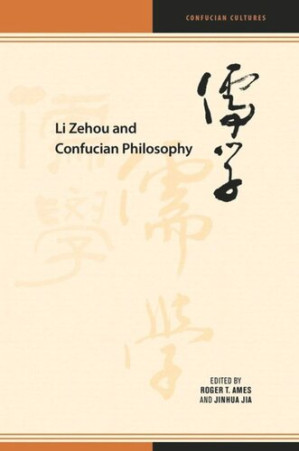
Although the authors of this volume hail from East Asia, North America, and Europe and a wide variety of academic backgrounds and fields of study, they are unanimous in their appreciation of Li’s contributions to not only an evolving Confucian philosophy, but also world philosophy. They view Li first and foremost as a __sui generis__ thinker with broad global interests and not one who fits neatly into any one philosophical category, Chinese or Western. This is clearly reflected in the chapters included here, which are organized into three parts: Li Zehou and the Modernization of Confucianism, Li Zehou’s Reconception of Confucian Philosophy, and Li Zehou’s Aesthetical Theory and Confucianism. Together they form a coherent narrative that reveals how Li has, for more than half a century, creatively studied, absorbed, and reconceptualized the Confucian ideational tradition to integrate it with Western philosophical elements and develop his own philosophical insights and original theories. At the same time, he has transformed and modernized Confucianism for the purpose of both coalescing with and reconstructing a new world cultural order.
<p>The book breaks new ground in Daoist studies, the understanding of Chinese religion and medieval society, and the theoretical understanding and interpretation of the comparative phenomenon of monasticism. It will be required reading for scholars of Daoist studies and Chinese religion and medieval history and illuminating to experts in comparative religion and religious studies in general as well as to the wider public interested in questions of monastic life.</p>
Series Editors’ Preface
Introduction
Response to Paul Gauguin’s Triple Question
Part I. Li Zehou and the Modernization of Confucianism
1. Li Zehou and New Confucianism: A Philosophy for New Global Cultures
2. “Western Learning as Substance, Chinese Learning for Application”: Li Zehou’s Thought on Tradition and Modernity
3. Modernizing Confucianism: Li Zehou’s Vision and Inspiration for an Unfinished Project
4. Determinism and the Problem of Individual Freedom in Li Zehou’s Thought
5. What Should the World Look Like? Li Zehou, Confucius, Kant, and the World Observer
Part II. Li Zehou’s Reconception of Confucian Philosophy
6. Li Zehou’s Lunyu jindu (Reading the Analects Today)
7. Li Zehou’s Reconception of Confucian Ethics of Emotion
8. Li Zehou’s Doctrine of Emotion as Substance and Confucian Philosophy
9. Li Zehou and Pragmatism
10. Li Zehou’s View of Pragmatic Reason
Part III. Li Zehou’s Aesthetical Theory and Confucianism
11. Li Zehou’s Aesthetics: Moving On after Kant, Marx, and Confucianism
12. Li Zehou, Kant, and Darwin: The Theory of Sedimentation
13. Li Zehou’s Aesthetics and the Confucian “Body” of Chinese Cultural Sedimentation: An Inquiry into Alternative Interpretations of Confucianism
14. Modern Chinese Aesthetics and Its Traditional Backgrounds: A Critical Comparison of Li Zehou’s Sedimentation and Jung’s Archetypes
15. Li Zehou’s Aesthetics as a Form of Cognition
Appendix: Li Zehou’s Life and Works
Contributors
Index
❌ This file might have issues, and has been hidden from a source library. Sometimes this is by request of a copyright holder, sometimes it is because a better alternative is available, but sometimes it is because of an issue with the file itself. It might still be fine to download, but we recommend first searching for an alternative file. More details:
- Running exiftool failed on this file
🚀 Fast downloads
- Fast Partner Server #1 (recommended)
- Fast Partner Server #2 (recommended)
- Fast Partner Server #3 (recommended)
- Fast Partner Server #4 (recommended)
- Fast Partner Server #5 (recommended)
- Fast Partner Server #6 (recommended)
- Fast Partner Server #7
- Fast Partner Server #8
- Fast Partner Server #9
- Fast Partner Server #10
- Fast Partner Server #11
- Fast Partner Server #12
🐢 Slow downloads
From trusted partners. More information in the FAQ. (might require browser verification — unlimited downloads!)
- Slow Partner Server #1 (slightly faster but with waitlist)
- Slow Partner Server #2 (slightly faster but with waitlist)
- Slow Partner Server #3 (slightly faster but with waitlist)
- Slow Partner Server #4 (slightly faster but with waitlist)
- Slow Partner Server #5 (no waitlist, but can be very slow)
- Slow Partner Server #6 (no waitlist, but can be very slow)
- Slow Partner Server #7 (no waitlist, but can be very slow)
- Slow Partner Server #8 (no waitlist, but can be very slow)
- Slow Partner Server #9 (no waitlist, but can be very slow)
- After downloading: Open in our viewer
External downloads
-
For large files, we recommend using a download manager to prevent interruptions.
Recommended download managers: JDownloader -
You will need an ebook or PDF reader to open the file, depending on the file format.
Recommended ebook readers: Anna’s Archive online viewer, ReadEra, and Calibre -
Use online tools to convert between formats.
Recommended conversion tools: CloudConvert and PrintFriendly -
You can send both PDF and EPUB files to your Kindle or Kobo eReader.
Recommended tools: Amazon‘s “Send to Kindle” and djazz‘s “Send to Kobo/Kindle” -
Support authors and libraries
✍️ If you like this and can afford it, consider buying the original, or supporting the authors directly.
📚 If this is available at your local library, consider borrowing it for free there.
Total downloads:
A “file MD5” is a hash that gets computed from the file contents, and is reasonably unique based on that content. All shadow libraries that we have indexed on here primarily use MD5s to identify files.
A file might appear in multiple shadow libraries. For information about the various datasets that we have compiled, see the Datasets page.
For information about this particular file, check out its JSON file. Live/debug JSON version. Live/debug page.