nexusstc/AI, Consciousness and The New Humanism: Fundamental Reflections on Minds and Machines/09d865e07bbdaa22d5b7a7ed662d8b7e.pdf
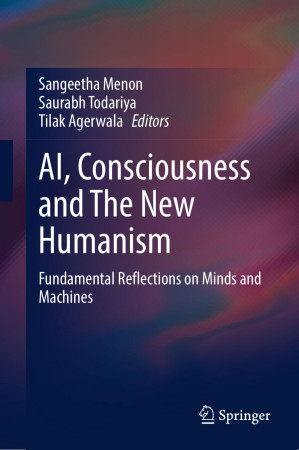
AI, consciousness and the new humanism : fundamental reflections on minds and machines 🔍
Sangeetha Menon (editor), Saurabh Todariya (editor), Tilak Agerwala (editor)
Springer Singapore, 1st ed. 2024, PS, 2024
English [en] · PDF · 6.1MB · 2024 · 📘 Book (non-fiction) · 🚀/lgli/lgrs/nexusstc/zlib · Save
description
This edited volume presents perspectives from computer science, information theory, neuroscience and brain imaging, aesthetics, social sciences, psychiatry, and philosophy to answer frontier questions related to artificial intelligence and human experience. Can a machine think, believe, aspire and be purposeful as a human? What is the place in the machine world for hope, meaning and transformative enlightenment that inspires human existence? How, or are, the minds of machines different from that of humans and other species? These questions are responded to along with questions in the intersection of health, intelligence and the brain. It highlights the place of consciousness by attempting to respond to questions with the help of fundamental reflections on human existence, its life-purposes and machine intelligence. The volume is a must-read for interdisciplinary and multidisciplinary researchers in humanities and social sciences and philosophy of science who wish to understand the future of AI and society.
Erscheinungsdatum: 21.03.2024
Erscheinungsdatum: 21.03.2024
Alternative filename
lgli/9819705029.pdf
Alternative filename
lgrsnf/9819705029.pdf
Alternative author
Sangeetha Menon, Saurabh Todariya, Tilak Agerwala, (eds.)
Alternative publisher
SPRINGER NATURE
Alternative edition
Singapore, 2024
Alternative edition
S.l, 2024
Alternative edition
US, 2024
metadata comments
{"edition":"2024","isbns":["9789819705023","9819705029"],"last_page":356,"publisher":"Springer","source":"libgen_rs"}
Alternative description
Contents
About the Editors
1 Fundamental Reflections on Minds and Machines
References
2 An Open Dialogue Between Neuromusicology and Computational Modelling Methods
1 Introduction
1.1 Neural Basis of Music Perception and Cognition
2 Brain and Statistics
3 Computational Musicology
4 Perceptual Attributes of Musical Dimensions
4.1 Gisting, Chunking, and Grouping (Transitional Probability Aspect) of the Musical Information
4.2 Syntax and Grammar of the Musical Information
4.3 Memory of Music
4.4 Music Similarity
4.5 Mathematical Modelling and Statistical Learning
4.6 Spatio-Temporal Mechanism of the Neural Probability and Uncertainty Encoding
5 Evaluation and Way Forward
5.1 Music, Artificial Intelligence, and Neuroscience
5.2 Empirical Versus Observational Studies
5.3 Generative Algorithms
5.4 Machine Listening Versus Appreciation
5.5 Concluding Remarks: Converging Humanistic Approaches
References
3 Testing for Causality in Artificial Intelligence (AI)
1 Introduction
2 The Turing Test for ‘Thinking Machines’
2.1 Nine Opposing Views Considered by Turing
2.2 Some Weaknesses of the Turing Test
2.3 CAPTCHA, Loebner Prize, LaMDA and LLMs
3 Causality and AI
3.1 The Ladder of Causation
3.2 Data is Dumb, Causal Revolution is on!
3.3 Strong AI and Causality
3.4 AI, Ethics and Counterfactuals
4 Can Machines Think Causally? Towards a Causal Turing Test (or Not?)
5 Conclusion
References
4 Artificial Intelligence: A Case for Ethical Design and Multidisciplinarity
1 Introduction
2 The State of the Art of AI Systems
2.1 Artificial General Intelligence
2.2 Artificial Narrow Intelligence
3 Examples of AI “Failures”
3.1 Internet of Things (IoT)
3.2 Conversational AI
3.3 Semi-autonomous Vehicle Example
4 Ethical Design and Multidisciplinarity
5 Summary and Discussion
References
5 Advaita Ethics for the Machine Age: The Pursuit of Happiness in an Interconnected World
1 The Context
2 The Moral Machine
3 Human Machine Interaction and the Artificial Moral Machine
4 The Method of Science, Advaita, and Its Ontology of Fundamental Reality
5 The Advaita-Yoga Drishti and the Substratum of Consciousness
6 Non-violence, Minimalist Living, and Technologies
7 Moral Yogi-Machine
8 Networked and Self-regulating Complex Systems
9 The Machine Self, Consciousness, and Co-existence
10 The Prospect of Advaita-Yoga Drishti
References
6 Singularity Beyond Silicon Valley: The Transmission of AI Values in a Global Context
1 Introduction
2 The “Inevitable” Singularity
3 Building a Cybernetic World
4 Expanding Viewpoints
5 Apocalyptic AI, with Indian Characteristics
6 Conclusion
References
7 Healthcare Artificial Intelligence in India and Ethical Aspects
1 Introduction
2 Healthcare in India
3 AI Application in Various Healthcare Domains
3.1 Public Health and Pandemics
3.2 Diagnosis and Early Disease Detection
3.3 Effective Treatment of Diseases
3.4 Pharmaceutical Research and Development
3.5 Palliative Care
3.6 Geriatric Care
3.7 Hospital Ecosystem Management
4 Ethical Challenges in Healthcare AI
4.1 Public Health and Pandemics
4.2 Diagnosis and Early Detection
4.3 Disease Treatment
4.4 Pharmaceutical Research and Development
4.5 Palliative and Geriatric Care
4.6 Hospital Ecosystem Management
5 Challenges and Way Forward
References
8 Human Learning and Machine Learning: Unfolding from Creativity Perspective
1 Introduction: Human Learning and Machine Learning
2 Human Learning Process
3 Concept Learning and Verbal Learning
4 Discrimination Learning and Problem-Solving
5 Non-deliberate Ignorance to Non-deliberate Mastery
6 Creativity and Learning
6.1 Psychological and Historical Creativity in Machines
6.2 Creativity Moments and Creativity Points
6.3 Creative Agents and Creative Disciplines
6.4 Creative Collaborative Intelligence
6.5 Out-Of-Pattern Learning Pointers
7 Learning Models
7.1 Cognitive Development Theory and Concept Maps
7.2 Human Learning-Inspired Machine Learning Models
8 Creative Learning Models
9 Creative Systemic Machine Learning (CSML)
10 Summary
References
9 Learning Agility: The Journey from Self-Awareness to Self-Immersion
1 Introduction
2 The Impact of AI (Automation and Digitization) on Core Organizational Components
3 The Need for an Agile Ecosystem to Respond to the Digital Transformations at the Organizational Level
3.1 Agile Mindset
3.2 Agile Leadership
4 Learning Agility—the Key Enabling Capability to Survive and Thrive in the VUCA World
4.1 AI and Learning Agility
5 The Dimensions and Enablers of Learning Agility and the Role of the Individual as They Move from Self-Awareness to Self-Immersion
5.1 The Enablers of Learning Agility
5.2 Learning Agility—The Journey from Self-Awareness to Self-Immersion
6 The Synergistic Path Ahead
References
10 Mind-Reading Machines: Promises, Pitfalls, and Solutions of Implementing Machine Learning in Mental Health
1 The Context: Machines and Minds—A Deeper Connect?
2 The Challenge: Psychiatric Diagnoses and Mental Healthcare Delivery
2.1 Can We Confidently Model Brain Disorders?
2.2 Delivery of Mental Health Care to All?
3 The Opportunity: Big Data and the Intersection of Clinical and Population Neuroscience
4 The Approach: Natural Language Processing and Machine Learning Exemplars
4.1 Natural Language Processing (NLP)
4.2 Machine Learning
4.3 Applications of AI in Mental Health
5 Caveats and Future Potentials
References
11 AI-Based Technological Interventions for Tackling Child Malnutrition
1 Introduction
2 Literature Review
2.1 Existing Policies and Infrastructure to Tackle Malnutrition in India
2.2 Novel Technologies to Eradicate Malnutrition
3 Methods
3.1 Study Design
4 Measures
4.1 Dependent Variables
4.2 Data Analysis
5 Results
5.1 Descriptive Statistic
5.2 Analysis
5.3 Discussion
6 Conclusion and Policy Implications
References
12 Autonomous Weapon System: Debating Legal–Ethical Consideration and Meaningful Human Control Challenges in the Military Environment
1 Introduction
2 AWS: Role, Advantages, and Projected Capabilities
3 AWS: Debate on Legal–Ethical Issues, Meaningful Human Control, and View of Military
3.1 Outright Ban on the AWS Because of Legal-Ethical and Moral Issues
3.2 AWS is Inevitable and One Must Proceed Cautiously and Judiciously
4 Conclusion
References
13 Artificial Intelligence and War: Understanding Their Convergence and the Resulting Complexities in the Military Decision-Making Process
1 Introduction
2 Understanding AI-Enabled DSS
3 How Can AI DSS Be Incorporated into Defence Ecosystem
3.1 Understanding How AI Will Develop Military CsOA
3.2 Understanding Non-kinetic Military Applications of AI
4 Risk Associated with AI
4.1 Ethics
5 Roadmap for Nations
6 Postscript
References
14 Converging Approach to Intelligence: Decision-Making Systems in Artificial Intelligence and Reflections on Human Intelligence
1 Introduction
2 Defining ‘Intelligence’: Exploring Various Approaches to the Study of Intelligence
2.1 The History of Intelligence
2.2 The Modern Approach
2.3 Machines as Information-Processing Systems
3 Machines as Intelligent Beings
3.1 The Question of Rationality
3.2 Decision Theory in Computational Systems
4 The Convergence Approach to Intelligence: Decision Support Systems in Rational Decision-Making
4.1 The Principles of Rationality—Rational Decision-Makers
4.2 The Rational Choice Theory and the Standard Model of ‘Decision Theory’
4.3 Simulation of Human Actions Through Decision-Making Systems in AI
5 Conclusion
References
15 Expanding Cognition: The Plasticity of Thought
References
16 The World as Affordances: Phenomenology and Embeddedness in Heidegger and AI
1 Introduction
2 Phenomenology of Existence
3 Ready-To-Hand as Disclosure
4 Context and Understanding
5 Embodied Affordances
6 Knowing-That and Knowing-How
7 Frame Problem in AI
8 Conclusion
References
17 Investigating the Ontology of AI vis-à-vis Technical Artefacts
1 A Brief Survey of the Ontology of Technical Artefacts
2 Intentionalist and Non-intentionalist Theories of Artefact Function
3 AI Systems and TA Desiderata
3.1 Proper and Accidental Functions
3.2 Malfunction
3.3 Support (Physical Restriction)
3.4 Innovation (Novelty)
4 AI Systems vis-à-vis Technical Artefacts
5 Conclusion
References
18 Being “LaMDA” and the Person of the Self in AI
1 The Pervasiveness of AI
2 From the Playground to the Play Store
3 The Interactive Chatbot Called LaMDA
4 The Chatbot That Seeks Sentience
5 From the Play Store to the Cyber Self, to the LaMDA—I and the Metaverse—me
6 The Looking Glass Self and the Several “Me”, “I”, and “Floating” Self
7 The Larger Questions that Emerge from LaMDA
References
About the Editors
1 Fundamental Reflections on Minds and Machines
References
2 An Open Dialogue Between Neuromusicology and Computational Modelling Methods
1 Introduction
1.1 Neural Basis of Music Perception and Cognition
2 Brain and Statistics
3 Computational Musicology
4 Perceptual Attributes of Musical Dimensions
4.1 Gisting, Chunking, and Grouping (Transitional Probability Aspect) of the Musical Information
4.2 Syntax and Grammar of the Musical Information
4.3 Memory of Music
4.4 Music Similarity
4.5 Mathematical Modelling and Statistical Learning
4.6 Spatio-Temporal Mechanism of the Neural Probability and Uncertainty Encoding
5 Evaluation and Way Forward
5.1 Music, Artificial Intelligence, and Neuroscience
5.2 Empirical Versus Observational Studies
5.3 Generative Algorithms
5.4 Machine Listening Versus Appreciation
5.5 Concluding Remarks: Converging Humanistic Approaches
References
3 Testing for Causality in Artificial Intelligence (AI)
1 Introduction
2 The Turing Test for ‘Thinking Machines’
2.1 Nine Opposing Views Considered by Turing
2.2 Some Weaknesses of the Turing Test
2.3 CAPTCHA, Loebner Prize, LaMDA and LLMs
3 Causality and AI
3.1 The Ladder of Causation
3.2 Data is Dumb, Causal Revolution is on!
3.3 Strong AI and Causality
3.4 AI, Ethics and Counterfactuals
4 Can Machines Think Causally? Towards a Causal Turing Test (or Not?)
5 Conclusion
References
4 Artificial Intelligence: A Case for Ethical Design and Multidisciplinarity
1 Introduction
2 The State of the Art of AI Systems
2.1 Artificial General Intelligence
2.2 Artificial Narrow Intelligence
3 Examples of AI “Failures”
3.1 Internet of Things (IoT)
3.2 Conversational AI
3.3 Semi-autonomous Vehicle Example
4 Ethical Design and Multidisciplinarity
5 Summary and Discussion
References
5 Advaita Ethics for the Machine Age: The Pursuit of Happiness in an Interconnected World
1 The Context
2 The Moral Machine
3 Human Machine Interaction and the Artificial Moral Machine
4 The Method of Science, Advaita, and Its Ontology of Fundamental Reality
5 The Advaita-Yoga Drishti and the Substratum of Consciousness
6 Non-violence, Minimalist Living, and Technologies
7 Moral Yogi-Machine
8 Networked and Self-regulating Complex Systems
9 The Machine Self, Consciousness, and Co-existence
10 The Prospect of Advaita-Yoga Drishti
References
6 Singularity Beyond Silicon Valley: The Transmission of AI Values in a Global Context
1 Introduction
2 The “Inevitable” Singularity
3 Building a Cybernetic World
4 Expanding Viewpoints
5 Apocalyptic AI, with Indian Characteristics
6 Conclusion
References
7 Healthcare Artificial Intelligence in India and Ethical Aspects
1 Introduction
2 Healthcare in India
3 AI Application in Various Healthcare Domains
3.1 Public Health and Pandemics
3.2 Diagnosis and Early Disease Detection
3.3 Effective Treatment of Diseases
3.4 Pharmaceutical Research and Development
3.5 Palliative Care
3.6 Geriatric Care
3.7 Hospital Ecosystem Management
4 Ethical Challenges in Healthcare AI
4.1 Public Health and Pandemics
4.2 Diagnosis and Early Detection
4.3 Disease Treatment
4.4 Pharmaceutical Research and Development
4.5 Palliative and Geriatric Care
4.6 Hospital Ecosystem Management
5 Challenges and Way Forward
References
8 Human Learning and Machine Learning: Unfolding from Creativity Perspective
1 Introduction: Human Learning and Machine Learning
2 Human Learning Process
3 Concept Learning and Verbal Learning
4 Discrimination Learning and Problem-Solving
5 Non-deliberate Ignorance to Non-deliberate Mastery
6 Creativity and Learning
6.1 Psychological and Historical Creativity in Machines
6.2 Creativity Moments and Creativity Points
6.3 Creative Agents and Creative Disciplines
6.4 Creative Collaborative Intelligence
6.5 Out-Of-Pattern Learning Pointers
7 Learning Models
7.1 Cognitive Development Theory and Concept Maps
7.2 Human Learning-Inspired Machine Learning Models
8 Creative Learning Models
9 Creative Systemic Machine Learning (CSML)
10 Summary
References
9 Learning Agility: The Journey from Self-Awareness to Self-Immersion
1 Introduction
2 The Impact of AI (Automation and Digitization) on Core Organizational Components
3 The Need for an Agile Ecosystem to Respond to the Digital Transformations at the Organizational Level
3.1 Agile Mindset
3.2 Agile Leadership
4 Learning Agility—the Key Enabling Capability to Survive and Thrive in the VUCA World
4.1 AI and Learning Agility
5 The Dimensions and Enablers of Learning Agility and the Role of the Individual as They Move from Self-Awareness to Self-Immersion
5.1 The Enablers of Learning Agility
5.2 Learning Agility—The Journey from Self-Awareness to Self-Immersion
6 The Synergistic Path Ahead
References
10 Mind-Reading Machines: Promises, Pitfalls, and Solutions of Implementing Machine Learning in Mental Health
1 The Context: Machines and Minds—A Deeper Connect?
2 The Challenge: Psychiatric Diagnoses and Mental Healthcare Delivery
2.1 Can We Confidently Model Brain Disorders?
2.2 Delivery of Mental Health Care to All?
3 The Opportunity: Big Data and the Intersection of Clinical and Population Neuroscience
4 The Approach: Natural Language Processing and Machine Learning Exemplars
4.1 Natural Language Processing (NLP)
4.2 Machine Learning
4.3 Applications of AI in Mental Health
5 Caveats and Future Potentials
References
11 AI-Based Technological Interventions for Tackling Child Malnutrition
1 Introduction
2 Literature Review
2.1 Existing Policies and Infrastructure to Tackle Malnutrition in India
2.2 Novel Technologies to Eradicate Malnutrition
3 Methods
3.1 Study Design
4 Measures
4.1 Dependent Variables
4.2 Data Analysis
5 Results
5.1 Descriptive Statistic
5.2 Analysis
5.3 Discussion
6 Conclusion and Policy Implications
References
12 Autonomous Weapon System: Debating Legal–Ethical Consideration and Meaningful Human Control Challenges in the Military Environment
1 Introduction
2 AWS: Role, Advantages, and Projected Capabilities
3 AWS: Debate on Legal–Ethical Issues, Meaningful Human Control, and View of Military
3.1 Outright Ban on the AWS Because of Legal-Ethical and Moral Issues
3.2 AWS is Inevitable and One Must Proceed Cautiously and Judiciously
4 Conclusion
References
13 Artificial Intelligence and War: Understanding Their Convergence and the Resulting Complexities in the Military Decision-Making Process
1 Introduction
2 Understanding AI-Enabled DSS
3 How Can AI DSS Be Incorporated into Defence Ecosystem
3.1 Understanding How AI Will Develop Military CsOA
3.2 Understanding Non-kinetic Military Applications of AI
4 Risk Associated with AI
4.1 Ethics
5 Roadmap for Nations
6 Postscript
References
14 Converging Approach to Intelligence: Decision-Making Systems in Artificial Intelligence and Reflections on Human Intelligence
1 Introduction
2 Defining ‘Intelligence’: Exploring Various Approaches to the Study of Intelligence
2.1 The History of Intelligence
2.2 The Modern Approach
2.3 Machines as Information-Processing Systems
3 Machines as Intelligent Beings
3.1 The Question of Rationality
3.2 Decision Theory in Computational Systems
4 The Convergence Approach to Intelligence: Decision Support Systems in Rational Decision-Making
4.1 The Principles of Rationality—Rational Decision-Makers
4.2 The Rational Choice Theory and the Standard Model of ‘Decision Theory’
4.3 Simulation of Human Actions Through Decision-Making Systems in AI
5 Conclusion
References
15 Expanding Cognition: The Plasticity of Thought
References
16 The World as Affordances: Phenomenology and Embeddedness in Heidegger and AI
1 Introduction
2 Phenomenology of Existence
3 Ready-To-Hand as Disclosure
4 Context and Understanding
5 Embodied Affordances
6 Knowing-That and Knowing-How
7 Frame Problem in AI
8 Conclusion
References
17 Investigating the Ontology of AI vis-à-vis Technical Artefacts
1 A Brief Survey of the Ontology of Technical Artefacts
2 Intentionalist and Non-intentionalist Theories of Artefact Function
3 AI Systems and TA Desiderata
3.1 Proper and Accidental Functions
3.2 Malfunction
3.3 Support (Physical Restriction)
3.4 Innovation (Novelty)
4 AI Systems vis-à-vis Technical Artefacts
5 Conclusion
References
18 Being “LaMDA” and the Person of the Self in AI
1 The Pervasiveness of AI
2 From the Playground to the Play Store
3 The Interactive Chatbot Called LaMDA
4 The Chatbot That Seeks Sentience
5 From the Play Store to the Cyber Self, to the LaMDA—I and the Metaverse—me
6 The Looking Glass Self and the Several “Me”, “I”, and “Floating” Self
7 The Larger Questions that Emerge from LaMDA
References
date open sourced
2024-03-22
🚀 Fast downloads
Become a member to support the long-term preservation of books, papers, and more. To show our gratitude for your support, you get fast downloads. ❤️
- Fast Partner Server #1 (recommended)
- Fast Partner Server #2 (recommended)
- Fast Partner Server #3 (recommended)
- Fast Partner Server #4 (recommended)
- Fast Partner Server #5 (recommended)
- Fast Partner Server #6 (recommended)
- Fast Partner Server #7
- Fast Partner Server #8
- Fast Partner Server #9
- Fast Partner Server #10
- Fast Partner Server #11
- Fast Partner Server #12
- Fast Partner Server #13
- Fast Partner Server #14
- Fast Partner Server #15
- Fast Partner Server #16
- Fast Partner Server #17
- Fast Partner Server #18
- Fast Partner Server #19
- Fast Partner Server #20
- Fast Partner Server #21
- Fast Partner Server #22
- Fast Partner Server #23
- Fast Partner Server #24
🐢 Slow downloads
From trusted partners. More information in the FAQ. (might require browser verification — unlimited downloads!)
- Slow Partner Server #1 (slightly faster but with waitlist)
- Slow Partner Server #2 (slightly faster but with waitlist)
- Slow Partner Server #3 (slightly faster but with waitlist)
- Slow Partner Server #4 (slightly faster but with waitlist)
- Slow Partner Server #5 (no waitlist, but can be very slow)
- Slow Partner Server #6 (no waitlist, but can be very slow)
- Slow Partner Server #7 (no waitlist, but can be very slow)
- Slow Partner Server #8 (no waitlist, but can be very slow)
- Slow Partner Server #9 (no waitlist, but can be very slow)
- Slow Partner Server #10 (slightly faster but with waitlist)
- Slow Partner Server #11 (slightly faster but with waitlist)
- Slow Partner Server #12 (slightly faster but with waitlist)
- Slow Partner Server #13 (slightly faster but with waitlist)
- Slow Partner Server #14 (no waitlist, but can be very slow)
- Slow Partner Server #15 (no waitlist, but can be very slow)
- Slow Partner Server #16 (no waitlist, but can be very slow)
- Slow Partner Server #17 (no waitlist, but can be very slow)
- Slow Partner Server #18 (no waitlist, but can be very slow)
- After downloading: Open in our viewer
All download options have the same file, and should be safe to use. That said, always be cautious when downloading files from the internet, especially from sites external to Anna’s Archive. For example, be sure to keep your devices updated.
External downloads
-
For large files, we recommend using a download manager to prevent interruptions.
Recommended download managers: JDownloader -
You will need an ebook or PDF reader to open the file, depending on the file format.
Recommended ebook readers: Anna’s Archive online viewer, ReadEra, and Calibre -
Use online tools to convert between formats.
Recommended conversion tools: CloudConvert and PrintFriendly -
You can send both PDF and EPUB files to your Kindle or Kobo eReader.
Recommended tools: Amazon‘s “Send to Kindle” and djazz‘s “Send to Kobo/Kindle” -
Support authors and libraries
✍️ If you like this and can afford it, consider buying the original, or supporting the authors directly.
📚 If this is available at your local library, consider borrowing it for free there.
Total downloads:
A “file MD5” is a hash that gets computed from the file contents, and is reasonably unique based on that content. All shadow libraries that we have indexed on here primarily use MD5s to identify files.
A file might appear in multiple shadow libraries. For information about the various datasets that we have compiled, see the Datasets page.
For information about this particular file, check out its JSON file. Live/debug JSON version. Live/debug page.