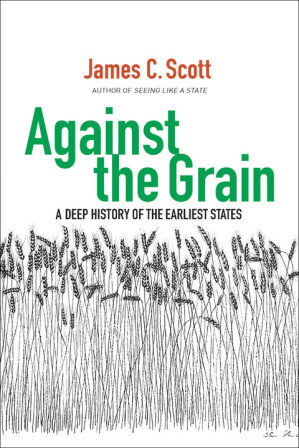
Against the Grain : A Deep History of the Earliest States 🔍
James C. Scott
Yale University Press, 1, 2017-08-22
English [en] · PDF · 2.7MB · 2017 · 📘 Book (non-fiction) · 🚀/lgli/lgrs/nexusstc/upload/zlib · Save
description
Review
“The most interesting non-fiction read of the year. . . . Urgently recommended, and fun to read as well.”—Tyler Cowen, Marginal Revolution
“Fascinating. . . . Our agrarian-biased view of history, Scott concludes, could use some reworking. Most of the world’s early human populations likely enjoyed semisettled, semiagrarian lives beyond the state’s grasp.”—Suzanne Shablovsky, Science
“A contemporary master of the political counter-narrative has produced a book on the origins of civilization – this is, quite simply, a must-read.”—David Wengrow, author of What Makes Civilization?
“This is a brilliant, accessible, and highly original account of the origins of sedentism, farming, states, and the relations between agrarian and nomadic communities. It should attract a wider audience than any of Scott’s earlier books.”—J. R. McNeill, co-author of The Great Acceleration: An Environmental History of the Anthropocene since 1945
“A sweeping and provocative look at the 'rise of civilization,' focusing particularly on those parts, peoples, and issues that are normally overlooked in conventional historical narratives.”—Alison Betts, The University of Sydney
“Brilliant, sparkling, dissident scholarship. In Scott’s hands, agriculture looks like a terrible choice, states and empires look fragile, ephemeral, and predatory, and the ‘barbarians’ beyond their borders lived in relative freedom and affluence.”—David Christian, Macquarie University, Sydney
“This book is fascinating and original, containing a lesson on every page. Brilliant. James Scott is a legend."—Tim Harford, author of Messy and The Undercover Economist
Read more
About the Author
James C. Scott is Sterling Professor of Political Science and codirector of the Agrarian Studies Program at Yale University. His previous books include Domination and the Arts of Resistance, Seeing Like a State, and The Art of Not Being Governed.
“The most interesting non-fiction read of the year. . . . Urgently recommended, and fun to read as well.”—Tyler Cowen, Marginal Revolution
“Fascinating. . . . Our agrarian-biased view of history, Scott concludes, could use some reworking. Most of the world’s early human populations likely enjoyed semisettled, semiagrarian lives beyond the state’s grasp.”—Suzanne Shablovsky, Science
“A contemporary master of the political counter-narrative has produced a book on the origins of civilization – this is, quite simply, a must-read.”—David Wengrow, author of What Makes Civilization?
“This is a brilliant, accessible, and highly original account of the origins of sedentism, farming, states, and the relations between agrarian and nomadic communities. It should attract a wider audience than any of Scott’s earlier books.”—J. R. McNeill, co-author of The Great Acceleration: An Environmental History of the Anthropocene since 1945
“A sweeping and provocative look at the 'rise of civilization,' focusing particularly on those parts, peoples, and issues that are normally overlooked in conventional historical narratives.”—Alison Betts, The University of Sydney
“Brilliant, sparkling, dissident scholarship. In Scott’s hands, agriculture looks like a terrible choice, states and empires look fragile, ephemeral, and predatory, and the ‘barbarians’ beyond their borders lived in relative freedom and affluence.”—David Christian, Macquarie University, Sydney
“This book is fascinating and original, containing a lesson on every page. Brilliant. James Scott is a legend."—Tim Harford, author of Messy and The Undercover Economist
Read more
About the Author
James C. Scott is Sterling Professor of Political Science and codirector of the Agrarian Studies Program at Yale University. His previous books include Domination and the Arts of Resistance, Seeing Like a State, and The Art of Not Being Governed.
Alternative filename
nexusstc/Against the Grain: A Deep History of the Earliest States/0fce4e4ee099df741daf48b7bfd5408c.pdf
Alternative filename
lgli/10.12987_9780300231687.pdf
Alternative filename
lgrsnf/10.12987_9780300231687.pdf
Alternative author
Scott, James C.
Alternative publisher
San Francisco Museum of Modern Art
Alternative publisher
Brandywine River Museum
Alternative publisher
Mariners' Museum, The
Alternative edition
Yale agrarian studies series, Connecticut, 2017
Alternative edition
Yale University Press, New Haven, CT, 2017
Alternative edition
United States, United States of America
Alternative edition
Yale agrarian studies, New Haven, 2017
Alternative edition
Degruyterct, New Haven, CT, 2017
Alternative edition
1, US, 2017
metadata comments
producers:
PyPDF2
PyPDF2
metadata comments
{"edition":"1","isbns":["0300182910","0300231687","2016960155","9780300182910","9780300231687"],"last_page":336,"publisher":"Yale University Press"}
metadata comments
Includes bibliographical references (pages 257-300) and index.
Alternative description
An Economist Best History Book 2017 “History as it should be written.”—Barry Cunliffe, Guardian “Scott hits the nail squarely on the head by exposing the staggering price our ancestors paid for civilization and political order.”—Walter Scheidel, Financial Times Why did humans abandon hunting and gathering for sedentary communities dependent on livestock and cereal grains, and governed by precursors of today's states? Most people believe that plant and animal domestication allowed humans, finally, to settle down and form agricultural villages, towns, and states, which made possible civilization, law, public order, and a presumably secure way of living. But archaeological and historical evidence challenges this narrative. The first agrarian states, says James C. Scott, were born of accumulations of domestications: first fire, then plants, livestock, subjects of the state, captives, and finally women in the patriarchal family—all of which can be viewed as a way of gaining control over reproduction. Scott explores why we avoided sedentism and plow agriculture, the advantages of mobile subsistence, the unforeseeable disease epidemics arising from crowding plants, animals, and grain, and why all early states are based on millets and cereal grains and unfree labor. He also discusses the “barbarians” who long evaded state control, as a way of understanding continuing tension between states and nonsubject peoples.
Alternative description
<DIV><B>An account of all the new and surprising evidence now available for the beginnings of the earliest civilizations that contradict the standard narrative</B><BR /><BR /> Why did humans abandon hunting and gathering for sedentary communities dependent on livestock and cereal grains, and governed by precursors of today’s states? Most people believe that plant and animal domestication allowed humans, finally, to settle down and form agricultural villages, towns, and states, which made possible civilization, law, public order, and a presumably secure way of living. But archaeological and historical evidence challenges this narrative. The first agrarian states, says James C. Scott, were born of accumulations of domestications: first fire, then plants, livestock, subjects of the state, captives, and finally women in the patriarchal family—all of which can be viewed as a way of gaining control over reproduction.<BR /><BR /> Scott explores why we avoided sedentism and plow agriculture, the advantages of mobile subsistence, the unforeseeable disease epidemics arising from crowding plants, animals, and grain, and why all early states are based on millets and cereal grains and unfree labor. He also discusses the “barbarians” who long evaded state control, as a way of understanding continuing tension between states and nonsubject peoples.</DIV>
Alternative description
An account of all the new and surprising evidence now available that contradicts the standard narrative for the beginnings of the earliest civilizations Why did humans abandon hunting and gathering for sedentary communities dependent on livestock and cereal grains, and governed by precursors of today's states? Most people believe that plant and animal domestication allowed humans, finally, to settle down and form agricultural villages, towns, and states, which made possible civilization, law, public order, and a presumably secure way of living. But archaeological and historical evidence challenges this narrative. The first agrarian states, says James C. Scott, were born of accumulations of domestications: first fire, then plants, livestock, subjects of the state, captives, and finally women in the patriarchal family-all of which can be viewed as a way of gaining control over reproduction. Scott explores why we avoided sedentism and plow agriculture, the advantages of mobile subsistence, the unforeseeable disease epidemics arising from crowding plants, animals, and grain, and why all early states are based on millets and cereal grains and unfree labor. He also discusses the "barbarians" who long evaded state control, as a way of understanding continuing tension between states and nonsubject peoples
Alternative description
A narrative in tatters : what I didn't know
The domestication of fire, plants, animals, and... us
Landscaping the world : the domus complex
Zoonoses : a perfect epidemiological storm
Agro-ecology of the early state
Population control : bondage and war
Fragility of the early state : collapse as disassembly
The golden age of the barbarians.
The domestication of fire, plants, animals, and... us
Landscaping the world : the domus complex
Zoonoses : a perfect epidemiological storm
Agro-ecology of the early state
Population control : bondage and war
Fragility of the early state : collapse as disassembly
The golden age of the barbarians.
date open sourced
2023-05-30
🚀 Fast downloads
Become a member to support the long-term preservation of books, papers, and more. To show our gratitude for your support, you get fast downloads. ❤️
- Fast Partner Server #1 (recommended)
- Fast Partner Server #2 (recommended)
- Fast Partner Server #3 (recommended)
- Fast Partner Server #4 (recommended)
- Fast Partner Server #5 (recommended)
- Fast Partner Server #6 (recommended)
- Fast Partner Server #7
- Fast Partner Server #8
- Fast Partner Server #9
- Fast Partner Server #10
- Fast Partner Server #11
- Fast Partner Server #12
🐢 Slow downloads
From trusted partners. More information in the FAQ. (might require browser verification — unlimited downloads!)
- Slow Partner Server #1 (slightly faster but with waitlist)
- Slow Partner Server #2 (slightly faster but with waitlist)
- Slow Partner Server #3 (slightly faster but with waitlist)
- Slow Partner Server #4 (slightly faster but with waitlist)
- Slow Partner Server #5 (no waitlist, but can be very slow)
- Slow Partner Server #6 (no waitlist, but can be very slow)
- Slow Partner Server #7 (no waitlist, but can be very slow)
- Slow Partner Server #8 (no waitlist, but can be very slow)
- Slow Partner Server #9 (no waitlist, but can be very slow)
- After downloading: Open in our viewer
All download options have the same file, and should be safe to use. That said, always be cautious when downloading files from the internet, especially from sites external to Anna’s Archive. For example, be sure to keep your devices updated.
External downloads
-
For large files, we recommend using a download manager to prevent interruptions.
Recommended download managers: JDownloader -
You will need an ebook or PDF reader to open the file, depending on the file format.
Recommended ebook readers: Anna’s Archive online viewer, ReadEra, and Calibre -
Use online tools to convert between formats.
Recommended conversion tools: CloudConvert and PrintFriendly -
You can send both PDF and EPUB files to your Kindle or Kobo eReader.
Recommended tools: Amazon‘s “Send to Kindle” and djazz‘s “Send to Kobo/Kindle” -
Support authors and libraries
✍️ If you like this and can afford it, consider buying the original, or supporting the authors directly.
📚 If this is available at your local library, consider borrowing it for free there.
Total downloads:
A “file MD5” is a hash that gets computed from the file contents, and is reasonably unique based on that content. All shadow libraries that we have indexed on here primarily use MD5s to identify files.
A file might appear in multiple shadow libraries. For information about the various datasets that we have compiled, see the Datasets page.
For information about this particular file, check out its JSON file. Live/debug JSON version. Live/debug page.