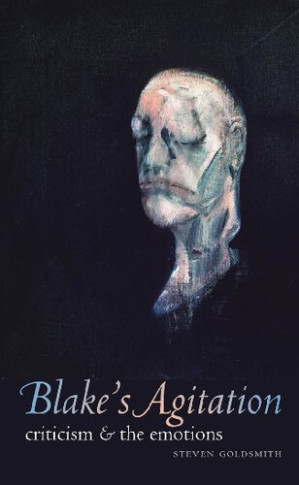
Blake's agitation : criticism and the emotions 🔍
Steven G Goldsmith
The Johns Hopkins University Press Project MUSE, Baltimore Baltimore Md, 2013
English [en] · Hindi [hi] · PDF · 6.6MB · 2013 · 📘 Book (non-fiction) · 🚀/lgli/lgrs/nexusstc/upload/zlib · Save
description
Since the Romantic period, the critical thinker's enthusiasm has served to substantiate his or her agency in the world.
Blake's Agitation is a thorough and engaging reflection on the dynamic, forward-moving, and active nature of critical thought. Steven Goldsmith investigates the modern notion that there's a fiery feeling in critical thought, a form of emotion that gives authentic criticism the potential to go beyond interpreting the world. By arousing this critical excitement in readers and practitioners, theoretical writing has the power to alter the course of history, even when the only evidence of its impact is the emotion it arouses.
Goldsmith identifies William Blake as a paradigmatic example of a socially critical writer who is moved by enthusiasm and whose work, in turn, inspires enthusiasm in his readers. He traces the particular feeling of engaged, dynamic urgency that characterizes criticism as a mode of action in Blake's own work, in Blake scholarship, and in recent theoretical writings that identify the heightened affect of critical thought with the potential for genuine historical change. Within each of these horizons, the critical thinker's enthusiasm serves to substantiate his or her agency in the world, supplying immediate, embodied evidence that criticism is not one thought-form among many but an action of consequence, accessing or even enabling the conditions of new possibility necessary for historical transformation to occur. The resulting picture of the emotional agency of criticism opens up a new angle on Blake's literary and visual legacy and offers a vivid interrogation of the practical potential of theoretical discourse.
Blake's Agitation is a thorough and engaging reflection on the dynamic, forward-moving, and active nature of critical thought. Steven Goldsmith investigates the modern notion that there's a fiery feeling in critical thought, a form of emotion that gives authentic criticism the potential to go beyond interpreting the world. By arousing this critical excitement in readers and practitioners, theoretical writing has the power to alter the course of history, even when the only evidence of its impact is the emotion it arouses.
Goldsmith identifies William Blake as a paradigmatic example of a socially critical writer who is moved by enthusiasm and whose work, in turn, inspires enthusiasm in his readers. He traces the particular feeling of engaged, dynamic urgency that characterizes criticism as a mode of action in Blake's own work, in Blake scholarship, and in recent theoretical writings that identify the heightened affect of critical thought with the potential for genuine historical change. Within each of these horizons, the critical thinker's enthusiasm serves to substantiate his or her agency in the world, supplying immediate, embodied evidence that criticism is not one thought-form among many but an action of consequence, accessing or even enabling the conditions of new possibility necessary for historical transformation to occur. The resulting picture of the emotional agency of criticism opens up a new angle on Blake's literary and visual legacy and offers a vivid interrogation of the practical potential of theoretical discourse.
Alternative filename
upload/motw_shc_2025_10/shc/Blake's Agitation_ Criticism an - Steven Goldsmith.pdf
Alternative filename
nexusstc/Blake's Agitation/171d5132ece1e1f45fe6f54dcfa1aa2c.pdf
Alternative filename
lgli/Blake's Agitation_ Criticism an - Steven Goldsmith.pdf
Alternative filename
lgrsnf/Blake's Agitation_ Criticism an - Steven Goldsmith.pdf
Alternative title
1421408066.pdf
Alternative author
Adobe InDesign CS5.5 (7.5)
Alternative author
Goldsmith, Steven;
Alternative edition
United States, United States of America
Alternative edition
Baltimore, Maryland, 2013
Alternative edition
Illustrated, PS, 2013
Alternative edition
2, 20130315
metadata comments
lg2987811
metadata comments
producers:
Adobe PDF Library 9.9
Adobe PDF Library 9.9
metadata comments
{"isbns":["1421408066","1421409062","9781421408064","9781421409061"],"last_page":416,"publisher":"Johns Hopkins University Press"}
metadata comments
Includes bibliographical references and index.
Alternative description
<p><i>Blake’s Agitation</i> is a thorough and engaging reflection on the dynamic, forward-moving, and active nature of critical thought. Steven Goldsmith investigates the modern notion that there’s a fiery feeling in critical thought, a form of emotion that gives authentic criticism the potential to go beyond interpreting the world. By arousing this critical excitement in readers and practitioners, theoretical writing has the power to alter the course of history, even when the only evidence of its impact is the emotion it arouses. Goldsmith identifies William Blake as a paradigmatic example of a socially critical writer who is moved by enthusiasm and whose work, in turn, inspires enthusiasm in his readers. He traces the particular feeling of engaged, dynamic urgency that characterizes criticism as a mode of action in Blake’s own work, in Blake scholarship, and in recent theoretical writings that identify the heightened affect of critical thought with the potential for genuine historical change. Within each of these horizons, the critical thinker’s enthusiasm serves to substantiate his or her agency in the world, supplying immediate, embodied evidence that criticism is not one thought-form among many but an action of consequence, accessing or even enabling the conditions of new possibility necessary for historical transformation to occur. The resulting picture of the emotional agency of criticism opens up a new angle on Blake’s literary and visual legacy and offers a vivid interrogation of the practical potential of theoretical discourse.</p>
<p> The Johns Hopkins University Press</p>
<p> The Johns Hopkins University Press</p>
Alternative description
<P><I>Blake’s Agitation</I> is a thorough and engaging reflection on the dynamic, forward-moving, and active nature of critical thought. Steven Goldsmith investigates the modern notion that there’s a fiery feeling in critical thought, a form of emotion that gives authentic criticism the potential to go beyond interpreting the world. By arousing this critical excitement in readers and practitioners, theoretical writing has the power to alter the course of history, even when the only evidence of its impact is the emotion it arouses. <BR> <BR>Goldsmith identifies William Blake as a paradigmatic example of a socially critical writer who is moved by enthusiasm and whose work, in turn, inspires enthusiasm in his readers. He traces the particular feeling of engaged, dynamic urgency that characterizes criticism as a mode of action in Blake’s own work, in Blake scholarship, and in recent theoretical writings that identify the heightened affect of critical thought with the potential for genuine historical change. Within each of these horizons, the critical thinker’s enthusiasm serves to substantiate his or her agency in the world, supplying immediate, embodied evidence that criticism is not one thought-form among many but an action of consequence, accessing or even enabling the conditions of new possibility necessary for historical transformation to occur. The resulting picture of the emotional agency of criticism opens up a new angle on Blake’s literary and visual legacy and offers a vivid interrogation of the practical potential of theoretical discourse.</P>
Alternative description
MuPDF error: syntax error: invalid key in dict
MuPDF error: syntax error: invalid key in dict
MuPDF error: syntax error: invalid key in dict
MuPDF error: syntax error: invalid key in dict
MuPDF error: syntax error: invalid key in dict
MuPDF error: syntax error: invalid key in dict
MuPDF error: syntax error: invalid key in dict
MuPDF error: syntax error: invalid key in dict
MuPDF error: syntax error: invalid key in dict
Cover 1
Contents 8
INTRODUCTION: The Future of Enthusiasm 12
PART ONE: Devil’s Party 52
CHAPTER ONE: Blake’s Agitation 54
CHAPTER TWO: Blake’s Virtue 90
PART TWO: A Passion for Blake 180
Introduction: Critique of Emotional Intelligence 182
CHAPTER THREE: “On Anothers Sorrow” 199
Toward an Auditory Imagination: Interlude on Kenzaburo Oe’s Rouse Up O Young Men of the New Age 230
CHAPTER FOUR: Strange Pulse 237
Wordsworth’s Pulsation Machine, or the Half-Life of Mary Hutchinson: Interlude on “She was a Phantom of delight” 273
CHAPTER FIVE: Criticism and the Work of Emotion 279
Acknowledgments 328
Appendix 330
Notes 332
Index 404
A 404
B 405
C 407
D 408
E 408
F 409
G 410
H 410
I 411
J 411
K 411
L 412
M 412
N 413
O 414
P 414
Q 414
R 414
S 415
T 416
U 416
V 416
W 416
Y 417
Z 417
MuPDF error: syntax error: invalid key in dict
MuPDF error: syntax error: invalid key in dict
MuPDF error: syntax error: invalid key in dict
MuPDF error: syntax error: invalid key in dict
MuPDF error: syntax error: invalid key in dict
MuPDF error: syntax error: invalid key in dict
MuPDF error: syntax error: invalid key in dict
MuPDF error: syntax error: invalid key in dict
Cover 1
Contents 8
INTRODUCTION: The Future of Enthusiasm 12
PART ONE: Devil’s Party 52
CHAPTER ONE: Blake’s Agitation 54
CHAPTER TWO: Blake’s Virtue 90
PART TWO: A Passion for Blake 180
Introduction: Critique of Emotional Intelligence 182
CHAPTER THREE: “On Anothers Sorrow” 199
Toward an Auditory Imagination: Interlude on Kenzaburo Oe’s Rouse Up O Young Men of the New Age 230
CHAPTER FOUR: Strange Pulse 237
Wordsworth’s Pulsation Machine, or the Half-Life of Mary Hutchinson: Interlude on “She was a Phantom of delight” 273
CHAPTER FIVE: Criticism and the Work of Emotion 279
Acknowledgments 328
Appendix 330
Notes 332
Index 404
A 404
B 405
C 407
D 408
E 408
F 409
G 410
H 410
I 411
J 411
K 411
L 412
M 412
N 413
O 414
P 414
Q 414
R 414
S 415
T 416
U 416
V 416
W 416
Y 417
Z 417
Alternative description
__Blake’s Agitation__
date open sourced
2021-04-17
🚀 Fast downloads
Become a member to support the long-term preservation of books, papers, and more. To show our gratitude for your support, you get fast downloads. ❤️
- Fast Partner Server #1 (recommended)
- Fast Partner Server #2 (recommended)
- Fast Partner Server #3 (recommended)
- Fast Partner Server #4 (recommended)
- Fast Partner Server #5 (recommended)
- Fast Partner Server #6 (recommended)
- Fast Partner Server #7
- Fast Partner Server #8
- Fast Partner Server #9
- Fast Partner Server #10
- Fast Partner Server #11
- Fast Partner Server #12
🐢 Slow downloads
From trusted partners. More information in the FAQ. (might require browser verification — unlimited downloads!)
- Slow Partner Server #1 (slightly faster but with waitlist)
- Slow Partner Server #2 (slightly faster but with waitlist)
- Slow Partner Server #3 (slightly faster but with waitlist)
- Slow Partner Server #4 (slightly faster but with waitlist)
- Slow Partner Server #5 (no waitlist, but can be very slow)
- Slow Partner Server #6 (no waitlist, but can be very slow)
- Slow Partner Server #7 (no waitlist, but can be very slow)
- Slow Partner Server #8 (no waitlist, but can be very slow)
- Slow Partner Server #9 (no waitlist, but can be very slow)
- After downloading: Open in our viewer
All download options have the same file, and should be safe to use. That said, always be cautious when downloading files from the internet, especially from sites external to Anna’s Archive. For example, be sure to keep your devices updated.
External downloads
-
For large files, we recommend using a download manager to prevent interruptions.
Recommended download managers: JDownloader -
You will need an ebook or PDF reader to open the file, depending on the file format.
Recommended ebook readers: Anna’s Archive online viewer, ReadEra, and Calibre -
Use online tools to convert between formats.
Recommended conversion tools: CloudConvert and PrintFriendly -
You can send both PDF and EPUB files to your Kindle or Kobo eReader.
Recommended tools: Amazon‘s “Send to Kindle” and djazz‘s “Send to Kobo/Kindle” -
Support authors and libraries
✍️ If you like this and can afford it, consider buying the original, or supporting the authors directly.
📚 If this is available at your local library, consider borrowing it for free there.
Total downloads:
A “file MD5” is a hash that gets computed from the file contents, and is reasonably unique based on that content. All shadow libraries that we have indexed on here primarily use MD5s to identify files.
A file might appear in multiple shadow libraries. For information about the various datasets that we have compiled, see the Datasets page.
For information about this particular file, check out its JSON file. Live/debug JSON version. Live/debug page.