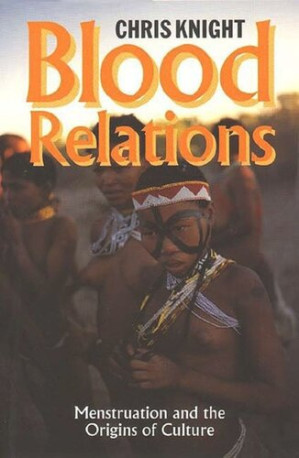
Blood relations : menstruation and the origins of culture 🔍
Chris Knight, Chris Knight
Yale University Press, 2018
English [en] · PDF · 6.2MB · 2018 · 📘 Book (non-fiction) · 🚀/lgli/lgrs/nexusstc/upload/zlib · Save
description
The emergence of symbolic culture is generally linked with the development of the hunger-gatherer adaptation based on a sexual division of labor. This original and ingenious book presents a new theory of how this symbolic domain originated. Integrating perspectives of evolutionary biography and social anthropology within a Marxist framework, Chris Knight rejects the common assumption that human culture was a modified extension of primate behavior and argues instead that it was the product of an immense social, sexual, and political revolution initiated by women.
Culture became established, says Knight, when evolving human females began to assert collective control over their own sexuality, refusing sex to all males except those who came to them with provisions. Women usually timed their ban on sexual relations with their periods of infertility while they were menstruating, and to the extent that their solidarity drew women together, these periods tended to occur in synchrony. The result was that every month with the onset of menstruation, sexual relations were ruptured in a collective, ritualistic way as the prelude to each successful hunting expedition. This ritual act was the means through which women motivated men not only to hunt but also to concentrate energies on bringing back the meat. Knight shows how this hypothesis sheds light on the roots of such cultural traditions as totemic rituals, incest and menstrual taboos, blood-sacrifice, and hunters’ atonement rites. Providing detailed ethnographic documentation, he also explains how Native American, Australian Aboriginal, and other magico-religious myths can be read as derivatives of the same symbolic logic.
Culture became established, says Knight, when evolving human females began to assert collective control over their own sexuality, refusing sex to all males except those who came to them with provisions. Women usually timed their ban on sexual relations with their periods of infertility while they were menstruating, and to the extent that their solidarity drew women together, these periods tended to occur in synchrony. The result was that every month with the onset of menstruation, sexual relations were ruptured in a collective, ritualistic way as the prelude to each successful hunting expedition. This ritual act was the means through which women motivated men not only to hunt but also to concentrate energies on bringing back the meat. Knight shows how this hypothesis sheds light on the roots of such cultural traditions as totemic rituals, incest and menstrual taboos, blood-sacrifice, and hunters’ atonement rites. Providing detailed ethnographic documentation, he also explains how Native American, Australian Aboriginal, and other magico-religious myths can be read as derivatives of the same symbolic logic.
Alternative filename
nexusstc/Blood Relations: Menstruation and the Origins of Culture/2392b58ced254156a7cd5ab6d9af6f09.pdf
Alternative filename
lgli/10.12987_9780300186550.pdf
Alternative filename
lgrsnf/10.12987_9780300186550.pdf
Alternative publisher
San Francisco Museum of Modern Art
Alternative publisher
Brandywine River Museum
Alternative publisher
Mariners' Museum, The
Alternative edition
United States, United States of America
Alternative edition
Cumberland, 1991
Alternative edition
New Haven, 1991
Alternative edition
2, 20131015
Alternative edition
2017
metadata comments
producers:
iTextSharp 5.0.6 (c) 1T3XT BVBA
iTextSharp 5.0.6 (c) 1T3XT BVBA
metadata comments
{"isbns":["030018655X","9780300186550"],"last_page":592,"publisher":"Yale University Press"}
Alternative description
<div><div><p>The emergence of symbolic culture is generally linked with the development of the hunger-gatherer adaptation based on a sexual division of labor. This original and ingenious book presents a new theory of how this symbolic domain originated. Integrating perspectives of evolutionary biography and social anthropology within a Marxist framework, Chris Knight rejects the common assumption that human culture was a modified extension of primate behavior and argues instead that it was the product of an immense social, sexual, and political revolution initiated by women.</p><p> </p><p>Culture became established, says Knight, when evolving human females began to assert collective control over their own sexuality, refusing sex to all males except those who came to them with provisions. Women usually timed their ban on sexual relations with their periods of infertility while they were menstruating, and to the extent that their solidarity drew women together, these periods tended to occur in synchrony. The result was that every month with the onset of menstruation, sexual relations were ruptured in a collective, ritualistic way as the prelude to each successful hunting expedition. This ritual act was the means through which women motivated men not only to hunt but also to concentrate energies on bringing back the meat. Knight shows how this hypothesis sheds light on the roots of such cultural traditions as totemic rituals, incest and menstrual taboos, blood-sacrifice, and hunters’ atonement rites. Providing detailed ethnographic documentation, he also explains how Native American, Australian Aboriginal, and other magico-religious myths can be read as derivatives of the same symbolic logic.</p></div></div><br>
Alternative description
Contents 7
Acknowledgements 8
Introduction 11
Chapter 1. Anthropology and Origins 60
Chapter 2. Levi-Strauss and ' the Mind' 81
Chapter 3. Totemism as Exchange 98
Chapter 4. The Sex Strike 132
Chapter 5. Origins Theories in the 1 98 0s 164
Chapter 6. Solidarity and Cycles 210
Chapter 7. The Shores of Eden 233
Chapter 8. Between Water , Stone and Fire 266
Chapter 9. The Revolution 291
Chapter 10. The Hunter's Moon 337
Chapter 11. The Raw and the Cooked 384
Chapter 12. The Reds 427
Chapter 13. The Rainbow Snake 459
Chapter 14. The Dragon Within 490
Chapter 15. Becoming Human 524
Bibliography 545
Author Index 576
Subject Index 579
Acknowledgements 8
Introduction 11
Chapter 1. Anthropology and Origins 60
Chapter 2. Levi-Strauss and ' the Mind' 81
Chapter 3. Totemism as Exchange 98
Chapter 4. The Sex Strike 132
Chapter 5. Origins Theories in the 1 98 0s 164
Chapter 6. Solidarity and Cycles 210
Chapter 7. The Shores of Eden 233
Chapter 8. Between Water , Stone and Fire 266
Chapter 9. The Revolution 291
Chapter 10. The Hunter's Moon 337
Chapter 11. The Raw and the Cooked 384
Chapter 12. The Reds 427
Chapter 13. The Rainbow Snake 459
Chapter 14. The Dragon Within 490
Chapter 15. Becoming Human 524
Bibliography 545
Author Index 576
Subject Index 579
date open sourced
2023-05-30
🚀 Fast downloads
Become a member to support the long-term preservation of books, papers, and more. To show our gratitude for your support, you get fast downloads. ❤️
- Fast Partner Server #1 (recommended)
- Fast Partner Server #2 (recommended)
- Fast Partner Server #3 (recommended)
- Fast Partner Server #4 (recommended)
- Fast Partner Server #5 (recommended)
- Fast Partner Server #6 (recommended)
- Fast Partner Server #7
- Fast Partner Server #8
- Fast Partner Server #9
- Fast Partner Server #10
- Fast Partner Server #11
- Fast Partner Server #12
🐢 Slow downloads
From trusted partners. More information in the FAQ. (might require browser verification — unlimited downloads!)
- Slow Partner Server #1 (slightly faster but with waitlist)
- Slow Partner Server #2 (slightly faster but with waitlist)
- Slow Partner Server #3 (slightly faster but with waitlist)
- Slow Partner Server #4 (slightly faster but with waitlist)
- Slow Partner Server #5 (no waitlist, but can be very slow)
- Slow Partner Server #6 (no waitlist, but can be very slow)
- Slow Partner Server #7 (no waitlist, but can be very slow)
- Slow Partner Server #8 (no waitlist, but can be very slow)
- Slow Partner Server #9 (no waitlist, but can be very slow)
- After downloading: Open in our viewer
All download options have the same file, and should be safe to use. That said, always be cautious when downloading files from the internet, especially from sites external to Anna’s Archive. For example, be sure to keep your devices updated.
External downloads
-
For large files, we recommend using a download manager to prevent interruptions.
Recommended download managers: JDownloader -
You will need an ebook or PDF reader to open the file, depending on the file format.
Recommended ebook readers: Anna’s Archive online viewer, ReadEra, and Calibre -
Use online tools to convert between formats.
Recommended conversion tools: CloudConvert and PrintFriendly -
You can send both PDF and EPUB files to your Kindle or Kobo eReader.
Recommended tools: Amazon‘s “Send to Kindle” and djazz‘s “Send to Kobo/Kindle” -
Support authors and libraries
✍️ If you like this and can afford it, consider buying the original, or supporting the authors directly.
📚 If this is available at your local library, consider borrowing it for free there.
Total downloads:
A “file MD5” is a hash that gets computed from the file contents, and is reasonably unique based on that content. All shadow libraries that we have indexed on here primarily use MD5s to identify files.
A file might appear in multiple shadow libraries. For information about the various datasets that we have compiled, see the Datasets page.
For information about this particular file, check out its JSON file. Live/debug JSON version. Live/debug page.