lgli/P_Physics/PD_Dynamical systems/Handbook of dynamical systems, Vol.1B (NH, 2006)(ISBN 0444520554)(1235s)_PD_.pdf
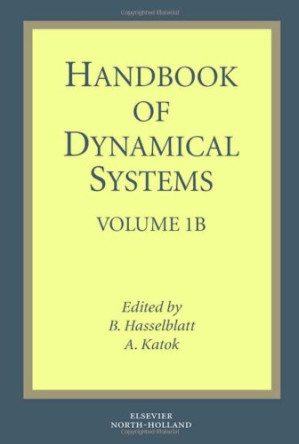
Handbook of Dynamical Systems, Volume 1B: Volume 1B (Handbook of Dynamical Systems) 🔍
A. Katok, B. Hasselblatt, H. Broer, F. Takens
Elsevier Science & Technology Books, Volume 1B, 1, 2005
English [en] · PDF · 5.8MB · 2005 · 📘 Book (non-fiction) · 🚀/lgli/lgrs/nexusstc/zlib · Save
description
This second half of Volume 1 of this Handbook follows Volume 1A, which was published in 2002. The contents of these two tightly integrated parts taken together come close to a realization of the program formulated in the introductory survey "Principal Structures" of Volume 1A. The present volume contains surveys on subjects in four areas of dynamical systems: Hyperbolic dynamics, parabolic dynamics, ergodic theory and infinite-dimensional dynamical systems (partial differential equations). . Written by experts in the field. . The coverage of ergodic theory in these two parts of Volume 1 is considerably more broad and thorough than that provided in other existing sources. . The final cluster of chapters discusses partial differential equations from the point of view of dynamical systems.
Alternative filename
lgli/P_Physics/PD_Dynamical systems/Handbook of dynamical systems, Vol.1B (NH, 2006)(ISBN 0444520554)(O)(1235s)_PD_.pdf
Alternative filename
lgrsnf/P_Physics/PD_Dynamical systems/Handbook of dynamical systems, Vol.1B (NH, 2006)(ISBN 0444520554)(1235s)_PD_.pdf
Alternative filename
nexusstc/Handbook of dynamical systems/23a4bac8ca3b74d1a7469182d86ffd2c.pdf
Alternative title
Handbook of dynamical systems : Editors vary
Alternative author
Boris Hasselblatt; A. B Katok; Bernold Fiedler
Alternative author
edited by B. Hasselblatt, A. Katok
Alternative author
Katok, A.; Hasselblatt, B.
Alternative author
A B Katok; B Hasselblatt
Alternative publisher
Wolters Kluwer Legal & Regulatory U.S.
Alternative publisher
North Holland : Elsevier
Alternative publisher
Woodhead Publishing Ltd
Alternative publisher
N.H. North Holland
Alternative publisher
John Murray Press
Alternative publisher
Aspen Publishers
Alternative publisher
Focal Press
Alternative edition
Handbook of Dynamical Systems, v. 1B, Amsterdam, 2014
Alternative edition
1st ed., Amsterdam, New York, Netherlands, 2002
Alternative edition
United Kingdom and Ireland, United Kingdom
Alternative edition
United States, United States of America
Alternative edition
Handbook of Dynamical Systems, 2005
Alternative edition
1st ed, Amsterdam ; New York, 2006
Alternative edition
Elsevier Ltd., Amsterdam, 2006
Alternative edition
Amsterdam ; Oxford, 2006
Alternative edition
December 17, 2005
Alternative edition
1, PS, 2005
metadata comments
Kolxo3 -- 28
metadata comments
lg75488
metadata comments
{"edition":"1","isbns":["0080478220","0444520554","9780080478227","9780444520555"],"last_page":1235,"publisher":"Elsevier","volume":"Volume 1B"}
metadata comments
Editors vary.
Includes bibliographical references and indexes.
Includes bibliographical references and indexes.
Alternative description
<br><h3> Chapter One </h3> <b>Preliminaries of Dynamical Systems Theory <p> <p> H.W. Broer and F. Takens</b> <i>Johann Bernoulli Institute for Mathematics and Computer Science, P.O. Box 407 9700 AK Groningen, The Netherlands Bernoulliborg, Building 5161, Nijenborgh 9, 9747 AG Groningen, The Netherlands <p> Contents</i> <p> 1. General definition of a dynamical system 3 1.1. The state space 4 1.2. The time set 5 1.3. The evolution map 7 1.4. Relations between the different classes of dynamical systems 11 2. Transversality and generic properties 13 2.1. The notion of genericity 13 2.2. Sard's theorem and Thom's tranversality lemma 14 2.3. Generic properties of dynamical systems based on transversality (Kupka-Smale theorems) 19 3. Generic properties which are not based on transversality: the Closing Lemma 26 4. Generic local bifurcations 28 4.1. Generic local bifurcations of functions (Catatrophe Theory) 28 4.2. Centre manifolds and generic local bifurcations of differential equations 30 4.3. Centre manifolds and local bifurcations of fixed points of diffeomorphisms 34 4.4. Concluding remarks 37 5. Structural stability and moduli 38 References 40 <p> <p> In this volume we present a collection of surveys on various aspects of the theory of bifurcations of differentiable dynamical systems and related topics. In the choice of the subjects we have tried to focus on those developments in which we think research will be active in the coming years. The surveys are intended to orientate the reader towards the recent literature in these subjects. <p> The purpose of this chapter is the presentation of preliminary material: basic definitions (in Section 1) and brief compilations of results, which are not any longer central themes of ongoing research, but which are still important as tools. As such we discuss in Section 2 transversality and generic properties like the various forms of the so-called Kupka-Smale theorem, in Section 3 the Closing Lemma and in Section 4 generic local bifurcations of functions (so-called catastrophe theory) and generic local bifurcations in 1-parameter families of dynamical systems. Finally, in Section 5 we discuss the notions of structural stability and moduli. <p> We should point out also that the various volumes of the Encyclopaedia of Mathematical Sciences (English translation of the original Russian edition) dealing with dynamical systems contain much valuable information on these topics. For the subjects discussed in this chapter, we mention in particular the volumes 6 and 39 (Dynamical Systems VI, respectively, VIII), dealing with singularity theory and its applications, and volume 5 (Dynamical Systems V), dealing with bifurcations and catastrophe theory. These volumes are recommended as a reference for the theory as developed up to the mid-1980s. <p> Finally we mention also the surveys in on the various topics discussed here, though they are on a more elementary level. For general reference also see the textbook and its guided bibliography. <p> <p> <b>1. General definition of a dynamical system</b> <p> We first give an abstract and general definition of a dynamical system, which will then be given a more concrete content in the form of a number of specific classes of dynamical systems. <p> In this general sense, a dynamical system consists of a <i>state space X</i>, which is a set, a <i>time set T</i> [subset] R, which is an additive semi-group, i.e. 0 [member of] <i>T</i> and for <i>t</i><sub>1</sub>, <i>t</i><sub>2</sub> [member of] <i>T</i> also <i>t</i><sub>1</sub> + <i>t</i><sub>2</sub> [member of] <i>T</i>, and an <i>evolution map</i> [PHI] : <i>X</i> x <i>T</i> [right arrow] <i>X</i> having the (semi-)group property, i.e. satisfying [PHI]([PHI](<i>x</i>, <i>t</i><sub>1</sub>), <i>t</i><sub>2</sub>) = [PHI](<i>x</i>, (<i>t</i><sub>1</sub> + <i>t</i><sub>2</sub>)) and [PHI](<i>x</i>, 0) = <i>x</i>. <p> These structures are used to construct mathematical models for the deterministic evolution in time of various systems. The state space <i>X</i> is to be considered as the set of all possible states of the system — the notion of state should be interpreted in such a way that it contains all the information which is relevant for the prediction of the future of the system. The time set <i>T</i> consists of those real numbers <i>t</i> for which it is possible, from knowing the state <i>x</i>(τ) at time τ, to determine the state <i>x</i>(τ + <i>t</i>) at time (τ + <i>t</i>). The evolution map assigns to <i>x</i>(τ) and <i>t</i> the state <i>x</i>(τ + <i>t</i>) = [PHI](<i>x</i>(τ), <i>t</i>) at time (τ + <i>t</i>). So possible <i>evolutions</i>, or <i>orbits</i>, of a dynamical system, in terms of its evolution map [PHI], are of the form <i>T</i> [contains as member] <i>t</i> [??] [PHI](<i>x</i><sub>0</sub>, <i>t</i>) [member of] <i>X</i>; <i>x</i><sub>0</sub> [member of] <i>X</i> is called the <i>initial state</i>. <p> <p> <b>1.1.</b> <i>The state space</i> <p> In our considerations, state spaces always have some extra structure: at least a topological structure, possibly with a Borel (probability) measure or a differentiable structure. The most important case is where the state space <i>X</i> is a finite dimensional manifold, with a finite dimensional vector space as an important special case. We note here that we shall assume all manifolds to be sufficiently smooth, except if there is an explicit statement about the differentiability of a particular (sub)manifold. This type of state space is used whenever the state of a system can be specified by finitely many real numbers. Important examples of this are: <p> - chemical reactions, where the state, at a given moment, is specified by the concentrations of the various chemical substances, at that moment; <p> - electrical circuits, where the state (at a given moment) is specified by the voltages at the various nodes and the currents in the various branches (at that moment) — especially in the case of nonlinear circuits — the set of <i>realizable</i> states, i.e. the states which are compatible with the Kirchhoff laws and the resistor characteristics, may form a (nonlinear) sub-manifold of the vector space of all possible voltages and currents; <p> - simple mechanical systems (simple in the sense that they contain only a finite number of point masses and rigid bodies, apart from springs etc. which create interaction forces), where the state is specified by the various positions and velocities of the point masses and rigid bodies involved — also, here, the state space will in general be a manifold and not just a vector space: for the specification of the position of a rigid body we not only need three space coordinates (as for a point mass) but also its orientation, given by an element of the special orthogonal group <i>SO</i>(3). <p> <p> Also (infinite dimensional) function spaces often are a natural choice as state spaces in models for time evolution: they appear where systems are described by partial differential equations, such as the dynamics of <p> - fluids or gases (Navier-Stokes-equation), where the state space consists of velocity fields; <p> - heat (heat equation), where the state space consists of functions which specify the temperature as a function of position; <p> - electromagnetic fields (Maxwell-equations), where an element of the state space specifies the electromagnetic field. <p> <p> In this volume we mainly restrict ourselves to systems with finite dimensional state spaces. We note however that it is often possible to reduce systems with infinite dimensional state spaces to ones with finite dimensional state spaces. This is in particular the case for dissipative systems like the ones describing fluid/gas dynamics or heat conduction, e.g. see. <p> There are various other types of state space, like sequence spaces (for symbolic dynamics) or manifolds with extra structure, e.g. symplectic manifolds. We come back to this when discussing evolution maps. <p> <p> <b>1.2.</b> <i>The time set</i> <p> The restrictions imposed on the time set leave only a few interesting possibilities which we list: <p> 1. <i>T</i> = R; <p> 2. <i>T</i> = R<sub>+</sub> = {<i>x</i> [member of] R|<i>x</i> [greater than or equal to] 0}; <p> 3. <i>a</i>Z = {<i>an|n</i> [member of] Z} for some <i>a</i> > 0; <p> 4. <i>a</i>Z<sub>+</sub> = {<i>an</i>|0 [greater than or equal to] <i>n</i> [member of] Z} for some <i>a</i> > 0. <p> <p> Without loss of generality we may assume that the number a in the items 3. and 4. is equal to one, in which case we denote these time sets by Z, respectively Z<sub>+</sub>. These time sets correspond to classes of dynamical systems which we discuss below. <p> <b>1.2.1.</b> Time set R. Dynamical systems with this time set are typically defined by differential equations, at least in the case of a finite dimensional manifold as a state space and a differentiable evolution map. The <i>differential equation</i> corresponding to the dynamical system with evolution map [PHI]: <i>X</i> x R [right arrow] <i>X</i> is then <i>x' = f (x)</i>, where <i>f</i> is the <i>vector field</i> on <i>X</i> defined by <i>f (x)</i> = [partial derivative]<sub><i>t</i></sub> (<i>x</i>, 0). The evolution map can then be considered as the <i>general solution</i> of this differential equation: for each <i>x</i> [member of] <i>X, t</i> [??] <i>(x, t)</i> is the (unique) solution of the differential equation with initial state <i>x</i>. Note that we often use vector fields and (first-order autonomous) differential equations as synonyms, though formally a vector field is just the `right-hand side' of such a differential equation. <p> Apart from some technical conditions, like [PHI] being differentiable and the solutions of <i>x' = f (x)</i> being defined for all <i>t</i> [member of] R and solutions, for a given initial state, being unique, there is a one-to-one correspondence between differential equations and dynamical systems with time set <b>R</b>, at least in the case of a finite dimensional manifold as state space. <p> We define the time <i>t</i> map as [PHI]<sup><i>t</i></sup><i>(x)</i> = [PHI]<i>(x, t)</i>. For dynamical systems given by a differential equation <i>x' = f (x)</i> with <i>f</i> smooth, it is a time dependent <i>diffeomorphism</i>, i.e. a differentiable map with a differentiable inverse: the inverse of [PHI]<sup><i>t</i></sup> is [PHI]<sup><i>-t</i></sup>. The map R [contains as member] <i>t</i> [??][PHI]<sup><i>t</i></sup> is called the flow of <i>f</i>. Sometimes we use the term <i>flow</i> also to refer to a dynamical system with time set R. <p> For differential equations which have no unicity of solutions (for some initial states) these maps [PHI]<sup><i>t</i></sup> cannot be defined; however, if the 'right-hand side' <i>f</i> of the differential equation is ITLITL<sup>1</sup> (or locally Lipschitz) there is unicity of solutions. If there is unicity of solutions, but if some solutions disappear to 'infinity' for finite <i>t</i>, i.e. if there are solutions whose domain of definition cannot be extended to all of R, then the maps [PHI]<sup><i>t</i></sup> are only partially defined. Even in this case the maps [PHI]<sup><i>t</i></sup> have locally a differentiable inverse, i.e. they are local diffeomorphisms. Also, where they are defined, they have the group property, i.e. [MATHEMATICAL EXPRESSION NOT REPRODUCIBLE IN ASCII], wherever defined. We sometimes call such a system with an only partially defined evolution map a <i>local dynamical system</i>. They occur e.g. on so-called centre manifolds, to be introduced in Section 4.2.1. If the state space is a <i>compact</i> manifold, then no solutions can disappear to infinity and the maps t are globally defined (for all <i>t</i>). <p> Also some partial differential equations define dynamical systems with time set <b>R</b>. In that case the state space is an infinite dimensional function space. The partial differential equation should then be of a type which can also be solved backwards in time. An example of this is the system of equations for electromagnetic fields in vacuum (the Maxwell equations). <p> <b>1.2.2.</b> <i>Time set</i> R<sub>+</sub>. For each dynamical system with time set R, we can trivially obtain a system with time set R<sub>+</sub> by simply restricting the evolution map. The most important non-trivial examples where the time set is R<sub>+</sub>, are dynamical systems defined by partial differential equations which can only be solved in the positive time direction, like the heat equation and other parabolic equations. Since we are mainly concerned with dynamical systems whose state space is finite dimensional, this time set is not of much interest to us. <p> <b>1.2.3.</b> <i>Time set</i> Z. In this case the evolution map [PHI] is completely determined by the map φ: <i>X</i> [right arrow] <i>X</i>, defined by φ<i>(x)</i> = [PHI](<i>x</i>, 1): we have [PHI]<i>(x, n)</i> = φ<sup><i>n</i></sup><i>(x)</i> for all <i>n</i> [member of] Z, so that the evolution map consists of all iterations of φ. This state of affairs makes the above notation [PHI]<sup><i>t</i></sup> less useful. The map φ is invertible: its inverse is given by φ<sup>- 1</sup><i>(x)</i> = [PHI](<i>x</i>, -1). Conversely, any <i>invertible</i> map, or <i>automorphism</i> φ : <i>X</i> [right arrow] <i>X</i> determines a dynamical system with time set Z. In the case of a differentiable dynamical system, the evolution map is determined by a <i>diffeomorphism</i> φ. <p> Though the usual mathematical model for the 'time set' is the real line, there are many situations where a representation of the time by integers is more to the point. An important class of examples is that of periodically driven systems: One chooses a fixed phase of the forcing. Then the state of the system is only recorded at the times where the forcing is in that particular phase. The map describing the dynamics assigns to each state the state which is reached after one period of the forcing (starting at the selected phase). Maps which are obtained from dynamical systems with periodic forcing in the above way are called <i>period maps</i> or <i>stroboscopic maps</i>. A closely related notion is that of a <i>Poincar map</i>, see Section 1.4.2. <p> Also for this time set one sometimes deals with dynamical systems with an evolution map which is not defined on all of <i>X</i> x <b>Z</b>. This happens in particular in the case of Poincar maps of periodic orbits, see Section 2.3.1. Also in this case we speak of <i>local dynamical systems</i>. <p> <b>1.2.4.</b> <i>Time set</i> Z<sub>+</sub>. These systems are just defined by any possibly non-invertible map, or <i>endomorphism</i>, φ : <i>X</i> [right arrow] <i>X</i>. The corresponding evolution map is again given by [PHI]<i>(x, n)</i> = φ<sup><i>n</i></sup><i>(x)</i>, so [PHI] 'consists of' the iterations of φ. The main difference between these systems and the previous case is that one cannot reconstruct the past from the present (compare the case with time set R<sub>+</sub>). An important class of examples of such dynamical systems is formed by algorithms which are based on iterative procedures to obtain better approximations. A particular example is the Newton algorithm to obtain solutions of an equation of the form <i>f (x)</i> = 0. The iteration step in question is <i>x</i> [??]φ<i>(x) = x - f (x)/f' (x)</i> (we omit the details concerning the proper choice of the state space and the problem that <i>f' (x)</i> may be zero for some values of <i>x</i>). The algorithm consists of choosing an initial value <i>x</i>, then iterating φ on <i>x</i>, i.e. calculating φ<sup><i>n</i></sup><i>(x)</i> for <i>n</i> = 1, ..., <i>N</i>. If the algorithm is successful, these iterations converges to a solution of the equation <i>f (x)</i> = 0; then φ<sup><i>N</i></sup> <i>(x)</i> will be a good approximation of that solution, provided <i>N</i> is big enough. For more information on the Newton algorithm as dynamical system, see [51]. <p> <i>(Continues...)</i> <p> <p> <!-- copyright notice --> <br></pre> <blockquote><hr noshade size='1'><font size='-2'> Excerpted from <b>Handbook Of Dynamical Systems Volume 3</b> Copyright © 2010 by Elsevier B.V. . Excerpted by permission of North-Holland. All rights reserved. No part of this excerpt may be reproduced or reprinted without permission in writing from the publisher.<br>Excerpts are provided by Dial-A-Book Inc. solely for the personal use of visitors to this web site.
Alternative description
Preface......Page 6
List of Contributors......Page 8
Contents......Page 10
Contents of Volume 1A......Page 12
Partially Hyperbolic Dynamical Systems......Page 14
Introduction......Page 16
Definitions and examples......Page 20
Filtrations of stable and unstable foliations......Page 30
Central foliations......Page 34
Intermediate foliations......Page 40
Failure of absolute continuity......Page 44
Accessibility and stable accessibility......Page 47
The Pugh-Shub ergodicity theory......Page 54
Partially hyperbolic attractors......Page 61
References......Page 65
Smooth Ergodic Theory and Nonuniformly Hyperbolic Dynamics......Page 70
Introduction......Page 74
Lyapunov exponents of dynamical systems......Page 75
Examples of systems with nonzero exponents......Page 79
Lyapunov exponents associated with sequences of matrices......Page 93
Cocycles and Lyapunov exponents......Page 100
Regularity and Multiplicative Ergodic Theorem......Page 110
Cocycles over smooth dynamical systems......Page 129
Methods for estimating exponents......Page 137
Local manifold theory......Page 147
Global manifold theory......Page 162
Absolute continuity......Page 168
Smooth invariant measures......Page 173
Metric entropy......Page 188
Genericity of systems with nonzero exponents......Page 196
SRB-measures......Page 209
Hyperbolic measures I: Topological properties......Page 218
Hyperbolic measures II: Entropy and dimension......Page 227
Geodesic flows on manifolds without conjugate points......Page 234
Dynamical systems with singularities: The conservative case......Page 240
Hyperbolic attractors with singularities......Page 245
Appendix A. Decay of correlations, by Omri Sarig......Page 257
References......Page 267
Stochastic-Like Behaviour in Nonuniformly Expanding Maps......Page 278
Introduction......Page 280
Basic definitions......Page 282
Markov structures......Page 288
Uniformly expanding maps......Page 298
Almost uniformly expanding maps......Page 300
One-dimensional maps with critical points......Page 302
General theory of nonuniformly expanding maps......Page 314
Existence of nonuniformly expanding maps......Page 317
Conclusion......Page 328
References......Page 333
Homoclinic Bifurcations, Dominated Splitting, and Robust Transitivity......Page 340
Introduction......Page 342
A weaker form of hyperbolicity: Dominated splitting......Page 343
Homoclinic tangencies......Page 347
Surface diffeomorphisms......Page 350
Nonhyperbolic robustly transitive systems......Page 366
Flows and singular splitting......Page 381
References......Page 387
Random Dynamics......Page 392
Introduction......Page 394
Basic structures of random transformations......Page 396
Smooth RDS: Invariant manifolds......Page 412
Relations between entropy, exponents and dimension......Page 430
Thermodynamic formalism and its applications......Page 457
Random perturbations of dynamical systems......Page 488
Concluding remarks......Page 503
References......Page 507
An Introduction to Veech Surfaces......Page 514
Introduction to Veech surfaces......Page 516
State of the art......Page 526
References......Page 537
Ergodic Theory of Translation Surfaces......Page 540
Three definitions of translation surface or flat surface and examples......Page 542
Spaces of translations surfaces and Riemann surfaces......Page 546
SL(2,R)-action and invariant measures......Page 547
Ergodicity of flows defined by translation surfaces......Page 549
Further results on unique ergodicity......Page 553
Boshernitzan's Theorem and sketch of proof of Theorem 3......Page 555
Further results on dynamics of actions of subgroups of SL(2,R)......Page 557
References......Page 559
On the Lyapunov Exponents of the Kontsevich-Zorich Cocycle......Page 562
Introduction......Page 564
Elements of Teichmüller theory......Page 567
The Kontsevich-Zorich cocycle......Page 571
Variational formulas......Page 573
Bounds on the exponents......Page 577
The determinant locus......Page 579
An example......Page 583
Invariant sub-bundles......Page 586
References......Page 591
Counting Problems in Moduli Space......Page 594
LECTURE 1: Counting problems and volumes of strata......Page 596
LECTURE 2: Lattice points and branched covers......Page 599
LECTURE 3: The Oppenheim conjecture and Ratner's theorem......Page 602
References......Page 607
On the Interplay between Measurable and Topological Dynamics......Page 610
Introduction......Page 612
Poincaré recurrence vs. Birkhoff's recurrence......Page 613
The equivalence of weak mixing and continuous spectrum......Page 618
Disjointness: measure vs. topological......Page 621
Mild mixing: measure vs. topological......Page 622
Distal systems: topological vs. measure......Page 630
Furstenberg-Zimmer structure theorem vs. its topological PI version......Page 632
Entropy: measure and topological......Page 634
Unique ergodicity......Page 646
The relative Jewett-Krieger theorem......Page 647
Models for other commutative diagrams......Page 653
Cantor minimal representations......Page 654
Other related theorems......Page 655
References......Page 658
Spectral Properties and Combinatorial Constructions in Ergodic Theory......Page 662
Spectral theory for Abelian groups of unitary operators......Page 664
Spectral properties and typical behavior in ergodic theory......Page 675
General properties of spectra......Page 684
Some aspects of theory of joinings......Page 697
Combinatorial constructions and applications......Page 704
Key examples outside combinatorial constructions......Page 741
Acknowledgements......Page 750
References......Page 751
Combinatorial and Diophantine Applications of Ergodic Theory......Page 758
Introduction......Page 760
Topological dynamics and partition Ramsey theory......Page 775
Dynamical, combinatorial, and Diophantine applications of betaN......Page 790
Multiple recurrence......Page 806
Actions of amenable groups......Page 838
Issues of convergence......Page 851
Appendix A. Host-Kra and Ziegler factors and convergence of multiple ergodic averages, by A. Leibman......Page 854
Appendix B. Ergodic averages along the squares, by A. Quas and M. Wierdl......Page 866
References......Page 877
Pointwise Ergodic Theorems for Actions of Groups......Page 884
Introduction......Page 886
Averaging along orbits in group actions......Page 888
Ergodic theorems for commutative groups......Page 892
Invariant metrics, volume growth, and ball averages......Page 896
Pointwise ergodic theorems for groups of polynomial volume growth......Page 906
Amenable groups: Følner averages and their applications......Page 914
A non-commutative generalization of Wiener's theorem......Page 922
Spherical averages......Page 936
The spectral approach to maximal inequalities......Page 944
Groups with commutative radial convolution structure......Page 953
Actions with a spectral gap......Page 966
Beyond radial averages......Page 976
Weighted averages on discrete groups and Markov operators......Page 982
Further developments......Page 986
References......Page 990
Global Attractors in PDE......Page 996
Introduction......Page 998
Global attractors of semigroups......Page 1002
Properties of attractors......Page 1024
Dynamical systems in function spaces......Page 1033
Generalized attractors......Page 1072
References......Page 1082
Hamiltonian PDEs......Page 1100
Symplectic Hilbert scales and Hamiltonian equations......Page 1102
Basic theorems on Hamiltonian systems......Page 1108
Lax-integrable equations......Page 1110
KAM for PDEs......Page 1114
Around the Nekhoroshev theorem......Page 1126
Invariant Gibbs measures......Page 1128
The non-squeezing phenomenon and symplectic capacity......Page 1129
The squeezing phenomenon and the essential part of the phase-space......Page 1134
Acknowledgements......Page 1136
Appendix. Families of periodic orbits in reversible PDEs, by D. Bambusi......Page 1137
References......Page 1144
Extended Hamiltonian Systemsextended Hamiltonian systems......Page 1148
Overview......Page 1150
Linear and nonlinear bound states......Page 1152
Orbital stability of ground states......Page 1154
Asymptotic stability of ground states I. No neutral oscillations......Page 1156
Resonance and radiation damping of neutral oscillations-metastability of bound states of the nonlinear Klein-Gordon equation......Page 1157
Acknowledgements......Page 1159
References......Page 1164
Author Index of Volume 1A......Page 1168
Subject Index of Volume 1A......Page 1182
Author Index......Page 1200
Subject Index......Page 1218
List of Contributors......Page 8
Contents......Page 10
Contents of Volume 1A......Page 12
Partially Hyperbolic Dynamical Systems......Page 14
Introduction......Page 16
Definitions and examples......Page 20
Filtrations of stable and unstable foliations......Page 30
Central foliations......Page 34
Intermediate foliations......Page 40
Failure of absolute continuity......Page 44
Accessibility and stable accessibility......Page 47
The Pugh-Shub ergodicity theory......Page 54
Partially hyperbolic attractors......Page 61
References......Page 65
Smooth Ergodic Theory and Nonuniformly Hyperbolic Dynamics......Page 70
Introduction......Page 74
Lyapunov exponents of dynamical systems......Page 75
Examples of systems with nonzero exponents......Page 79
Lyapunov exponents associated with sequences of matrices......Page 93
Cocycles and Lyapunov exponents......Page 100
Regularity and Multiplicative Ergodic Theorem......Page 110
Cocycles over smooth dynamical systems......Page 129
Methods for estimating exponents......Page 137
Local manifold theory......Page 147
Global manifold theory......Page 162
Absolute continuity......Page 168
Smooth invariant measures......Page 173
Metric entropy......Page 188
Genericity of systems with nonzero exponents......Page 196
SRB-measures......Page 209
Hyperbolic measures I: Topological properties......Page 218
Hyperbolic measures II: Entropy and dimension......Page 227
Geodesic flows on manifolds without conjugate points......Page 234
Dynamical systems with singularities: The conservative case......Page 240
Hyperbolic attractors with singularities......Page 245
Appendix A. Decay of correlations, by Omri Sarig......Page 257
References......Page 267
Stochastic-Like Behaviour in Nonuniformly Expanding Maps......Page 278
Introduction......Page 280
Basic definitions......Page 282
Markov structures......Page 288
Uniformly expanding maps......Page 298
Almost uniformly expanding maps......Page 300
One-dimensional maps with critical points......Page 302
General theory of nonuniformly expanding maps......Page 314
Existence of nonuniformly expanding maps......Page 317
Conclusion......Page 328
References......Page 333
Homoclinic Bifurcations, Dominated Splitting, and Robust Transitivity......Page 340
Introduction......Page 342
A weaker form of hyperbolicity: Dominated splitting......Page 343
Homoclinic tangencies......Page 347
Surface diffeomorphisms......Page 350
Nonhyperbolic robustly transitive systems......Page 366
Flows and singular splitting......Page 381
References......Page 387
Random Dynamics......Page 392
Introduction......Page 394
Basic structures of random transformations......Page 396
Smooth RDS: Invariant manifolds......Page 412
Relations between entropy, exponents and dimension......Page 430
Thermodynamic formalism and its applications......Page 457
Random perturbations of dynamical systems......Page 488
Concluding remarks......Page 503
References......Page 507
An Introduction to Veech Surfaces......Page 514
Introduction to Veech surfaces......Page 516
State of the art......Page 526
References......Page 537
Ergodic Theory of Translation Surfaces......Page 540
Three definitions of translation surface or flat surface and examples......Page 542
Spaces of translations surfaces and Riemann surfaces......Page 546
SL(2,R)-action and invariant measures......Page 547
Ergodicity of flows defined by translation surfaces......Page 549
Further results on unique ergodicity......Page 553
Boshernitzan's Theorem and sketch of proof of Theorem 3......Page 555
Further results on dynamics of actions of subgroups of SL(2,R)......Page 557
References......Page 559
On the Lyapunov Exponents of the Kontsevich-Zorich Cocycle......Page 562
Introduction......Page 564
Elements of Teichmüller theory......Page 567
The Kontsevich-Zorich cocycle......Page 571
Variational formulas......Page 573
Bounds on the exponents......Page 577
The determinant locus......Page 579
An example......Page 583
Invariant sub-bundles......Page 586
References......Page 591
Counting Problems in Moduli Space......Page 594
LECTURE 1: Counting problems and volumes of strata......Page 596
LECTURE 2: Lattice points and branched covers......Page 599
LECTURE 3: The Oppenheim conjecture and Ratner's theorem......Page 602
References......Page 607
On the Interplay between Measurable and Topological Dynamics......Page 610
Introduction......Page 612
Poincaré recurrence vs. Birkhoff's recurrence......Page 613
The equivalence of weak mixing and continuous spectrum......Page 618
Disjointness: measure vs. topological......Page 621
Mild mixing: measure vs. topological......Page 622
Distal systems: topological vs. measure......Page 630
Furstenberg-Zimmer structure theorem vs. its topological PI version......Page 632
Entropy: measure and topological......Page 634
Unique ergodicity......Page 646
The relative Jewett-Krieger theorem......Page 647
Models for other commutative diagrams......Page 653
Cantor minimal representations......Page 654
Other related theorems......Page 655
References......Page 658
Spectral Properties and Combinatorial Constructions in Ergodic Theory......Page 662
Spectral theory for Abelian groups of unitary operators......Page 664
Spectral properties and typical behavior in ergodic theory......Page 675
General properties of spectra......Page 684
Some aspects of theory of joinings......Page 697
Combinatorial constructions and applications......Page 704
Key examples outside combinatorial constructions......Page 741
Acknowledgements......Page 750
References......Page 751
Combinatorial and Diophantine Applications of Ergodic Theory......Page 758
Introduction......Page 760
Topological dynamics and partition Ramsey theory......Page 775
Dynamical, combinatorial, and Diophantine applications of betaN......Page 790
Multiple recurrence......Page 806
Actions of amenable groups......Page 838
Issues of convergence......Page 851
Appendix A. Host-Kra and Ziegler factors and convergence of multiple ergodic averages, by A. Leibman......Page 854
Appendix B. Ergodic averages along the squares, by A. Quas and M. Wierdl......Page 866
References......Page 877
Pointwise Ergodic Theorems for Actions of Groups......Page 884
Introduction......Page 886
Averaging along orbits in group actions......Page 888
Ergodic theorems for commutative groups......Page 892
Invariant metrics, volume growth, and ball averages......Page 896
Pointwise ergodic theorems for groups of polynomial volume growth......Page 906
Amenable groups: Følner averages and their applications......Page 914
A non-commutative generalization of Wiener's theorem......Page 922
Spherical averages......Page 936
The spectral approach to maximal inequalities......Page 944
Groups with commutative radial convolution structure......Page 953
Actions with a spectral gap......Page 966
Beyond radial averages......Page 976
Weighted averages on discrete groups and Markov operators......Page 982
Further developments......Page 986
References......Page 990
Global Attractors in PDE......Page 996
Introduction......Page 998
Global attractors of semigroups......Page 1002
Properties of attractors......Page 1024
Dynamical systems in function spaces......Page 1033
Generalized attractors......Page 1072
References......Page 1082
Hamiltonian PDEs......Page 1100
Symplectic Hilbert scales and Hamiltonian equations......Page 1102
Basic theorems on Hamiltonian systems......Page 1108
Lax-integrable equations......Page 1110
KAM for PDEs......Page 1114
Around the Nekhoroshev theorem......Page 1126
Invariant Gibbs measures......Page 1128
The non-squeezing phenomenon and symplectic capacity......Page 1129
The squeezing phenomenon and the essential part of the phase-space......Page 1134
Acknowledgements......Page 1136
Appendix. Families of periodic orbits in reversible PDEs, by D. Bambusi......Page 1137
References......Page 1144
Extended Hamiltonian Systemsextended Hamiltonian systems......Page 1148
Overview......Page 1150
Linear and nonlinear bound states......Page 1152
Orbital stability of ground states......Page 1154
Asymptotic stability of ground states I. No neutral oscillations......Page 1156
Resonance and radiation damping of neutral oscillations-metastability of bound states of the nonlinear Klein-Gordon equation......Page 1157
Acknowledgements......Page 1159
References......Page 1164
Author Index of Volume 1A......Page 1168
Subject Index of Volume 1A......Page 1182
Author Index......Page 1200
Subject Index......Page 1218
Alternative description
This second half of Volume 1 of this Handbook follows Volume 1A, which was published in 2002. The contents of these two tightly integrated parts taken together come close to a realization of the program formulated in the introductory survey “Principal Structures of Volume 1A.<br><br>The present volume contains surveys on subjects in four areas of dynamical systems: Hyperbolic dynamics, parabolic dynamics, ergodic theory and infinite-dimensional dynamical systems (partial differential equations).<br><br>. Written by experts in the field.<br>. The coverage of ergodic theory in these two parts of Volume 1 is considerably more broad and thorough than that provided in other existing sources. <br>. The final cluster of chapters discusses partial differential equations from the point of view of dynamical systems.
Alternative description
This second half of Volume 1 of this Handbook follows Volume 1A, which was published in 2002. The contents of these two tightly integrated parts taken together come close to a realization of the program formulated in the introductory survey Principal Structures of Volume 1A. The present volume contains surveys on subjects in four areas of dynamical systems: Hyperbolic dynamics, parabolic dynamics, ergodic theory and infinite-dimensional dynamical systems (partial differential equations). It is written by experts in the field. The coverage of ergodic theory in these two parts of Volume 1 is considerably more broad and thorough than that provided in other existing sources. The final cluster of chapters discusses partial differential equations from the point of view of dynamical systems
Alternative description
This second half of Volume 1 of this Handbook follows Volume 1A, which was published in 2002. The contents of these two tightly integrated parts taken together come close to a realization of the program formulated in the introductory survey "Principal Structures℗ؤ of Volume 1A. The present volume contains surveys on subjects in four areas of dynamical systems: Hyperbolic dynamics, parabolic dynamics, ergodic theory and infinite-dimensional dynamical systems (partial differential equations). . Written by experts in the field. . The coverage of ergodic theory in these two parts o
date open sourced
2009-07-20
🚀 Fast downloads
Become a member to support the long-term preservation of books, papers, and more. To show our gratitude for your support, you get fast downloads. ❤️
- Fast Partner Server #1 (recommended)
- Fast Partner Server #2 (recommended)
- Fast Partner Server #3 (recommended)
- Fast Partner Server #4 (recommended)
- Fast Partner Server #5 (recommended)
- Fast Partner Server #6 (recommended)
- Fast Partner Server #7
- Fast Partner Server #8
- Fast Partner Server #9
- Fast Partner Server #10
- Fast Partner Server #11
- Fast Partner Server #12
🐢 Slow downloads
From trusted partners. More information in the FAQ. (might require browser verification — unlimited downloads!)
- Slow Partner Server #1 (slightly faster but with waitlist)
- Slow Partner Server #2 (slightly faster but with waitlist)
- Slow Partner Server #3 (slightly faster but with waitlist)
- Slow Partner Server #4 (slightly faster but with waitlist)
- Slow Partner Server #5 (no waitlist, but can be very slow)
- Slow Partner Server #6 (no waitlist, but can be very slow)
- Slow Partner Server #7 (no waitlist, but can be very slow)
- Slow Partner Server #8 (no waitlist, but can be very slow)
- Slow Partner Server #9 (no waitlist, but can be very slow)
- After downloading: Open in our viewer
All download options have the same file, and should be safe to use. That said, always be cautious when downloading files from the internet, especially from sites external to Anna’s Archive. For example, be sure to keep your devices updated.
External downloads
-
For large files, we recommend using a download manager to prevent interruptions.
Recommended download managers: JDownloader -
You will need an ebook or PDF reader to open the file, depending on the file format.
Recommended ebook readers: Anna’s Archive online viewer, ReadEra, and Calibre -
Use online tools to convert between formats.
Recommended conversion tools: CloudConvert and PrintFriendly -
You can send both PDF and EPUB files to your Kindle or Kobo eReader.
Recommended tools: Amazon‘s “Send to Kindle” and djazz‘s “Send to Kobo/Kindle” -
Support authors and libraries
✍️ If you like this and can afford it, consider buying the original, or supporting the authors directly.
📚 If this is available at your local library, consider borrowing it for free there.
Total downloads:
A “file MD5” is a hash that gets computed from the file contents, and is reasonably unique based on that content. All shadow libraries that we have indexed on here primarily use MD5s to identify files.
A file might appear in multiple shadow libraries. For information about the various datasets that we have compiled, see the Datasets page.
For information about this particular file, check out its JSON file. Live/debug JSON version. Live/debug page.