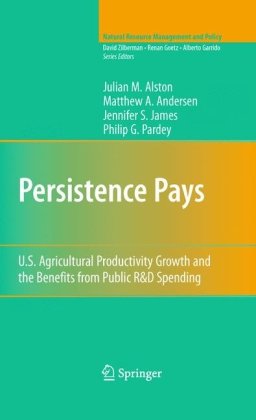
Persistence Pays: U.s. Agricultural Productivity Growth And The Benefits From Public R&d Spending (natural Resource Management And Policy) 🔍
Julian M. Alston, Matthew A. Andersen, Jennifer S. James, Philip G. Pardey (auth.)
Springer-Verlag New York, Natural Resource Management and Policy 34, 1, 2010
English [en] · PDF · 7.8MB · 2010 · 📘 Book (non-fiction) · 🚀/lgli/lgrs/nexusstc/scihub/zlib · Save
description
This book documents the evolving path of U.S. agriculture in the 20th Century and the role of public R & D in that evolution. The work begins with a detailed quantitative assessment of the shifting patterns of production among the states and over time and of the public institutions and investments in agricultural R & D. Then, based on newly constructed sets of panel data, some of which span the entire 20th Century and more, the authors present new econometric evidence linking state-specific agricultural productivity measures to federal and state government investments in agricultural research and extension. The results show that the time lags between R & D spending and its effects on productivity are longer than commonly found or assumed in the prior published work. Also, the spillover effects of R & D among states are important, such that the national net benefits from a state's agricultural research investments are much greater than own-state net benefits. The main findings are consistent across a wide range of reasonable model specifications. In sum, the benefits from past public investments in agricultural research have been worth many times more than the costs, a significant share of the benefits accrue as spillovers, and the research lags are very long. An accelerated investment in public agricultural R & D is warranted by the high returns to the nation, and may be necessary to revitalize U.S. agricultural productivity growth even though the benefits may not be visible for many years. Julian M. Alston is Professor in the Department of Agricultural and Resource Economics and Director of the Robert Mondavi Institute Center for Wine Economics at the University of California, Davis and Associate Director for Science and Technology at the University of California Agricultural Issues Center Matthew A. Andersen is Assistant Professor in the Department of Agricultural and Applied Economics at the University of Wyoming Jennifer S. James is Associate Professor in the Department of Agribusiness at California Polytechnic State University, San Luis Obispo Philip G. Pardey is Professor in the Department of Applied Economics and Director of the International Science and Technology Practice and Policy (InSTePP) Center at the University of Minnesota
Alternative filename
lgrsnf/D:\!genesis\library.nu\3c\_106188.3c0a681678b45fcb9545d2cfa7f744c8.pdf
Alternative filename
nexusstc/Persistence Pays: U.S. Agricultural Productivity Growth and the Benefits from Public R&D Spending/3c0a681678b45fcb9545d2cfa7f744c8.pdf
Alternative filename
scihub/10.1007/978-1-4419-0658-8.pdf
Alternative title
Persistence pays : U.S. agricultural productivity growth and the benefits from public R & D spending
Alternative author
Julian M. Alston ... [et al.]
Alternative publisher
Springer New York : Imprint : Springer
Alternative publisher
Springer Nature
Alternative edition
Natural resource management and policy, Natural resource management and policy, New York, New York State, 2010
Alternative edition
Natural resource management and policy, 1st ed. 2010, New York, NY, 2010
Alternative edition
Natural Resource Management and Policy, 1. Aufl, New York, NY, 2009
Alternative edition
United States, United States of America
Alternative edition
Springer Nature, New York, NY, 2009
Alternative edition
1, 20091127
metadata comments
до 2011-01
metadata comments
sm22923934
metadata comments
{"edition":"1","isbns":["1441906576","1441906584","9781441906571","9781441906588"],"last_page":504,"publisher":"Springer New York","series":"Natural Resource Management and Policy 34"}
metadata comments
Includes bibliographical references (p. [465]-492) and index.
Alternative description
"Agricultural science policy in the United States has profoundly affected the growth and development of agriculture worldwide, not just in the A United States. Over the past 150 years, and especially over the second th half of the 20 Century, public investments in agricultural R & D in the United States grew faster than the value of agricultural production. Public spending on agricultural science grew similarly in other more-developed countries, and c- lectively these efforts, along with private spending, spurred agricultural prod- tivity growth in rich and poor nations alike. The value of this investment is seldom fully appreciated. The resulting p- ductivity improvements have released labor and other resources for alternative uses--in 1900, 29. 2 million Americans (39 percent of the population) were - rectly engaged in farming compared with just 2. 9 million (1. 1 percent) today-- while making food and fiber more abundant and cheaper. The benefits are not confined to Americans. U.S. agricultural science has contributed with others to growth in agricultural productivity in many other countries as well as the Un- ed States. The world's population more than doubled from around 3 billion in 1961 to 6. 54 billion in 2006 (U.S. Census Bureau 2009). Over the same period, production of important grain crops (including maize, wheat and rice) almost trebled, such that global per capita grain production was 18 percent higher in 2006"--Publisher's description
Alternative description
gricultural science policy in the United States has profoundly affected the growth and development of agriculture worldwide, not just in the A United States. Over the past 150 years, and especially over the second th half of the 20 Century, public investments in agricultural R&D in the United States grew faster than the value of agricultural production. Public spending on agricultural science grew similarly in other more-developed countries, and c- lectively these efforts, along with private spending, spurred agricultural prod- tivity growth in rich and poor nations alike. The value of this investment is seldom fully appreciated. The resulting p- ductivity improvements have released labor and other resources for alternative uses—in 1900, 29. 2 million Americans (39 percent of the population) were - rectly engaged in farming compared with just 2. 9 million (1. 1 percent) today— while making food and fiber more abundant and cheaper. The benefits are not confined to Americans. U. S. agricultural science has contributed with others to growth in agricultural productivity in many other countries as well as the Un- ed States. The world's population more than doubled from around 3 billion in 1961 to 6. 54 billion in 2006 (U. S. Census Bureau 2009). Over the same period, production of important grain crops (including maize, wheat and rice) almost trebled, such that global per capita grain production was 18 percent higher in 2006.
Alternative description
Front Matter....Pages i-xxx
Front Matter....Pages 1-1
Introduction....Pages 3-8
A Brief History of U.S. Agriculture....Pages 9-21
Front Matter....Pages 24-24
Agricultural Inputs....Pages 25-56
Agricultural Outputs....Pages 57-85
Agricultural Productivity Patterns....Pages 87-133
Front Matter....Pages 136-136
Research Funding and Performance....Pages 137-185
The Federal Role....Pages 187-236
Front Matter....Pages 238-238
Research Lags and Spillovers....Pages 239-269
Models of Research and Productivity....Pages 271-311
Econometric Estimation and Results....Pages 313-351
Productivity Patterns and Research Benefits....Pages 353-408
Front Matter....Pages 410-410
Interpretation and Assessment of Benefit-Cost Findings....Pages 411-451
Synthesis....Pages 453-463
Back Matter....Pages 465-502
Front Matter....Pages 1-1
Introduction....Pages 3-8
A Brief History of U.S. Agriculture....Pages 9-21
Front Matter....Pages 24-24
Agricultural Inputs....Pages 25-56
Agricultural Outputs....Pages 57-85
Agricultural Productivity Patterns....Pages 87-133
Front Matter....Pages 136-136
Research Funding and Performance....Pages 137-185
The Federal Role....Pages 187-236
Front Matter....Pages 238-238
Research Lags and Spillovers....Pages 239-269
Models of Research and Productivity....Pages 271-311
Econometric Estimation and Results....Pages 313-351
Productivity Patterns and Research Benefits....Pages 353-408
Front Matter....Pages 410-410
Interpretation and Assessment of Benefit-Cost Findings....Pages 411-451
Synthesis....Pages 453-463
Back Matter....Pages 465-502
date open sourced
2011-06-04
🚀 Fast downloads
Become a member to support the long-term preservation of books, papers, and more. To show our gratitude for your support, you get fast downloads. ❤️
- Fast Partner Server #1 (recommended)
- Fast Partner Server #2 (recommended)
- Fast Partner Server #3 (recommended)
- Fast Partner Server #4 (recommended)
- Fast Partner Server #5 (recommended)
- Fast Partner Server #6 (recommended)
- Fast Partner Server #7
- Fast Partner Server #8
- Fast Partner Server #9
- Fast Partner Server #10
- Fast Partner Server #11
- Fast Partner Server #12
🐢 Slow downloads
From trusted partners. More information in the FAQ. (might require browser verification — unlimited downloads!)
- Slow Partner Server #1 (slightly faster but with waitlist)
- Slow Partner Server #2 (slightly faster but with waitlist)
- Slow Partner Server #3 (slightly faster but with waitlist)
- Slow Partner Server #4 (slightly faster but with waitlist)
- Slow Partner Server #5 (no waitlist, but can be very slow)
- Slow Partner Server #6 (no waitlist, but can be very slow)
- Slow Partner Server #7 (no waitlist, but can be very slow)
- Slow Partner Server #8 (no waitlist, but can be very slow)
- Slow Partner Server #9 (no waitlist, but can be very slow)
- After downloading: Open in our viewer
All download options have the same file, and should be safe to use. That said, always be cautious when downloading files from the internet, especially from sites external to Anna’s Archive. For example, be sure to keep your devices updated.
External downloads
-
For large files, we recommend using a download manager to prevent interruptions.
Recommended download managers: JDownloader -
You will need an ebook or PDF reader to open the file, depending on the file format.
Recommended ebook readers: Anna’s Archive online viewer, ReadEra, and Calibre -
Use online tools to convert between formats.
Recommended conversion tools: CloudConvert and PrintFriendly -
You can send both PDF and EPUB files to your Kindle or Kobo eReader.
Recommended tools: Amazon‘s “Send to Kindle” and djazz‘s “Send to Kobo/Kindle” -
Support authors and libraries
✍️ If you like this and can afford it, consider buying the original, or supporting the authors directly.
📚 If this is available at your local library, consider borrowing it for free there.
Total downloads:
A “file MD5” is a hash that gets computed from the file contents, and is reasonably unique based on that content. All shadow libraries that we have indexed on here primarily use MD5s to identify files.
A file might appear in multiple shadow libraries. For information about the various datasets that we have compiled, see the Datasets page.
For information about this particular file, check out its JSON file. Live/debug JSON version. Live/debug page.