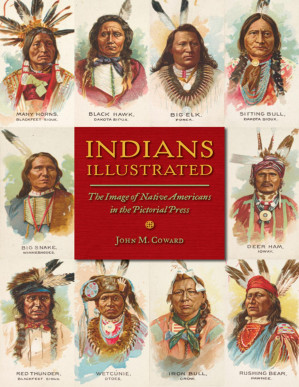
Indians Illustrated: The Image of Native Americans in the Pictorial Press (History of Communication) 🔍
John M. Coward
University of Illinois Press, The History of Media and Communication, 2016
English [en] · PDF · 23.3MB · 2016 · 📘 Book (non-fiction) · 🚀/lgli/zlib · Save
description
After 1850, Americans swarmed to take in a raft of new illustrated journals and papers. Engravings and drawings of "buckskinned braves" and "Indian princesses" proved an immensely popular attraction for consumers of publications like Frank Leslie's Illustrated Newspaper and Harper's Weekly . In Indians Illustrated , John M. Coward charts a social and cultural history of Native American illustrations—romantic, violent, racist, peaceful, and otherwise—in the heyday of the American pictorial press. These woodblock engravings and ink drawings placed Native Americans into categories that drew from venerable "good" Indian and "bad" Indian stereotypes already threaded through the culture. Coward's examples show how the genre cemented white ideas about how Indians should look and behave—ideas that diminished Native Americans' cultural values and political influence. His powerful analysis of themes and visual tropes unlocks the racial codes and visual cues that whites used to represent—and marginalize—native cultures already engaged in a twilight struggle against inexorable westward expansion.|
Cover
Title Page
Copyright
Contents
Acknowledgments
Introduction: Illustrating Indians in the Pictorial Press
Chapter 1. Posing the Indian: Native American Portraits in the Illustrated Press
Chapter 2. Illustrating Indian Lives: Difference and Deficiency in Native American Imagery
Chapter 3. The Princess and the Squaw: The Construction of Native American Women in the Pictorial
Chapter 4. Making Images on the Indian Frontier: The Adventures of Special Artist Theodore Davis
Chapter 5. Illustrating the Indian Wars: Fact, Fantasy, and Ideology
Chapter 6. Making Sense of Savagery: Native American Cartoons in the Daily Graphic
Chapter 7. Remington's Indian Illustrations: Race, Realism, and Pictorial Journalism
Chapter 8. Visualizing Race: Native American and African American Imagery in Frank Leslie's
Conclusion: Illustrating Race, Demonstrating Difference
Notes
Index
|
" Indians Illustrated is a good read that strongly contributes to our knowledge of American Indians' depictions and stereotyping while bringing the world of nineteenth-century printed press into our own homes." — American Indian Quarterly
"In Indians Illustrated , Coward not only has written a book that clearly and decisively achieves the primary objective of providing a history of the development and consequences of Native American stereotypes, but he also provides a framework useful for anyone who seeks to understand stereotyping of any group in American media."— Journalism History
"Coward provides a fascinating look at how powerful the visual image can be on the development of cultural attitudes."— Jhistory
| John M. Coward is an associate professor of communication at the University of Tulsa. He is the author of The Newspaper Indian: Native American Identity in the Press, 1820–90 .
Cover
Title Page
Copyright
Contents
Acknowledgments
Introduction: Illustrating Indians in the Pictorial Press
Chapter 1. Posing the Indian: Native American Portraits in the Illustrated Press
Chapter 2. Illustrating Indian Lives: Difference and Deficiency in Native American Imagery
Chapter 3. The Princess and the Squaw: The Construction of Native American Women in the Pictorial
Chapter 4. Making Images on the Indian Frontier: The Adventures of Special Artist Theodore Davis
Chapter 5. Illustrating the Indian Wars: Fact, Fantasy, and Ideology
Chapter 6. Making Sense of Savagery: Native American Cartoons in the Daily Graphic
Chapter 7. Remington's Indian Illustrations: Race, Realism, and Pictorial Journalism
Chapter 8. Visualizing Race: Native American and African American Imagery in Frank Leslie's
Conclusion: Illustrating Race, Demonstrating Difference
Notes
Index
|
" Indians Illustrated is a good read that strongly contributes to our knowledge of American Indians' depictions and stereotyping while bringing the world of nineteenth-century printed press into our own homes." — American Indian Quarterly
"In Indians Illustrated , Coward not only has written a book that clearly and decisively achieves the primary objective of providing a history of the development and consequences of Native American stereotypes, but he also provides a framework useful for anyone who seeks to understand stereotyping of any group in American media."— Journalism History
"Coward provides a fascinating look at how powerful the visual image can be on the development of cultural attitudes."— Jhistory
| John M. Coward is an associate professor of communication at the University of Tulsa. He is the author of The Newspaper Indian: Native American Identity in the Press, 1820–90 .
Alternative author
Coward, John M
Alternative edition
University of Illinois Press, Urbana, 2016
Alternative edition
The history of communication, Urbana, 2016
Alternative edition
United States, United States of America
Alternative edition
Reprint, 2016
Alternative description
"Indians Illustrated is a social and cultural history of Indian illustrations in Frank Leslie's Illustrated Newspaper, Harper's Weekly, and other illustrated journals during the last half of the nineteenth century, the heyday of the American pictorial press. The pictorial press era, spurred in the mid-1850s by the transportation revolution, innovations in printing technology, and an expanded literary and pictorial market, was marked by a proliferation of detailed, realistic woodblock engravings, pictures of newsworthy people and interesting events from across the nation and the world. The pictorial press frequently depicted Indians and Indian life in popular but narrowly conceived ways. In pictures, Indians were simplified and presented in familiar and easily understood categories, usually as variations on the 'good' Indian/'bad' Indian stereotypes long established in Euro-American culture. Indian men were depicted as 'tall and copper-colored, with braided hair, clothed in buckskin, and moccasins, and adorned in headdresses, beadwork and/or turquoise' while Indian women were depicted as either Indian princesses or squaws. John Coward argues that these pictures helped create and sustain a host of popular ideas and attitudes about Indians, especially ideas about the way Indians were supposed to look and act. By describing and analyzing the various themes and visual tropes across the years of the illustrated press, this book provides a deeper understanding of the racial codes and visual signs that white Americans used to represent Native Americans in an era of western expansion and Manifest Destiny"--Provided by publisher
Alternative description
"Indians Illustrated is a social and cultural history of Indian illustrations in Frank Leslie's Illustrated Newspaper, Harper's Weekly, and other illustrated journals during the last half of the nineteenth century, the heyday of the American pictorial press. The pictorial press era, spurred in the mid-1850s by the transportation revolution, innovations in printing technology, and an expanded literary and pictorial market, was marked by a proliferation of detailed, realistic woodblock engravings, pictures of newsworthy people and interesting events from across the nation and the world. The pictorial press frequently depicted Indians and Indian life in popular but narrowly conceived ways. In pictures, Indians were simplified and presented in familiar and easily understood categories, usually as variations on the 'good' Indian/'bad' Indian stereotypes long established in Euro-American culture. Indian men were depicted as 'tall and copper-colored, with braided hair, clothed in buckskin, and moccasins, and adorned in headdresses, beadwork and/or turquoise' while Indian women were depicted as either Indian princesses or squaws. John Coward argues that these pictures helped create and sustain a host of popular ideas and attitudes about Indians, especially ideas about the way Indians were supposed to look and act. By describing and analyzing the various themes and visual tropes across the years of the illustrated press, this book provides a deeper understanding of the racial codes and visual signs that white Americans used to represent Native Americans in an era of western expansion and Manifest Destiny"-- Résumé de l'éditeur
date open sourced
2022-07-13
🚀 Fast downloads
Become a member to support the long-term preservation of books, papers, and more. To show our gratitude for your support, you get fast downloads. ❤️
- Fast Partner Server #1 (recommended)
- Fast Partner Server #2 (recommended)
- Fast Partner Server #3 (recommended)
- Fast Partner Server #4 (recommended)
- Fast Partner Server #5 (recommended)
- Fast Partner Server #6 (recommended)
- Fast Partner Server #7
- Fast Partner Server #8
- Fast Partner Server #9
- Fast Partner Server #10
- Fast Partner Server #11
- Fast Partner Server #12
🐢 Slow downloads
From trusted partners. More information in the FAQ. (might require browser verification — unlimited downloads!)
- Slow Partner Server #1 (slightly faster but with waitlist)
- Slow Partner Server #2 (slightly faster but with waitlist)
- Slow Partner Server #3 (slightly faster but with waitlist)
- Slow Partner Server #4 (slightly faster but with waitlist)
- Slow Partner Server #5 (no waitlist, but can be very slow)
- Slow Partner Server #6 (no waitlist, but can be very slow)
- Slow Partner Server #7 (no waitlist, but can be very slow)
- Slow Partner Server #8 (no waitlist, but can be very slow)
- Slow Partner Server #9 (no waitlist, but can be very slow)
- After downloading: Open in our viewer
All download options have the same file, and should be safe to use. That said, always be cautious when downloading files from the internet, especially from sites external to Anna’s Archive. For example, be sure to keep your devices updated.
External downloads
-
For large files, we recommend using a download manager to prevent interruptions.
Recommended download managers: JDownloader -
You will need an ebook or PDF reader to open the file, depending on the file format.
Recommended ebook readers: Anna’s Archive online viewer, ReadEra, and Calibre -
Use online tools to convert between formats.
Recommended conversion tools: CloudConvert and PrintFriendly -
You can send both PDF and EPUB files to your Kindle or Kobo eReader.
Recommended tools: Amazon‘s “Send to Kindle” and djazz‘s “Send to Kobo/Kindle” -
Support authors and libraries
✍️ If you like this and can afford it, consider buying the original, or supporting the authors directly.
📚 If this is available at your local library, consider borrowing it for free there.
Total downloads:
A “file MD5” is a hash that gets computed from the file contents, and is reasonably unique based on that content. All shadow libraries that we have indexed on here primarily use MD5s to identify files.
A file might appear in multiple shadow libraries. For information about the various datasets that we have compiled, see the Datasets page.
For information about this particular file, check out its JSON file. Live/debug JSON version. Live/debug page.