nexusstc/The Brain’s Sense of Movement (Perspectives in Cognitive Neuroscience)/3d83d74d19279e7785fed074bcc5412a.pdf
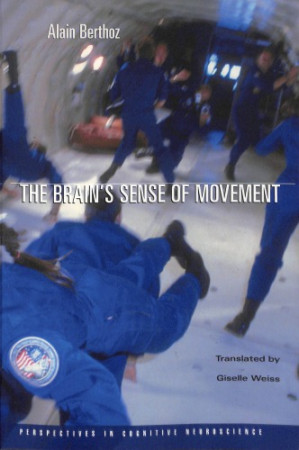
The Brain’s Sense of Movement (Perspectives in Cognitive Neuroscience) 🔍
Alain Berthoz
Harvard University, Department of Sanskrit & Indian Studies, 2010
English [en] · PDF · 139.4MB · 2010 · 📘 Book (non-fiction) · 🚀/lgli/lgrs/nexusstc/zlib · Save
description
The neuroscientist Alain Berthoz experimented on Russian astronauts in space to answer these questions: How does weightlessness affect motion? How are motion and three-dimensional space perceived? In this erudite and witty book, Berthoz describes how human beings on earth perceive and control bodily movement. Reviewing a wealth of research in neurophysiology and experimental psychology, he argues for a rethinking of the traditional separation between action and perception, and for the division of perception into five senses.
In Berthoz's view, perception and cognition are inherently predictive, functioning to allow us to anticipate the consequences of current or potential actions. The brain acts like a simulator that is constantly inventing models to project onto the changing world, models that are corrected by steady, minute feedback from the world. We move in the direction we are looking, anticipate the trajectory of a falling ball, recover when we stumble, and continually update our own physical position, all thanks to this sense of movement.
This interpretation of perception and action allows Berthoz, in The Brain's Sense of Movement , to focus on psychological phenomena largely ignored in standard texts: proprioception and kinaesthesis, the mechanisms that maintain balance and coordinate actions, and basic perceptual and memory processes involved in navigation.
In Berthoz's view, perception and cognition are inherently predictive, functioning to allow us to anticipate the consequences of current or potential actions. The brain acts like a simulator that is constantly inventing models to project onto the changing world, models that are corrected by steady, minute feedback from the world. We move in the direction we are looking, anticipate the trajectory of a falling ball, recover when we stumble, and continually update our own physical position, all thanks to this sense of movement.
This interpretation of perception and action allows Berthoz, in The Brain's Sense of Movement , to focus on psychological phenomena largely ignored in standard texts: proprioception and kinaesthesis, the mechanisms that maintain balance and coordinate actions, and basic perceptual and memory processes involved in navigation.
Alternative filename
lgli/The Brain__039;s Sense of Movement_Alain Berthoz _337_A.pdf
Alternative filename
lgrsnf/The Brain__039;s Sense of Movement_Alain Berthoz _337_A.pdf
Alternative author
Berthoz, Alain
Alternative publisher
Belknap Press of Harvard University Press
Alternative edition
Perspectives in cognitive neuroscience, Cambridge, Mass, 2000
Alternative edition
United States, United States of America
Alternative edition
New edition, PS, 2002
Alternative edition
September 30, 2002
metadata comments
0
metadata comments
lg2438864
metadata comments
{"isbns":["0674009800","9780674009806"],"last_page":352,"publisher":"Harvard University Press"}
Alternative description
The neuroscientist Alain Berthoz experimented on Russian astronauts in space to answer these questions: How does weightlessness affect motion? How are motion and three-dimensional space perceived? In this erudite and witty book, Berthoz describes how human beings on earth perceive and control bodily movement. Reviewing a wealth of research in neurophysiology and experimental psychology, he argues for a rethinking of the traditional separation between action and perception, and for the division of perception into five senses.In Berthoz's view, perception and cognition are inherently predictive, functioning to allow us to anticipate the consequences of current or potential actions. The brain acts like a simulator that is constantly inventing models to project onto the changing world, models that are corrected by steady, minute feedback from the world. We move in the direction we are looking, anticipate the trajectory of a falling ball, recover when we stumble, and continually update our own physical position, all thanks to this sense of movement.This interpretation of perception and action allows Berthoz, in The Brain's Sense of Movement, to focus on psychological phenomena largely ignored in standard texts: proprioception and kinaesthesis, the mechanisms that maintain balance and coordinate actions, and basic perpetual and memory processes involved in navigation.
Alternative description
This interpretation of perception and action allows Alain Berthoz to focus on psychological phenomena: proprioception and kinaesthesis; the mechanisms that maintain balance and co-ordination actions; and basic perceptual and memory processes involved in navigation
date open sourced
2019-11-17
🚀 Fast downloads
Become a member to support the long-term preservation of books, papers, and more. To show our gratitude for your support, you get fast downloads. ❤️
- Fast Partner Server #1 (recommended)
- Fast Partner Server #2 (recommended)
- Fast Partner Server #3 (recommended)
- Fast Partner Server #4 (recommended)
- Fast Partner Server #5 (recommended)
- Fast Partner Server #6 (recommended)
- Fast Partner Server #7
- Fast Partner Server #8
- Fast Partner Server #9
- Fast Partner Server #10
- Fast Partner Server #11
- Fast Partner Server #12
🐢 Slow downloads
From trusted partners. More information in the FAQ. (might require browser verification — unlimited downloads!)
- Slow Partner Server #1 (slightly faster but with waitlist)
- Slow Partner Server #2 (slightly faster but with waitlist)
- Slow Partner Server #3 (slightly faster but with waitlist)
- Slow Partner Server #4 (slightly faster but with waitlist)
- Slow Partner Server #5 (no waitlist, but can be very slow)
- Slow Partner Server #6 (no waitlist, but can be very slow)
- Slow Partner Server #7 (no waitlist, but can be very slow)
- Slow Partner Server #8 (no waitlist, but can be very slow)
- Slow Partner Server #9 (no waitlist, but can be very slow)
- After downloading: Open in our viewer
All download options have the same file, and should be safe to use. That said, always be cautious when downloading files from the internet, especially from sites external to Anna’s Archive. For example, be sure to keep your devices updated.
External downloads
-
For large files, we recommend using a download manager to prevent interruptions.
Recommended download managers: JDownloader -
You will need an ebook or PDF reader to open the file, depending on the file format.
Recommended ebook readers: Anna’s Archive online viewer, ReadEra, and Calibre -
Use online tools to convert between formats.
Recommended conversion tools: CloudConvert and PrintFriendly -
You can send both PDF and EPUB files to your Kindle or Kobo eReader.
Recommended tools: Amazon‘s “Send to Kindle” and djazz‘s “Send to Kobo/Kindle” -
Support authors and libraries
✍️ If you like this and can afford it, consider buying the original, or supporting the authors directly.
📚 If this is available at your local library, consider borrowing it for free there.
Total downloads:
A “file MD5” is a hash that gets computed from the file contents, and is reasonably unique based on that content. All shadow libraries that we have indexed on here primarily use MD5s to identify files.
A file might appear in multiple shadow libraries. For information about the various datasets that we have compiled, see the Datasets page.
For information about this particular file, check out its JSON file. Live/debug JSON version. Live/debug page.