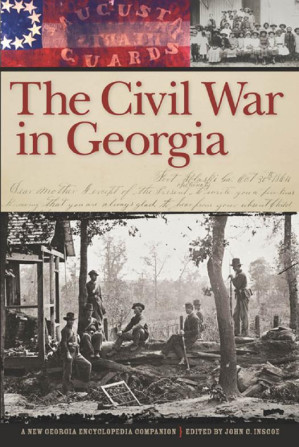
The Civil War in Georgia : A New Georgia Encyclopedia Companion 🔍
John C. Inscoe, Jarrod Atchison, Anne J. Bailey, Keith S. Bohannon, Katherine Brackett
University of Georgia Press, Lightning Source Inc. (Tier 3), Athens, 2011
English [en] · PDF · 6.4MB · 2011 · 📘 Book (non-fiction) · 🚀/lgli/zlib · Save
description
Georgians, like all Americans, experienced the Civil War in a variety of ways. Through selected articles drawn from the New Georgia Encyclopedia (www.georgiaencyclopedia.org), this collection chronicles the diversity of Georgia's Civil War experience and reflects the most current scholarship in terms of how the Civil War has come to be studied, documented, and analyzed. The Atlanta campaign and Sherman's March to the Sea changed the course of the war in 1864, in terms both of the upheaval and destruction inflicted on the state and the life span of the Confederacy. While the dramatic events of 1864 are fully documented, this companion gives equal coverage to the many other aspects of the war--naval encounters and guerrilla warfare, prisons and hospitals, factories and plantations, politics and policies-- all of which provided critical support to the Confederacy's war effort. The book also explores home-front conditions in depth, with an emphasis on emancipation, dissent, Unionism, and the experience and activity of African Americans and women. Historians today are far more conscious of how memory--as public commemoration, individual reminiscence, historic preservation, and literary and cinematic depictions--has shaped the war's multiple meanings. Nowhere is this legacy more varied or more pronounced than in Georgia, and a substantial part of this companion explores the many ways in which Georgians have interpreted the war experience for themselves and others over the past 150 years. At the outset of the sesquicentennial these new historical perspectives allow us to appreciate the Civil War as a complex and multifaceted experience for Georgians and for all southerners. A Project of the New Georgia Encyclopedia; Published in Association with the Georgia Humanities Council and the University System of Georgia/GALILEO.
Alternative author
Albert Churella; Angela Esco Elder; Anne J. Bailey; Anthony Gene Carey; Barton A. Myers; Brad Wood; Brian Brown; Bruce E. Stewart; Bruce Smith; Caroline Matheny Dillman; Chris Wilkinson; Clarence L. Mohr; Dan Childs; Dan Du; David H. McGee; David N. Wiggins; David S. Williams; David Williams; Debra Reddin van Tuyll; Denise Wright; Diane Trap; Edwin L. Jackson; Franklin C. Sammons Jr.; Garrett W. Silliman; George Justice; Glenna R. Schroeder-Lein; Gordon L. Jones; Heather L. Whittaker; Hubert H. McAlexander; Hugh Ruppersburg; Jacqueline Miller Carmichael; James C. Turner; James H. Welborn III; Jarrod Atchison; Jason Manthorne; Jeffrey Robert Young; John D. Fowler; Jun Suk Hyun; Katherine Brackett; Katherine E. Rohrer; Keith S. Bohannon; Kevin W. Young; Kyle Osborn; Laura McCarty; Laverne W. Hill; Leah Richier; Levi Collins; Lisa Tendrich Frank; Melvin B. Hill Jr.; Robert J. Wilson III; Robert Scott Davis Jr.; Samuel B. McGuire; Sean H. Vanatta; Stephen Davis; Stephen Huggins; Steve Longcrier; Susan Eva O'Donovan; Vanessa P. Tome; William Harris Bragg; John C. Inscoe; Richard Houston; Cindy Schmid
Alternative author
Churella, Albert; Elder, Angela Esco; Bailey, Anne J.; Carey, Anthony Gene; Myers, Barton A.; Wood, Brad; Brown, Brian; Stewart, Bruce E.; Smith, Bruce; Dillman, Caroline; Wilkinson, Chris; Mohr, Clarence L.; Childs, Dan; Du, Dan; McGee, David; Wiggins, David; Williams, David S.; Williams, David; van Tuyll, Debra Reddin; Wright, Denise; Trap, Diane; Jackson, Edwin; Sammons, Franklin; Silliman, Garrett W.; Justice, George; Schroeder-Lein, Glenna; Jones, Gordon L.; Whittaker, Heather; McAlexander, Hubert H.; Ruppersburg, Hugh; Carmichael, Jacqueline Miller; Turner, James; Welborn, James; Atchison, Jarrod; Manthorne, Jason; Young, Jeffrey Robert; Fowler, John D.; Hyun, Jun; Brackett, Katherine; Rohrer, Katherine; Bohannon, Keith S.; Young, Kevin W.; Osborn, Kyle; McCarty, Laura; Hill, Laverne; Richier, Leah; Collins, Levi; Frank, Lisa Tendrich; Hill, Melvin; Wilson, Robert; Davis, Robert Scott; McGuire, Samuel B.; Vanatta, Sean H.; Davis, Stephen; Huggins, Stephen; Longcrier, Steve; O'Donovan, Susan Eva; Tome, Vanessa P.; Bragg, William Harris; Inscoe, John C.; Houston, Richard; Schmid, Cindy
Alternative edition
United States, United States of America
Alternative edition
Athens; London, 2011
Alternative edition
Illustrated, 2011
Alternative description
<p>Georgians, like all Americans, experienced the Civil War in a variety of ways. Through selected articles drawn from the New Georgia Encyclopedia (www.georgiaencyclopedia.org), this collection chronicles the diversity of Georgia's Civil War experience and reflects the most current scholarship in terms of how the Civil War has come to be studied, documented, and analyzed.<br></p><p>The Atlanta campaign and Sherman's March to the Sea changed the course of the war in 1864, in terms both of the upheaval and destruction inflicted on the state and the life span of the Confederacy. While the dramatic events of 1864 are fully documented, this companion gives equal coverage to the many other aspects of the war—naval encounters and guerrilla warfare, prisons and hospitals, factories and plantations, politics and policies— all of which provided critical support to the Confederacy's war effort. The book also explores home-front conditions in depth, with an emphasis on emancipation, dissent, Unionism, and the experience and activity of African Americans and women.<br></p><p>Historians today are far more conscious of how memory—as public commemoration, individual reminiscence, historic preservation, and literary and cinematic depictions—has shaped the war's multiple meanings. Nowhere is this legacy more varied or more pronounced than in Georgia, and a substantial part of this companion explores the many ways in which Georgians have interpreted the war experience for themselves and others over the past 150 years. At the outset of the sesquicentennial these new historical perspectives allow us to appreciate the Civil War as a complex and multifaceted experience for Georgians and for all southerners.<br></p><p>A Project of the New Georgia Encyclopedia; Published in Association with the Georgia Humanities Council and the University System of Georgia/GALILEO.<br></p>
Alternative description
Georgians, like all Americans, experienced the Civil War in a variety of ways. Through selected articles drawn from the New Georgia Encyclopedia (www.georgiaencyclopedia.org), this collection chronicles the diversity of Georgia's Civil War experience and reflects the most current scholarship in terms of how the Civil War has come to be studied, documented, and analyzed. The Atlanta campaign and Sherman's March to the Sea changed the course of the war in 1864, in terms both of the upheaval and destruction inflicted on the state and the life span of the Confederacy. While the dramatic events of 1864 are fully documented, this companion gives equal coverage to the many other aspects of the war-naval encounters and guerrilla warƯfare, prisons and hospitals, factories and plantations, politics and policies- all of which provided critical support to the Confederacy's war effort. The book also explores home-front conditions in depth, with an emphasis on emancipation, dissent, Unionism, and the experience and activity of African Americans and women. Historians today are far more conscious of how memory-as public commemoration, individual reminiscence, historic preservation, and literary and cinematic depictions-has shaped the war's multiple meanings. Nowhere is this legacy more varied or more pronounced than in Georgia, and a substantial part of this companion explores the many ways in which Georgians have interpreted the war experience for themselves and others over the past 150 years. At the outset of the sesquicentennial these new historical perspectives allow us to appreciate the Civil War as a complex and multifaceted experience for Georgians and for all southerners. A Project of the New Georgia Encyclopedia; Published in Association with the Georgia Humanities Council and the University System of Georgia/GALILEO
date open sourced
2022-07-24
🚀 Fast downloads
Become a member to support the long-term preservation of books, papers, and more. To show our gratitude for your support, you get fast downloads. ❤️
- Fast Partner Server #1 (recommended)
- Fast Partner Server #2 (recommended)
- Fast Partner Server #3 (recommended)
- Fast Partner Server #4 (recommended)
- Fast Partner Server #5 (recommended)
- Fast Partner Server #6 (recommended)
- Fast Partner Server #7
- Fast Partner Server #8
- Fast Partner Server #9
- Fast Partner Server #10
- Fast Partner Server #11
- Fast Partner Server #12
🐢 Slow downloads
From trusted partners. More information in the FAQ. (might require browser verification — unlimited downloads!)
- Slow Partner Server #1 (slightly faster but with waitlist)
- Slow Partner Server #2 (slightly faster but with waitlist)
- Slow Partner Server #3 (slightly faster but with waitlist)
- Slow Partner Server #4 (slightly faster but with waitlist)
- Slow Partner Server #5 (no waitlist, but can be very slow)
- Slow Partner Server #6 (no waitlist, but can be very slow)
- Slow Partner Server #7 (no waitlist, but can be very slow)
- Slow Partner Server #8 (no waitlist, but can be very slow)
- Slow Partner Server #9 (no waitlist, but can be very slow)
- After downloading: Open in our viewer
All download options have the same file, and should be safe to use. That said, always be cautious when downloading files from the internet, especially from sites external to Anna’s Archive. For example, be sure to keep your devices updated.
External downloads
-
For large files, we recommend using a download manager to prevent interruptions.
Recommended download managers: JDownloader -
You will need an ebook or PDF reader to open the file, depending on the file format.
Recommended ebook readers: Anna’s Archive online viewer, ReadEra, and Calibre -
Use online tools to convert between formats.
Recommended conversion tools: CloudConvert and PrintFriendly -
You can send both PDF and EPUB files to your Kindle or Kobo eReader.
Recommended tools: Amazon‘s “Send to Kindle” and djazz‘s “Send to Kobo/Kindle” -
Support authors and libraries
✍️ If you like this and can afford it, consider buying the original, or supporting the authors directly.
📚 If this is available at your local library, consider borrowing it for free there.
Total downloads:
A “file MD5” is a hash that gets computed from the file contents, and is reasonably unique based on that content. All shadow libraries that we have indexed on here primarily use MD5s to identify files.
A file might appear in multiple shadow libraries. For information about the various datasets that we have compiled, see the Datasets page.
For information about this particular file, check out its JSON file. Live/debug JSON version. Live/debug page.