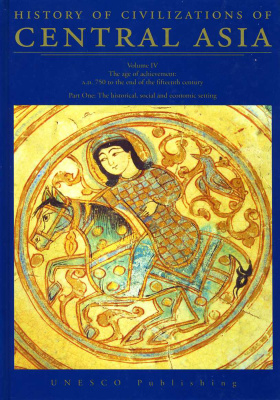
History of civilizations of Central Asia. Volume IV. The age of achievement: A.D. 750 to the end of the fifteenth century. Part One. The historical, social and economic setting 🔍
Ahmad Hasan Dani; V. M Masson; J Harmatta; Baij Nath Puri; G. F Etemadi; B. A Litvinskiĭ; Guangda Zhang; R. Shabani Samghabadi; Muḣammad Osimī; Clifford Edmund Bosworth; C Adle; Irfan Habib; Madhavan K Palat; Anara Tabyshalieva; Unesco
UNESCO Regional Office for, Multiple history series, Paris, 1992-2005
English [en] · PDF · 12.0MB · 1992 · 📘 Book (non-fiction) · 🚀/lgli/lgrs/nexusstc/zlib · Save
description
Asimov M.S., Bosworth C.E. (eds.) - Paris: UNESCO Publishing, 1998. — 485 pp. — (Multiple History Series). — ISBN 92-3-103467-7. Volume IV of the History of Civilizations of Central Asia covers some eight centuries during which the new faith of Islam arose, affecting, over a long period of time, much of Central Asia, the southern fringes of Siberia and the eastern regions of China, and competing in these areas witholder-established faiths. The expansion of the peoples of what is now the Mongolian region and the lands around lake Baikal - first the Turks, then the Kitans and finally the Mongols - was of a wider, international significance. The westward migrations of Turkic tribal nomads were to have long-term effects on the ethnic and social composition of the lands running westwards from Afghanistan through Iran to Anatolia. Turkish, and to a much lesser extent Mongol military expansion south of the Oxus river into what is now Afghanistan and northern India was also to have lasting political effects on these regions. The changes brought about by the movements of Turkish peoples were accelerated by the Mongol invasions of the thirteenth century. The region had always been content to absorb influences from the surrounding civilizations. In the long run, however, it was Lamaist Buddhism which established itself in the Mongolian region and in Tibet, and Islam among the Turkish peoples of Transoxania, southern Siberia and Xinjiang. It was in eastern Europe, above all in Russia, that the constituting of the Turco-Mongol Golden Horde was to have a major, enduring influence on the course of the region's history. Introduction (C. E. Bosworth).
Central Asia under the Umayyads and the early Abbasids (C. E. Bosworth and O. G. Bolshakov).
Sectarian and national movements in Iran, Khurasan and Transoxania during Umayyad and early Abbasid times (F. Daftary).
The states of the Oghuz, the Kimek and the Kipchak (S. G. Agajanov).
The Samanid state (N. N. Negmatov).
The Ghaznavids (C. E. Bosworth).
The Karakhanids (E. A. Davidovich).
The Seljuqs and the Khwarazm Shahs (A. Sevim and C. E. Bosworth).
The Ghurids (K. A. Nizami).
The Uighurs, the Kyrgyz and the Tangut ((eighth to the thirteenth century) (D. Sinor, Geng Shimin and Y. I. Kychanov).
The western Himalayan states (A. H. Dani).
The Kitan and the Kara Khitay (D. Sinor).
The Mongols and their state in the twelfth to the thirteenth century (Sh. Bira).
Central Asia under the rule of Chinggis Khan's successors (B. Akhmedov revised by D. Sinor).
The Delhi Sultanate (Riazul Islam and C. E. Bosworth).
The regions of Sind, Baluchistan, Multan and Kashmir: the historical, social and economic setting (N. A. Baloch and A. Q. Rafiqi).
Central Asia under Timur from 1370 to the early fifteenth century (K. Z. Ashrafyan).
The Timurid states in the fifteenth and sixteenth centuries (R. G. Mukminova).
Popular movements, religious trends and Sufi influence on the masses in the post-Abbasid period (K. A. Nizami).
Socio-economic development: food and clothing in eastern Iran and Central Asia (N. Kasai and S. Natsagdorj).
Coinage and the monetary system (E. A. Davidovich and A. H. Dani).
Conclusion (C. E. Bosworth).
Maps.
Central Asia under the Umayyads and the early Abbasids (C. E. Bosworth and O. G. Bolshakov).
Sectarian and national movements in Iran, Khurasan and Transoxania during Umayyad and early Abbasid times (F. Daftary).
The states of the Oghuz, the Kimek and the Kipchak (S. G. Agajanov).
The Samanid state (N. N. Negmatov).
The Ghaznavids (C. E. Bosworth).
The Karakhanids (E. A. Davidovich).
The Seljuqs and the Khwarazm Shahs (A. Sevim and C. E. Bosworth).
The Ghurids (K. A. Nizami).
The Uighurs, the Kyrgyz and the Tangut ((eighth to the thirteenth century) (D. Sinor, Geng Shimin and Y. I. Kychanov).
The western Himalayan states (A. H. Dani).
The Kitan and the Kara Khitay (D. Sinor).
The Mongols and their state in the twelfth to the thirteenth century (Sh. Bira).
Central Asia under the rule of Chinggis Khan's successors (B. Akhmedov revised by D. Sinor).
The Delhi Sultanate (Riazul Islam and C. E. Bosworth).
The regions of Sind, Baluchistan, Multan and Kashmir: the historical, social and economic setting (N. A. Baloch and A. Q. Rafiqi).
Central Asia under Timur from 1370 to the early fifteenth century (K. Z. Ashrafyan).
The Timurid states in the fifteenth and sixteenth centuries (R. G. Mukminova).
Popular movements, religious trends and Sufi influence on the masses in the post-Abbasid period (K. A. Nizami).
Socio-economic development: food and clothing in eastern Iran and Central Asia (N. Kasai and S. Natsagdorj).
Coinage and the monetary system (E. A. Davidovich and A. H. Dani).
Conclusion (C. E. Bosworth).
Maps.
Alternative filename
lgrsnf/F:\twirpx\_19\_9\1873601\1history_of_civilizations_of_central_asia_volume_iv_the_age_o.pdf
Alternative filename
nexusstc/History of civilizations of Central Asia. Volume IV. The age of achievement: A.D. 750 to the end of the fifteenth century. Part One. The historical, social and economic setting/42ae3aacde66f8bc41deaaac3f1bb1ef.pdf
Alternative title
History of Civilizations of Central Asia, V. 4: A.D. 750 to the End of the Fifteenth Century: Pt. I: the historical, social and economic setting
Alternative title
History of Civilizations of Central Asia: Age of Achievement, 8750 Ad to the End of the 15th Century (SANS COLL - UNESCO) (French Edition)
Alternative title
The Age of Achievement, A. D. 750 to the End of the Fifteenth Century - The Historical, Social and Economic Setting
Alternative author
Ahmad Hasan Dani; V. M Masson; J Harmatta; Boris Anatolevich Litvinskii; Clifford Edmund Bosworth; M. S Asimov; Unesco
Alternative author
Muhamed Sajfitdinovič Asimov; Clifford Edmund Bosworth
Alternative edition
August 1998
Alternative edition
US, 2006
metadata comments
1873601
metadata comments
twirpx
metadata comments
lg1859334
Alternative description
Part One: The Historical, Social and Economic SettingDuring the eight centuries covered in this volume, the new faith of Islam arose in Arabia and gradually spread eastwards and northwards, eventually affecting much of Central Asia, the southern fringes of Siberia and the eastern regions of China. These were also the centuries in which nomadic and military empires arose in the heart of Asia, impinging on the history of adjacent, well-established civilizations and cultures (China, India, Islamic Western Asia and Christian eastern and central Europe) to an unparalleled extent. Lamaist Buddhism established itself inthe Mongolian region and in Tibet and Islam among the Turkish people of Transoxania, southern Siberia and Xinjiang. It was in Eastern Europe, above all in Russia, that the Turco-Mongol Golden Horde was to have a major, enduring influence on the course of the region's history.
date open sourced
2017-08-07
🚀 Fast downloads
Become a member to support the long-term preservation of books, papers, and more. To show our gratitude for your support, you get fast downloads. ❤️
- Fast Partner Server #1 (recommended)
- Fast Partner Server #2 (recommended)
- Fast Partner Server #3 (recommended)
- Fast Partner Server #4 (recommended)
- Fast Partner Server #5 (recommended)
- Fast Partner Server #6 (recommended)
- Fast Partner Server #7
- Fast Partner Server #8
- Fast Partner Server #9
- Fast Partner Server #10
- Fast Partner Server #11
- Fast Partner Server #12
🐢 Slow downloads
From trusted partners. More information in the FAQ. (might require browser verification — unlimited downloads!)
- Slow Partner Server #1 (slightly faster but with waitlist)
- Slow Partner Server #2 (slightly faster but with waitlist)
- Slow Partner Server #3 (slightly faster but with waitlist)
- Slow Partner Server #4 (slightly faster but with waitlist)
- Slow Partner Server #5 (no waitlist, but can be very slow)
- Slow Partner Server #6 (no waitlist, but can be very slow)
- Slow Partner Server #7 (no waitlist, but can be very slow)
- Slow Partner Server #8 (no waitlist, but can be very slow)
- Slow Partner Server #9 (no waitlist, but can be very slow)
- After downloading: Open in our viewer
All download options have the same file, and should be safe to use. That said, always be cautious when downloading files from the internet, especially from sites external to Anna’s Archive. For example, be sure to keep your devices updated.
External downloads
-
For large files, we recommend using a download manager to prevent interruptions.
Recommended download managers: JDownloader -
You will need an ebook or PDF reader to open the file, depending on the file format.
Recommended ebook readers: Anna’s Archive online viewer, ReadEra, and Calibre -
Use online tools to convert between formats.
Recommended conversion tools: CloudConvert and PrintFriendly -
You can send both PDF and EPUB files to your Kindle or Kobo eReader.
Recommended tools: Amazon‘s “Send to Kindle” and djazz‘s “Send to Kobo/Kindle” -
Support authors and libraries
✍️ If you like this and can afford it, consider buying the original, or supporting the authors directly.
📚 If this is available at your local library, consider borrowing it for free there.
Total downloads:
A “file MD5” is a hash that gets computed from the file contents, and is reasonably unique based on that content. All shadow libraries that we have indexed on here primarily use MD5s to identify files.
A file might appear in multiple shadow libraries. For information about the various datasets that we have compiled, see the Datasets page.
For information about this particular file, check out its JSON file. Live/debug JSON version. Live/debug page.