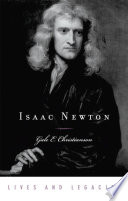
lgli/Christianson, Gale E. - Isaac Newton (Lives and Legacies Series) (2005, Oxford University Press).rtf
Isaac Newton (Lives and Legacies Series) 🔍
Christianson, Gale E.
Oxford University Press, USA, Lives and Legacies Series, 1, 2005
English [en] · RTF · 1.0MB · 2005 · 📘 Book (non-fiction) · 🚀/lgli/zlib · Save
description
Quarrelsome and quirky, a disheveled recluse who ate little, slept less, and yet had an iron constitution, Isaac Newton rose from a virtually illiterate family to become one of the towering intellects of science. Now, in this fast-paced, colorful biography, Gale E. Christianson paints an engaging portrait of Newton and the times in which he lived.
We follow Newton from his childhood in rural England to his student days at Cambridge, where he devoured the works of Copernicus, Kepler, and Galileo, and taught himself mathematics. There ensued two miraculous years at home in Woolsthorpe Manor, where he fled when plague threatened Cambridge, a remarkably fertile period when Newton formulated his theory of gravity, a new theory of light, and calculus—all by his twenty-fourth birthday. Christianson describes Newton's creation of the first working model of the reflecting telescope, which brought him to the attention of the Royal Society, and he illuminates the eighteen months of intense labor that resulted in his Principia , arguably the most important scientific work ever published. The book sheds light on Newton's later life as master of the mint in London, where he managed to convict and hang the arch criminal William Chaloner (a remarkable turn for a once reclusive scholar), and his presidency of the Royal Society, which he turned from a dilettante's club into an eminent scientific organization. Christianson also explores Newton's less savory side, including his long, bitter feud with Robert Hooke and the underhanded way that Newton established his priority in the invention of calculus and tarnished Liebniz's reputation.
Newton was an authentic genius with all too human faults. This book captures both sides of this truly extraordinary man.
Publishers Weekly Christianson has built a small empire of Newton biographies, including the full-length In the Presence of the Creator and the much briefer Isaac Newton and the Scientific Revolution. In fact, this volume is more or less identical to the briefer one, published by Oxford in 1996 as part of its young adult Portraits in Science series. The relatively simple prose betrays its origins, but the book itself gives a solid and accessible introduction to the life and work of Newton (1642-1727), from his early days at Cambridge to his time as a member of Parliament in the critical year of 1689, after King James II fled to France, and the political battles that surrounded Newton's later work as master of the mint. Newton was a loner pure and simple, secure in the knowledge that he was without peers when it came to almost all matters cerebral, Christianson writes. This biography works best as a brief introduction for general readers; those familiar with the general history of science (or, for that matter, those who've read Neal Stephenson's vastly more nuanced if fictional portrayal of Newton in his Baroque Cycle) will find little that isn't familiar. (Nov.) Copyright 2005 Reed Business Information.
We follow Newton from his childhood in rural England to his student days at Cambridge, where he devoured the works of Copernicus, Kepler, and Galileo, and taught himself mathematics. There ensued two miraculous years at home in Woolsthorpe Manor, where he fled when plague threatened Cambridge, a remarkably fertile period when Newton formulated his theory of gravity, a new theory of light, and calculus—all by his twenty-fourth birthday. Christianson describes Newton's creation of the first working model of the reflecting telescope, which brought him to the attention of the Royal Society, and he illuminates the eighteen months of intense labor that resulted in his Principia , arguably the most important scientific work ever published. The book sheds light on Newton's later life as master of the mint in London, where he managed to convict and hang the arch criminal William Chaloner (a remarkable turn for a once reclusive scholar), and his presidency of the Royal Society, which he turned from a dilettante's club into an eminent scientific organization. Christianson also explores Newton's less savory side, including his long, bitter feud with Robert Hooke and the underhanded way that Newton established his priority in the invention of calculus and tarnished Liebniz's reputation.
Newton was an authentic genius with all too human faults. This book captures both sides of this truly extraordinary man.
Publishers Weekly Christianson has built a small empire of Newton biographies, including the full-length In the Presence of the Creator and the much briefer Isaac Newton and the Scientific Revolution. In fact, this volume is more or less identical to the briefer one, published by Oxford in 1996 as part of its young adult Portraits in Science series. The relatively simple prose betrays its origins, but the book itself gives a solid and accessible introduction to the life and work of Newton (1642-1727), from his early days at Cambridge to his time as a member of Parliament in the critical year of 1689, after King James II fled to France, and the political battles that surrounded Newton's later work as master of the mint. Newton was a loner pure and simple, secure in the knowledge that he was without peers when it came to almost all matters cerebral, Christianson writes. This biography works best as a brief introduction for general readers; those familiar with the general history of science (or, for that matter, those who've read Neal Stephenson's vastly more nuanced if fictional portrayal of Newton in his Baroque Cycle) will find little that isn't familiar. (Nov.) Copyright 2005 Reed Business Information.
Alternative author
Gale E. Christianson
Alternative publisher
IRL Press at Oxford University Press
Alternative publisher
Oxford Institute for Energy Studies
Alternative publisher
German Historical Institute London
Alternative edition
United Kingdom and Ireland, United Kingdom
Alternative edition
Oxford University Press USA, Oxford, 2005
Alternative edition
Lives and legacies, New York, 2005
Alternative edition
Lives and legacies, Oxford, 2005
Alternative edition
1st ed., Oxford, England, 2005
metadata comments
lg_fict_id_627338
metadata comments
Includes bibliographical references and index.
Alternative description
"We follow Newton from his childhood in rural England to his student days at Cambridge, where he devoured the works of Copernicus, Kepler, and Galileo and taught himself mathematics. There ensued two miraculous years at home in Woolsthorpe Manor, where he fled when plague threatened Cambridge, a remarkably fertile period when Newton formulated his theory of gravity, a new theory of light, and calculus - all by his twenty-fourth birthday. Christianson describes Newton's creation of the first working model of the reflecting telescope, which brought him to the attention of the Royal Society, and he illuminates the eighteen months of intense labor that resulted in his Principia, arguably the most important scientific work ever published. The book sheds light on Newton's later life as master of the mint in London, where he managed to convict and hang the arch criminal William Chaloner (a remarkable turn for a once reclusive scholar), and his presidency of the Royal Society, which he turned from a dilettante's club into an eminent scientific organization. Christianson also explores Newton's less savory side, including his long, bitter feud with Robert Hooke and the underhanded way that Newton established his priority in the invention of calculus and tarnished Liebniz's reputation." "Newton was an authentic genius with all too human faults. This book captures both sides of this truly extraordinary man."--Résumé de l'éditeur
date open sourced
2021-10-28
🚀 Fast downloads
Become a member to support the long-term preservation of books, papers, and more. To show our gratitude for your support, you get fast downloads. ❤️
- Fast Partner Server #1 (recommended)
- Fast Partner Server #2 (recommended)
- Fast Partner Server #3 (recommended)
- Fast Partner Server #4 (recommended)
- Fast Partner Server #5 (recommended)
- Fast Partner Server #6 (recommended)
- Fast Partner Server #7
- Fast Partner Server #8
- Fast Partner Server #9
- Fast Partner Server #10
- Fast Partner Server #11
- Fast Partner Server #12
- Fast Partner Server #13
- Fast Partner Server #14
- Fast Partner Server #15
- Fast Partner Server #16
- Fast Partner Server #17
- Fast Partner Server #18
- Fast Partner Server #19
- Fast Partner Server #20
- Fast Partner Server #21
- Fast Partner Server #22
- Fast Partner Server #23
- Fast Partner Server #24
🐢 Slow downloads
From trusted partners. More information in the FAQ. (might require browser verification — unlimited downloads!)
- Slow Partner Server #1 (slightly faster but with waitlist)
- Slow Partner Server #2 (slightly faster but with waitlist)
- Slow Partner Server #3 (slightly faster but with waitlist)
- Slow Partner Server #4 (slightly faster but with waitlist)
- Slow Partner Server #5 (no waitlist, but can be very slow)
- Slow Partner Server #6 (no waitlist, but can be very slow)
- Slow Partner Server #7 (no waitlist, but can be very slow)
- Slow Partner Server #8 (no waitlist, but can be very slow)
- Slow Partner Server #9 (no waitlist, but can be very slow)
- Slow Partner Server #10 (slightly faster but with waitlist)
- Slow Partner Server #11 (slightly faster but with waitlist)
- Slow Partner Server #12 (slightly faster but with waitlist)
- Slow Partner Server #13 (slightly faster but with waitlist)
- Slow Partner Server #14 (no waitlist, but can be very slow)
- Slow Partner Server #15 (no waitlist, but can be very slow)
- Slow Partner Server #16 (no waitlist, but can be very slow)
- Slow Partner Server #17 (no waitlist, but can be very slow)
- Slow Partner Server #18 (no waitlist, but can be very slow)
All download options have the same file, and should be safe to use. That said, always be cautious when downloading files from the internet, especially from sites external to Anna’s Archive. For example, be sure to keep your devices updated.
External downloads
-
For large files, we recommend using a download manager to prevent interruptions.
Recommended download managers: JDownloader -
You will need an ebook or PDF reader to open the file, depending on the file format.
Recommended ebook readers: Anna’s Archive online viewer, ReadEra, and Calibre -
Use online tools to convert between formats.
Recommended conversion tools: CloudConvert and PrintFriendly -
You can send both PDF and EPUB files to your Kindle or Kobo eReader.
Recommended tools: Amazon‘s “Send to Kindle” and djazz‘s “Send to Kobo/Kindle” -
Support authors and libraries
✍️ If you like this and can afford it, consider buying the original, or supporting the authors directly.
📚 If this is available at your local library, consider borrowing it for free there.
Total downloads:
A “file MD5” is a hash that gets computed from the file contents, and is reasonably unique based on that content. All shadow libraries that we have indexed on here primarily use MD5s to identify files.
A file might appear in multiple shadow libraries. For information about the various datasets that we have compiled, see the Datasets page.
For information about this particular file, check out its JSON file. Live/debug JSON version. Live/debug page.