English [en] · EPUB · 2.0MB · 1978 · 📗 Book (unknown) · 🚀/zlib · Save
description
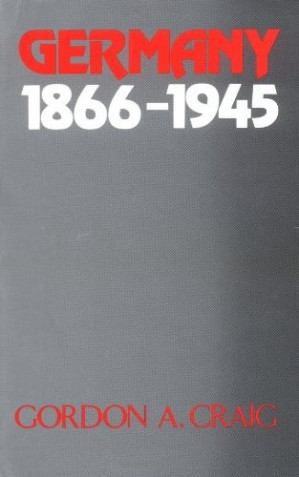
This is the history of the rise and fall of united Germany, which lasted only 75 years from its establishment by Bismark in 1870. Ending in the rubble of Hitler's regime, It is a history of greed, fear, cruelty, and the corruption of power on one hand; of courage, struggle for liberty, and resistance to tyranny on the other. Gordon Craig not only analyses the political structures of and the foreign, social, and economic policies of successive governments, but also examines the individuals who dominated the period and the important intellectual and cultural influences at work. His fascinating chapter on the rich diversity of Weimar culture - Mann and Hesse, Marlene Deitrich and film, Brecht, Schonberg, Expressionist art, and the growth of psychoanalytic theory - is proof enough that this is not an ordinary historybook. It is rather a full and vivid re-creation of a period of history which, as he says, demands the attention of reflective men'.ISBN : 0198221134
Alternative author
by Gordon A. Craig. --
Alternative author
Craig, Gordon A.
Alternative publisher
IRL Press at Oxford University Press
Alternative publisher
Oxford Institute for Energy Studies
Alternative publisher
German Historical Institute London
Alternative publisher
Oxford University Press, USA
Alternative edition
Oxford history of modern Europe, Oxford, New York, 1999
Alternative edition
Oxford history of modern Europe, Oxford, England, 1978
Alternative edition
Oxford University Press paperback, Oxford, 1980
Alternative edition
United Kingdom and Ireland, United Kingdom
Alternative edition
March 6, 1980
Alternative edition
1, PS, 1980
Alternative edition
1st, 1978
metadata comments
Includes bibliographical references (p. [744]-809) and index.
metadata comments
Bibliography: p. [774]-809. *** Includes index. 6
metadata comments
Bibliography: p. [774]-809. Includes index.
Alternative description
G.A. Craig, author of several distinguished books including The Politics of the Prussian Army 1640-1945 ('55), has written a magisterial history of Germany from Prussia's 1866 triumph over Austria at Koeniggroetz to the destruction of the 3rd Reich in 1945. His story focuses upon the two dominating personalities of the period: Bismarck, the "great star" whose genius & penetration are undeniable, but whose achievement "had its 'night side' as well as its 'day side,'" & Hitler, who, unlike the Iron Chancellor, was "sui generis a force without a real historical past." Craig agrees with Dahrendorf (Society & Democracy in Germany) that, paradoxically, it was precisely because he lacked roots in tradition that Hitler could destroy the major obstacle to its progress towards a liberal modernity--"the conservative-militaristic concern that had dominated politics in the Wilhelmine period, done everything possible to shorten the life of the Weimar Republic & elevated him to power in 1933." The concentration on these two figures in no way represents a failure to appreciate institutional, economic & social factors of development. A major part of the story--the place & treatment of women under the Empire, Weimar & Hitler--receives an overdue coherent treatment as do religion & education. Craig (J.E. Wallace Sterling Professor of the Humanities, Stanford) displays an equally keen appreciation of the role of culture. In particular, he forcefully portrays the flight from political responsibility which was characteristic of most artists & intellectuals under the Empire & which marred the splendid cultural achievements of Weimar as well. The combination of his learning with his gracefully lucid style has yielded a work of historical synthesis more readable & better organized than any book of comparable scope.--Kirkus (edited)
Alternative description
Isbn 0195027248 Lccn 784871. The Unification Of Germany, 1866-1871 -- The Institutional Structure Of The Empire -- The Consolidation Of The Empire : Politics And Economics, 1871-1879 -- Ideology And Interest : The Limitations Of Diplomacy, 1871-1890 -- The Campaign Against Social Democracy And Bismarck's Fall, 1879-1890 -- Religion, Education, And The Arts -- The New Course And The Deterioration Of Germany's Foreign Position, 1890-1897 -- Political Parties, Interest Groups, And The Failure Of The Reichstag, 1890-1914 -- Weltpolitik, Navalism, And The Coming Of The War, 1897-1914 -- The Great War, 1914-1918 -- From Kiel To Kapp : The Aborted Revolution, 1918-1920 -- Reparations, Inflation, And The Crisis Of 1923 -- Weimar Culture -- Party Politics And Foreign Policy, 1924-1930 -- The End Of Weimar -- The Nazi Dictatorship : The Instruments Of Power -- The Nazi Revolution : Economic And Social Developments -- Cultural Decline And Political Resistance -- Hitler And Europe : Foreign Policy, 1933-1939 -- Hitler's War, 1939-1945. By Gordon A. Craig. Includes Index. Bibliography: P. [774]-809.
Alternative description
The history of the rise and fall of united Germany, which lasted only 75 years from its establishment by Bismark in 1870. The author not only analyzes the political structures and foreign, social and economic policies of successive governments, but also examines the individuals who dominated.
Alternative description
A history of the rise and fall of united Germany, which lasted only 75 years from its establishment by Bismark in 1870. Suitable for A Level and upwards. In the OXFORD HISTORY OF MODERN EUROPE series
Server Path:g6/zlib3_files/20250119/annas_archive_data__aacid__zlib3_files__20250119T215504Z--20250119T215505Z/aacid__zlib3_files__20250119T215504Z__40610886__gfyjwSyaoJWptR9EH5aGMT
All download options have the same file, and should be safe to use. That said, always be cautious when downloading files from the internet, especially from sites external to Anna’s Archive. For example, be sure to keep your devices updated.
Support authors and libraries
✍️ If you like this and can afford it, consider buying the original, or supporting the authors directly.
📚 If this is available at your local library, consider borrowing it for free there.
📂 File quality
Help out the community by reporting the quality of this file! 🙌
A “file MD5” is a hash that gets computed from the file contents, and is reasonably unique based on that content. All shadow libraries that we have indexed on here primarily use MD5s to identify files.
A file might appear in multiple shadow libraries. For information about the various datasets that we have compiled, see the Datasets page.