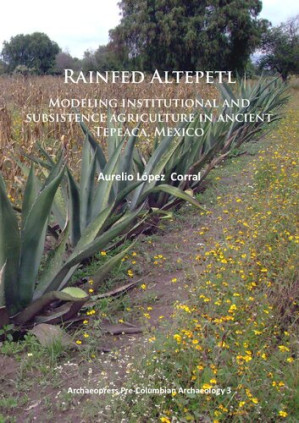
Rainfed Altepetl : Modeling Institutional and Subsistence Agriculture in Ancient Tepeaca, Mexico 🔍
Aurelio López Corral
Archaeopress Publishing Ltd, Archaeopress Publishing Ltd, Oxford, 2014
English [en] · PDF · 6.6MB · 2014 · 📘 Book (non-fiction) · 🚀/lgli/lgrs/nexusstc/upload/zlib · Save
description
Climate variability and human management strategies on crop stands were major factors that frequently affected agricultural yields among indigenous populations from central Mexico. This work seeks to model food production in ancient Tepeaca, a Late Postclassic (AD 1325-1521) and Early Colonial (16th century) state level-polity settled on the central highlands of Puebla, by applying a model that recognizes the presence of two independent and interconnected forms of food production: subsistence agriculture and institutional agriculture. Crop stands within this region depended heavily on rainfed conditions, a form of agriculture that often generates unstable interannual fluctuations in yields. Archaeology acknowledges the effects of such variations on the economy of households and institutions, but attention has been largely put on estimating average productivity values over long periods rather than focusing on interannual divergences. Such instability of agricultural production was recorded among modern Tepeaca's agriculturalists through an ethnographic survey. This crucial information, along with archaeological data and local 16th century historical sources, is used for modeling the effects of climate variability among prehispanic populations and serves to better comprehend the organization of past agrarian structures, tribute systems and land tenure organization at the household and regional levels.
Alternative filename
nexusstc/Rainfed Altepetl: Modeling institutional and subsistence agriculture in ancient Tepeaca, Mexico/5a1fd15e33e8a018f580c968e1a6ed6f.pdf
Alternative filename
lgrsnf/Rainfed Altepetl_ Modeling institutional a - Aurelio Lopez.pdf
Alternative author
Aurelio López Corral; Archaeopress
Alternative author
Aurelio López,Corral,Corral
Alternative author
López Corral, Aurelio;
Alternative publisher
Archaeopress Access Archaeology
Alternative edition
Archaeopress Pre-Columbian archaeology, Oxford, [U.K, 2014
Alternative edition
Archaeopress pre-Columbian archaeology, 3, Oxford, 2014
Alternative edition
United Kingdom and Ireland, United Kingdom
Alternative edition
Place of publication not identified, 2014
Alternative edition
1, 2014-12-31
metadata comments
lg3000104
metadata comments
producers:
Adobe PDF Library 10.0.1
Adobe PDF Library 10.0.1
metadata comments
{"isbns":["1784910406","1784910414","9781784910402","9781784910419"],"last_page":157,"publisher":"Archaeopress Publishing Ltd"}
Alternative description
Climate variability and human management strategies on crop stands were major factors that frequently affected agricultural yields among indigenous populations from central Mexico. This work seeks to model food production in ancient Tepeaca, a Late Postclassic (AD 1325-1521) and Early Colonial (16th century) state level-polity settled on the central highlands of Puebla, by applying a model that recognizes the presence of two independent and interconnected forms of food production: subsistence agriculture and institutional agriculture. Crop stands within this region depended heavily on rainfed conditions, a form of agriculture that often generates unstable interannual fluctuations in yields. Archaeology acknowledges the effects of such variations on the economy of households and institutions, but attention has been largely put on estimating average productivity values over long periods rather than focusing on interannual divergences. Such instability of agricultural production was recorded among modern Tepeaca’s agriculturalists through an ethnographic survey. This crucial information, along with archaeological data and local 16th century historical sources, is used for modeling the effects of climate variability among prehispanic populations and serves to better comprehend the organization of past agrarian structures, tribute systems and land tenure organization at the household and regional levels.
Book cover 1
Title 3
Copyright page 4
Contents 5
Chapter 1
Introduction 7
The goals of this work 7
Late Postclassic Tepeaca agriculture: a dualistic model 8
Studying agricultural production variability at the household and regional level 9
Regional agricultural production variation in Tepeaca: an ethnographic work 11
Chapter organization and content 13
Chapter 2
Agriculture And Theory 14
Subsistence agriculture 14
Institutional agriculture 18
Environmental and cultural variables that affect agricultural production 19
Soils and sediments 19
Water availability 19
Climate variability 20
Agro-ecological variables that affect agricultural production 21
Plant Sowing Densities and Farming Strategies 21
Cultural factors that affect agricultural production 22
Mesoamerican agriculture: rainfed dependent and artificially supplied water system 24
Agricultural food shortage 25
Chapter 3
The Natural Setting 27
The Tepeaca valley region 30
The Llanos de San Juan 33
The Puebla-Tlaxcala valley 34
Chapter 4
Regional History and the Tepeaca Altepetl 36
Tepeaca and the Puebla-Tlaxcala valley during the Postclassic 36
Regional history and the origins of the Tepeaca altepetl 36
Social structure in Tepeaca and the Puebla-Tlaxcala valley in the 16th century AD 39
Chapter 5
Traditional Agriculture in the Study Region 42
Stages and work in the agricultural cycle 42
Field preparation 42
Furrowing and sowing 43
Animal manure fertilization 45
Seed selection 45
Chemical fertilization 46
Primera, segunda and tercera labor (first, second and third labor) 46
Re-sowing 46
Second weeding 46
Harvest 47
Maize stalk upper portion removal 47
Storage 47
Other aspects of local agriculture 48
The use of High Yield Varieties (HYV’s) 48
Final remarks regarding modern agriculture in the study region 49
Chapter 6
Agricultural Production for the Year 2009:
the Ethnographic Survey 51
Part one: the household survey 52
Methodology 52
Measuring maize production 54
Problems using weight measurement 54
Volume as an alternative option for determining production 55
Calculation of maize production per hectare 56
Length of the cob and weight of the dry kernel 56
Length of the ear and weight of the dry kernel 56
Initial plant densities, survival plant densities and total productivity 58
Result 59
Production from the surveyed field 60
Soils and production 60
Rain patterns and the 2009 canícula drought 63
Other negative phenomenon 66
Types of rain 69
Work inputs to field 69
Second part: regional agricultural productivity in the Tepeaca region 69
The 2009 maize production in the study region 72
Maize yields in the study region according to land class 73
Methodology 73
Maize yields according to municipio 76
The Llanos de San Juan 76
The Puebla-Tlaxcala valley 76
The Tepeaca valley 76
Differential sowing and harvest within the region 78
Chapter 7
From Prehispanic Macehualli to Colonial Terrazgueros 81
Chichimec conquests in the Cuauhtinchan-Tepeaca region 82
The prehispanic macehualli 82
Colonial macehualli and terrazguero 84
Chapter 8
Agricultural Productivity and Tribute in 16th Century AD Tepeaca 86
Land allotment and agricultural tribute in Early Colonial Tepeaca 86
Land tenure in Early Colonial Tepeaca 86
The braza and the nehuitzantli 87
Types of length measures in Tepeaca 87
The indigenous rod or tlalquahuitl 89
The size of agricultural plot 90
Production capacity at the subsistence and institutional agriculture level 90
Institutional agriculture production 91
Subsistence agriculture production 94
Maize production within macehualli/terrazguero households 94
Buffering strategies against climatic variability 96
Field dispersion 96
Agricultural intensification 98
The marketplace 98
Summary 102
Chapter 9
Conclusions and Directions for Future Research 103
Modeling agricultural productivity in ancient Tepeaca 103
Identifying buffering strategies against cyclical food shortfall 104
The dual agricultural economic structure of the Tepeaca altepetl 106
Directions for future research 107
References 109
Appendix
2009 Ethnographic Survey:
Field Registers 121
Altepetl,Mexico,Late Postclassic,Tepeaca,Early Colonial,agriculture,crop yield,modelling,subsitence
Book cover 1
Title 3
Copyright page 4
Contents 5
Chapter 1
Introduction 7
The goals of this work 7
Late Postclassic Tepeaca agriculture: a dualistic model 8
Studying agricultural production variability at the household and regional level 9
Regional agricultural production variation in Tepeaca: an ethnographic work 11
Chapter organization and content 13
Chapter 2
Agriculture And Theory 14
Subsistence agriculture 14
Institutional agriculture 18
Environmental and cultural variables that affect agricultural production 19
Soils and sediments 19
Water availability 19
Climate variability 20
Agro-ecological variables that affect agricultural production 21
Plant Sowing Densities and Farming Strategies 21
Cultural factors that affect agricultural production 22
Mesoamerican agriculture: rainfed dependent and artificially supplied water system 24
Agricultural food shortage 25
Chapter 3
The Natural Setting 27
The Tepeaca valley region 30
The Llanos de San Juan 33
The Puebla-Tlaxcala valley 34
Chapter 4
Regional History and the Tepeaca Altepetl 36
Tepeaca and the Puebla-Tlaxcala valley during the Postclassic 36
Regional history and the origins of the Tepeaca altepetl 36
Social structure in Tepeaca and the Puebla-Tlaxcala valley in the 16th century AD 39
Chapter 5
Traditional Agriculture in the Study Region 42
Stages and work in the agricultural cycle 42
Field preparation 42
Furrowing and sowing 43
Animal manure fertilization 45
Seed selection 45
Chemical fertilization 46
Primera, segunda and tercera labor (first, second and third labor) 46
Re-sowing 46
Second weeding 46
Harvest 47
Maize stalk upper portion removal 47
Storage 47
Other aspects of local agriculture 48
The use of High Yield Varieties (HYV’s) 48
Final remarks regarding modern agriculture in the study region 49
Chapter 6
Agricultural Production for the Year 2009:
the Ethnographic Survey 51
Part one: the household survey 52
Methodology 52
Measuring maize production 54
Problems using weight measurement 54
Volume as an alternative option for determining production 55
Calculation of maize production per hectare 56
Length of the cob and weight of the dry kernel 56
Length of the ear and weight of the dry kernel 56
Initial plant densities, survival plant densities and total productivity 58
Result 59
Production from the surveyed field 60
Soils and production 60
Rain patterns and the 2009 canícula drought 63
Other negative phenomenon 66
Types of rain 69
Work inputs to field 69
Second part: regional agricultural productivity in the Tepeaca region 69
The 2009 maize production in the study region 72
Maize yields in the study region according to land class 73
Methodology 73
Maize yields according to municipio 76
The Llanos de San Juan 76
The Puebla-Tlaxcala valley 76
The Tepeaca valley 76
Differential sowing and harvest within the region 78
Chapter 7
From Prehispanic Macehualli to Colonial Terrazgueros 81
Chichimec conquests in the Cuauhtinchan-Tepeaca region 82
The prehispanic macehualli 82
Colonial macehualli and terrazguero 84
Chapter 8
Agricultural Productivity and Tribute in 16th Century AD Tepeaca 86
Land allotment and agricultural tribute in Early Colonial Tepeaca 86
Land tenure in Early Colonial Tepeaca 86
The braza and the nehuitzantli 87
Types of length measures in Tepeaca 87
The indigenous rod or tlalquahuitl 89
The size of agricultural plot 90
Production capacity at the subsistence and institutional agriculture level 90
Institutional agriculture production 91
Subsistence agriculture production 94
Maize production within macehualli/terrazguero households 94
Buffering strategies against climatic variability 96
Field dispersion 96
Agricultural intensification 98
The marketplace 98
Summary 102
Chapter 9
Conclusions and Directions for Future Research 103
Modeling agricultural productivity in ancient Tepeaca 103
Identifying buffering strategies against cyclical food shortfall 104
The dual agricultural economic structure of the Tepeaca altepetl 106
Directions for future research 107
References 109
Appendix
2009 Ethnographic Survey:
Field Registers 121
Altepetl,Mexico,Late Postclassic,Tepeaca,Early Colonial,agriculture,crop yield,modelling,subsitence
date open sourced
2021-04-29
🚀 Fast downloads
Become a member to support the long-term preservation of books, papers, and more. To show our gratitude for your support, you get fast downloads. ❤️
- Fast Partner Server #1 (recommended)
- Fast Partner Server #2 (recommended)
- Fast Partner Server #3 (recommended)
- Fast Partner Server #4 (recommended)
- Fast Partner Server #5 (recommended)
- Fast Partner Server #6 (recommended)
- Fast Partner Server #7
- Fast Partner Server #8
- Fast Partner Server #9
- Fast Partner Server #10
- Fast Partner Server #11
- Fast Partner Server #12
🐢 Slow downloads
From trusted partners. More information in the FAQ. (might require browser verification — unlimited downloads!)
- Slow Partner Server #1 (slightly faster but with waitlist)
- Slow Partner Server #2 (slightly faster but with waitlist)
- Slow Partner Server #3 (slightly faster but with waitlist)
- Slow Partner Server #4 (slightly faster but with waitlist)
- Slow Partner Server #5 (no waitlist, but can be very slow)
- Slow Partner Server #6 (no waitlist, but can be very slow)
- Slow Partner Server #7 (no waitlist, but can be very slow)
- Slow Partner Server #8 (no waitlist, but can be very slow)
- Slow Partner Server #9 (no waitlist, but can be very slow)
- After downloading: Open in our viewer
All download options have the same file, and should be safe to use. That said, always be cautious when downloading files from the internet, especially from sites external to Anna’s Archive. For example, be sure to keep your devices updated.
External downloads
-
For large files, we recommend using a download manager to prevent interruptions.
Recommended download managers: JDownloader -
You will need an ebook or PDF reader to open the file, depending on the file format.
Recommended ebook readers: Anna’s Archive online viewer, ReadEra, and Calibre -
Use online tools to convert between formats.
Recommended conversion tools: CloudConvert and PrintFriendly -
You can send both PDF and EPUB files to your Kindle or Kobo eReader.
Recommended tools: Amazon‘s “Send to Kindle” and djazz‘s “Send to Kobo/Kindle” -
Support authors and libraries
✍️ If you like this and can afford it, consider buying the original, or supporting the authors directly.
📚 If this is available at your local library, consider borrowing it for free there.
Total downloads:
A “file MD5” is a hash that gets computed from the file contents, and is reasonably unique based on that content. All shadow libraries that we have indexed on here primarily use MD5s to identify files.
A file might appear in multiple shadow libraries. For information about the various datasets that we have compiled, see the Datasets page.
For information about this particular file, check out its JSON file. Live/debug JSON version. Live/debug page.