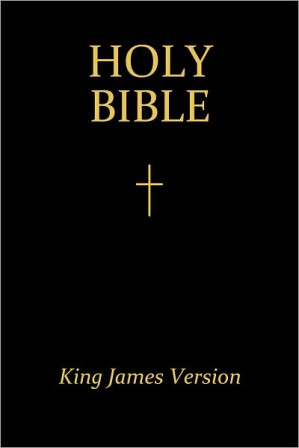
The Holy Bible (King James Version) 🔍
ravenger
1611
English [en] · FB2 · 4.7MB · 1611 · 📘 Book (non-fiction) · 🚀/lgli/zlib · Save
description
Traditionally loved and accepted by all Christians, the King James Version was the first version of Scripture authorized by the Protestant church. Commissioned by England’s King James I, three panels of scholars drew upon the work of early translators and versions of Hebrew and Greek manuscripts available at that time. Purpose in translation was "to deliver God's book unto God's people in a tongue which they can understand." Timeless treasure. In 1603 James I, already king of Scotland, ascended to the throne of England. He was presented with a petition containing grievances of the Puritan party. A conference was called at Hampton Court in 1604 to hear the complaints. At this conference Dr. John Reynolds, an Oxford scholar and Puritan leader, raised the subject of the imperfections of available Bibles. King James became interested in the idea of a new translation completed by university scholars, reviewed by bishops, and ratified by King James himself. James was displeased with the Geneva Bible, which he felt undermined the theory of divine right of kings and contained marginal notes that made it unacceptable to church leaders. King James appointed 6 panels of translators (about 50 men) to revise and translate assigned portions of the Old Testament, Apocrypha (which was at the time included in all Bibles), and the New Testament. The completed work was reviewed by a group of 12, consisting of 2 men from each panel, after which the work was sent to bishops and leading churchmen for approval. Among the translators were some of the finest scholars of the day. The revisers/translators, while not paid for their efforts, were granted free room and board. The Bishops’ Bible was used as the basis for this revision/translation, but it was also examined in the light of Hebrew and Greek documents, as well as compared with all other contemporary translations in various European languages. The work began in 1607, and in 1611 the new Bible was published. The Authorized Version — commonly referred to in America as the King James Version (KJV) — was dedicated to King James. The AV was printed three times during the year of initial publication. The early editions contained a significant number of misprints and variations in wording and spelling. During the course of time the spelling in the earlier editions was modified, the chapter summaries were reduced, and the marginal references expanded. Revisions were made in 1613, 1629, and 1638, but it was the revisions made at Cambridge in 1762 and at Oxford in 1769 that modernized its spelling so that it may be read with relative ease in our day.
metadata comments
librusecid_303682
date open sourced
2016-01-20
🚀 Fast downloads
Become a member to support the long-term preservation of books, papers, and more. To show our gratitude for your support, you get fast downloads. ❤️
- Fast Partner Server #1 (recommended)
- Fast Partner Server #2 (recommended)
- Fast Partner Server #3 (recommended)
- Fast Partner Server #4 (recommended)
- Fast Partner Server #5 (recommended)
- Fast Partner Server #6 (recommended)
- Fast Partner Server #7
- Fast Partner Server #8
- Fast Partner Server #9
- Fast Partner Server #10
- Fast Partner Server #11
- Fast Partner Server #12
- Fast Partner Server #13
- Fast Partner Server #14
- Fast Partner Server #15
- Fast Partner Server #16
- Fast Partner Server #17
- Fast Partner Server #18
- Fast Partner Server #19
- Fast Partner Server #20
- Fast Partner Server #21
- Fast Partner Server #22
- Fast Partner Server #23
- Fast Partner Server #24
🐢 Slow downloads
From trusted partners. More information in the FAQ. (might require browser verification — unlimited downloads!)
- Slow Partner Server #1 (slightly faster but with waitlist)
- Slow Partner Server #2 (slightly faster but with waitlist)
- Slow Partner Server #3 (slightly faster but with waitlist)
- Slow Partner Server #4 (slightly faster but with waitlist)
- Slow Partner Server #5 (no waitlist, but can be very slow)
- Slow Partner Server #6 (no waitlist, but can be very slow)
- Slow Partner Server #7 (no waitlist, but can be very slow)
- Slow Partner Server #8 (no waitlist, but can be very slow)
- Slow Partner Server #9 (no waitlist, but can be very slow)
- Slow Partner Server #10 (slightly faster but with waitlist)
- Slow Partner Server #11 (slightly faster but with waitlist)
- Slow Partner Server #12 (slightly faster but with waitlist)
- Slow Partner Server #13 (slightly faster but with waitlist)
- Slow Partner Server #14 (no waitlist, but can be very slow)
- Slow Partner Server #15 (no waitlist, but can be very slow)
- Slow Partner Server #16 (no waitlist, but can be very slow)
- Slow Partner Server #17 (no waitlist, but can be very slow)
- Slow Partner Server #18 (no waitlist, but can be very slow)
- After downloading: Open in our viewer
All download options have the same file, and should be safe to use. That said, always be cautious when downloading files from the internet, especially from sites external to Anna’s Archive. For example, be sure to keep your devices updated.
External downloads
-
For large files, we recommend using a download manager to prevent interruptions.
Recommended download managers: JDownloader -
You will need an ebook or PDF reader to open the file, depending on the file format.
Recommended ebook readers: Anna’s Archive online viewer, ReadEra, and Calibre -
Use online tools to convert between formats.
Recommended conversion tools: CloudConvert and PrintFriendly -
You can send both PDF and EPUB files to your Kindle or Kobo eReader.
Recommended tools: Amazon‘s “Send to Kindle” and djazz‘s “Send to Kobo/Kindle” -
Support authors and libraries
✍️ If you like this and can afford it, consider buying the original, or supporting the authors directly.
📚 If this is available at your local library, consider borrowing it for free there.
Total downloads:
A “file MD5” is a hash that gets computed from the file contents, and is reasonably unique based on that content. All shadow libraries that we have indexed on here primarily use MD5s to identify files.
A file might appear in multiple shadow libraries. For information about the various datasets that we have compiled, see the Datasets page.
For information about this particular file, check out its JSON file. Live/debug JSON version. Live/debug page.