nexusstc/Someone: The Pragmatics of Misfit Sexualities, from Colette to Hervé Guibert/62d7c7b3d796a71a3fc8dbdb2ec3c0cf.pdf
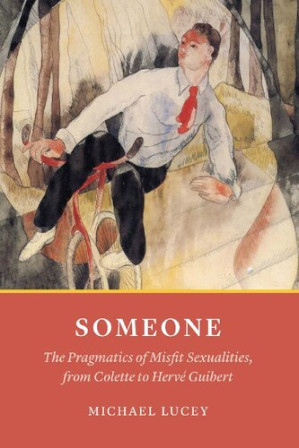
Someone : The Pragmatics of Misfit Sexualities, From Colette to Hervé Guibert 🔍
Professor Michael Lucey
The University of Chicago Press, University of Chicago Press, Chicago, 2019
English [en] · PDF · 2.3MB · 2019 · 📘 Book (non-fiction) · 🚀/lgli/lgrs/nexusstc/zlib · Save
description
Imagine trying to tell someone something about yourself and your desires for which there are no words. What if the mere attempt at expression was bound to misfire, to efface the truth of that ineluctable something?
In __Someone__, Michael Lucey considers characters from twentieth-century French literary texts whose sexual forms prove difficult to conceptualize or represent. The characters expressing these “misfit” sexualities gravitate towards same-sex encounters. Yet they differ in subtle but crucial ways from mainstream gay or lesbian identities—whether because of a discordance between gender identity and sexuality, practices specific to a certain place and time, or the fleetingness or non-exclusivity of desire. Investigating works by Simone de Beauvoir, Colette, Jean Genet, and others, Lucey probes both the range of same-sex sexual forms in twentieth-century France and the innovative literary language authors have used to explore these evanescent forms.
As a portrait of fragile sexualities that involve awkward and delicate maneuvers and modes of articulation, __Someone__ reveals just how messy the ways in which we experience and perceive sexuality remain, even to ourselves.
In __Someone__, Michael Lucey considers characters from twentieth-century French literary texts whose sexual forms prove difficult to conceptualize or represent. The characters expressing these “misfit” sexualities gravitate towards same-sex encounters. Yet they differ in subtle but crucial ways from mainstream gay or lesbian identities—whether because of a discordance between gender identity and sexuality, practices specific to a certain place and time, or the fleetingness or non-exclusivity of desire. Investigating works by Simone de Beauvoir, Colette, Jean Genet, and others, Lucey probes both the range of same-sex sexual forms in twentieth-century France and the innovative literary language authors have used to explore these evanescent forms.
As a portrait of fragile sexualities that involve awkward and delicate maneuvers and modes of articulation, __Someone__ reveals just how messy the ways in which we experience and perceive sexuality remain, even to ourselves.
Alternative filename
lgli/Lucey - Someone.pdf
Alternative filename
lgrsnf/Lucey - Someone.pdf
Alternative title
Someone : The Pragmatics of Misfit Sexualities, from Colette to Hervé Guibert
Alternative author
Lucey, Professor Michael
Alternative publisher
Chicago University Press
Alternative edition
United States, United States of America
Alternative edition
First, First Edition, US, 2019
Alternative edition
Chicago, IL, 2019
Alternative edition
Apr 04, 2019
metadata comments
lg2494470
metadata comments
{"isbns":["022660618X","022660621X","022660635X","2018028776","9780226606187","9780226606217","9780226606354"],"last_page":344,"publisher":"University of Chicago Press"}
metadata comments
Source title: Someone: The Pragmatics of Misfit Sexualities, from Colette to Hervé Guibert
Alternative description
<p>Imagine trying to tell someone something about yourself and your desires for which there are no words. What if the mere attempt at expression was bound to misfire, to efface the truth of that ineluctable something?In Someone, Michael Lucey considers characters from twentieth-century French literary texts whose sexual forms prove difficult to conceptualize or represent. The characters expressing these "misfit" sexualities gravitate towards same-sex encounters. Yet they differ in subtle but crucial ways from mainstream gay or lesbian identities—whether because of a discordance between gender identity and sexuality, practices specific to a certain place and time, or the fleetingness or non-exclusivity of desire. Investigating works by Simone de Beauvoir, Colette, Jean Genet, and others, Lucey probes both the range of same-sex sexual forms in twentieth-century France and the innovative literary language authors have used to explore these evanescent forms.As a portrait of fragile sexualities that involve awkward and delicate maneuvers and modes of articulation, Someone reveals just how messy the ways in which we experience and perceive sexuality remain, even to ourselves.<br></p>
Alternative description
Imagine trying to tell someone something about yourself and your desires for which there are no words. What if the mere attempt at expression was bound to misfire, to efface the truth of that ineluctable something? In Someone, Michael Lucey considers characters from twentieth-century French literary texts whose sexual forms prove difficult to conceptualize or represent. The characters expressing these "misfit" sexualities gravitate towards same-sex encounters. Yet they differ in subtle but crucial ways from mainstream gay or lesbian identities - whether because of a discordance between gender identity and sexuality, practices specific to a certain place and time, or the fleetingness or non-exclusivity of desire. Investigating works by Simone de Beauvoir, Colette, Jean Genet, and others, Lucey probes both the range of same-sex sexual forms in twentieth-century France and the innovative literary language authors have used to explore these evanescent forms. As a portrait of fragile sexualities that involve awkward and delicate maneuvers and modes of articulation, Someone reveals just how messy the ways in which we experience and perceive sexuality remain, even to ourselves
Alternative description
Epigraphs
Contents
Introduction: Roadmap to Someone
1 Colette and (Un)intelligibility
2 Sexuality and the Literary Field
3 Metapragmatics, Sexuality, and the Novel: Reading Jean Genet’s Querelle
4 Simone de Beauvoir and Sexuality in the Third Person
5 The Contexts of Marguerite Duras’s Homophobia
6 Multivariable Social Acrobatics and Misfit Counterpublics: Violette Leduc and Hervé Guibert
7 The Talk of the Town: Sexuality in Three Pinget Novels
Acknowledgments
Notes
Bibliography
Index
Contents
Introduction: Roadmap to Someone
1 Colette and (Un)intelligibility
2 Sexuality and the Literary Field
3 Metapragmatics, Sexuality, and the Novel: Reading Jean Genet’s Querelle
4 Simone de Beauvoir and Sexuality in the Third Person
5 The Contexts of Marguerite Duras’s Homophobia
6 Multivariable Social Acrobatics and Misfit Counterpublics: Violette Leduc and Hervé Guibert
7 The Talk of the Town: Sexuality in Three Pinget Novels
Acknowledgments
Notes
Bibliography
Index
Alternative description
This text explores a set of works from modern French literature that are interested in same-sex sexualities, but versions of those sexualities that fail to correspond to mainstream gay and lesbian identities in a variety of different ways that can be difficult to notice or talk about. The work's seven chapters trace the introduction of the topic of non-mainstream or misfit sexualities into the French literary field
date open sourced
2020-03-29
🚀 Fast downloads
Become a member to support the long-term preservation of books, papers, and more. To show our gratitude for your support, you get fast downloads. ❤️
- Fast Partner Server #1 (recommended)
- Fast Partner Server #2 (recommended)
- Fast Partner Server #3 (recommended)
- Fast Partner Server #4 (recommended)
- Fast Partner Server #5 (recommended)
- Fast Partner Server #6 (recommended)
- Fast Partner Server #7
- Fast Partner Server #8
- Fast Partner Server #9
- Fast Partner Server #10
- Fast Partner Server #11
- Fast Partner Server #12
🐢 Slow downloads
From trusted partners. More information in the FAQ. (might require browser verification — unlimited downloads!)
- Slow Partner Server #1 (slightly faster but with waitlist)
- Slow Partner Server #2 (slightly faster but with waitlist)
- Slow Partner Server #3 (slightly faster but with waitlist)
- Slow Partner Server #4 (slightly faster but with waitlist)
- Slow Partner Server #5 (no waitlist, but can be very slow)
- Slow Partner Server #6 (no waitlist, but can be very slow)
- Slow Partner Server #7 (no waitlist, but can be very slow)
- Slow Partner Server #8 (no waitlist, but can be very slow)
- Slow Partner Server #9 (no waitlist, but can be very slow)
- After downloading: Open in our viewer
All download options have the same file, and should be safe to use. That said, always be cautious when downloading files from the internet, especially from sites external to Anna’s Archive. For example, be sure to keep your devices updated.
External downloads
-
For large files, we recommend using a download manager to prevent interruptions.
Recommended download managers: JDownloader -
You will need an ebook or PDF reader to open the file, depending on the file format.
Recommended ebook readers: Anna’s Archive online viewer, ReadEra, and Calibre -
Use online tools to convert between formats.
Recommended conversion tools: CloudConvert and PrintFriendly -
You can send both PDF and EPUB files to your Kindle or Kobo eReader.
Recommended tools: Amazon‘s “Send to Kindle” and djazz‘s “Send to Kobo/Kindle” -
Support authors and libraries
✍️ If you like this and can afford it, consider buying the original, or supporting the authors directly.
📚 If this is available at your local library, consider borrowing it for free there.
Total downloads:
A “file MD5” is a hash that gets computed from the file contents, and is reasonably unique based on that content. All shadow libraries that we have indexed on here primarily use MD5s to identify files.
A file might appear in multiple shadow libraries. For information about the various datasets that we have compiled, see the Datasets page.
For information about this particular file, check out its JSON file. Live/debug JSON version. Live/debug page.