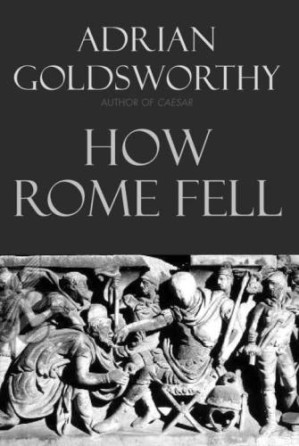
How Rome fell : death of a superpower 🔍
Goldsworthy, Adrian Keith
Yale University Press, 1st Edition, First Edition, PT, 2009
English [en] · EPUB · 5.3MB · 2009 · 📘 Book (non-fiction) · 🚀/lgli/lgrs/nexusstc/zlib · Save
description
Starred Review. At only 40 years of age, British historian Goldsworthys (Caesar) ninth Roman history offers the same high level of scholarship, analysis and lucid prose as the previous eight. After a superb survey of Roman politics and civilization, Goldsworthy begins with the death in A.D. 180 of emperor Marcus Aurelius, whose reign is traditionally viewed as the apex of Roman power. During the disastrous century that followed, emperors rarely ruled more than a few years most were murdered, and civil wars raged, though there was some stability during the reigns of Diocletian and Constantine. Invasions slowly chipped away at the empire until it vanished in A.D. 476 with the abdication of the last Western emperor. Goldsworthy makes sense of 300 years of poorly documented wars, murders and political scheming. Highly opinionated, he presents surviving documents and archeological evidence to back his views such as that Constantine became Christian because Roman leaders traditionally believed that divine help won battles, and the Christian god seemed to Constantine like the front-runner. This richly rewarding work will serve as an introduction to Roman history, but will also provide plenty of depth to satisfy the educated reader.
Alternative filename
lgrsnf/N:\!genesis_\0day\!non_fiction\How Rome Fell_ Death of a Superpower.epub
Alternative filename
nexusstc/How Rome Fell: Death of a Superpower/6bc634ea1214aaa4e5661bcc2308df7c.epub
Alternative author
Adrian Keith Goldsworthy
Alternative publisher
San Francisco Museum of Modern Art
Alternative publisher
Brandywine River Museum
Alternative publisher
Mariners' Museum, The
Alternative edition
Yale University Press, New Haven, CT, 2009
Alternative edition
United States, United States of America
Alternative edition
New Haven, Connecticut, 2009
Alternative edition
First Edition Thus, 2009
Alternative edition
Illustrated, 2010
Alternative edition
Sep 28, 2010
metadata comments
lg2418464
metadata comments
{"edition":"1","isbns":["0300137192","0300164262","9780300137194","9780300164268"],"last_page":674,"publisher":"Yale University Press"}
metadata comments
Includes bibliographical references (p. 449-465) and index.
metadata comments
Source title: How Rome Fell: Death of a Superpower
Alternative description
<p><p>in Ad 200, The Roman Empire Seemed Unassailable. Its Vast Territory Accounted For Most Of The Known World. by The End Of The Fifth Century, Roman Rule Had Vanished In Western Europe And Much Of Northern Africa, And Only A Shrunken Eastern Empire Remained. what Accounts For This Improbable Decline? here, Adrian Goldsworthy Applies The Scholarship, Perspective, And Narrative Skill That Defined His Monumental <i>caesar</i> To Address Perhaps The Greatest Of All Historical Questions—how Rome Fell.<p> <p>it Was A Period Of Remarkable Personalities, From The Philosopher-emperor Marcus Aurelius To Emperors Like Diocletian, Who Portrayed Themselves As Tough, Even Brutal, Soldiers. it Was A Time Of Revolutionary Ideas, Especially In Religion, As Christianity Went From Persecuted Sect To The Religion Of State And Emperors. goldsworthy Pays Particular Attention To The Willingness Of Roman Soldiers To Fight And Kill Each Other. Ultimately, This Is The Story Of How An Empire Without A Serious Rival Rotted From Within, Its Rulers And Institutions Putting Short-term Ambition And Personal Survival Over The Wider Good Of The State.<p> <p>how Rome Fell Is A Brilliant Successor To Goldsworthy's Monumental (<i>the Atlantic</i>) <i>caesar</i>.</p> <h3> The Barnes & Noble Review </h3> <p> There's Been A Steady Stream Of Books About The Fall Of The Roman Empire These Last Few Years. Publishers' Interest Reflects A Popular Perception That There Is Something To Be Learned About Contemporary America From Studying Roman Decline. (are We Rome? Asked One Of The More Egregious Examples -- Exemplifying The Old Adage That If A Title Is A Question It's Because The Answer Is No.) It's A Perception That Runs To The Very Highest Levels Of Government. Adrian Goldsworthy's New <em>how Rome Fell: Death Of A Superpower </em>had Its Origin In His Being Invited To Lecture U.s. Policymakers At A Two-day Conference Devoted To The Historical Strategies And Decline Of Great Powers. Goldsworthy Was Intrigued By The Parallels Encouraged At The Conference, And His Publishers Saw An Opening For The Historian To Figure In The Wider Debate On America In The 21st Century. </p>
Alternative description
In Ad 200, The Roman Empire Seemed Unassailable. Its Vast Territory Accounted For Most Of The Known World. By The End Of The Fifth Century, Roman Rule Had Vanished In Western Europe And Much Of Northern Africa, And Only A Shrunken Eastern Empire Remained. What Accounts For This Improbable Decline? Here, Adrian Goldsworthy Applies The Scholarship, Perspective, And Narrative Skill That Defined His Monumental Caesar To Address Perhaps The Greatest Of All Historical Questions - How Rome Fell. It Was A Period Of Remarkable Personalities, From The Philosopher-emperor Marcus Aurelius To Emperors Like Diocletian, Who Portrayed Themselves As Tough, Even Brutal, Soldiers. It Was A Time Of Revolutionary Ideas, Especially In Religion, As Christianity Went From Persecuted Sect To The Religion Of State And Emperors. Goldsworthy Pays Particular Attention To The Willingness Of Roman Soldiers To Fight And Kill Each Other. Ultimately, This Is The Story Of How An Empire Without A Serious Rival Rotted From Within, Its Rulers And Institutions Putting Short-term Ambition And Personal Survival Over The Wider Good Of The State. -- Publisher Description. The Big Question -- Crisis? : The Third Century. The Kingdom Of Gold ; The Secret Of Empire ; Imperial Women ; King Of Kings ; Barbarians ; The Queen And The Necessary Emperor ; Crisis -- Recovery? : The Fourth Century. The Four : Diocletian And The Tetrarchy ; The Christian ; Rivals ; Enemies ; The Pagan ; Goths ; East And West -- Fall? : The Fifth And Sixth Centuries. Barbarians And Romans : Generals And Rebels ; The Sister And The Eternal City ; The Hun ; Sunset On An Outpost Of Empire ; Emperors, Kings, And Warlords ; West And East ; Rise And Fall -- A Simple Answer -- An Even Simpler Moral. Adrian Goldsworthy. Includes Bibliographical References (p. 449-509) And Index.
Alternative description
A major new history of the fall of the Roman Empire, by the prizewinning author of Caesar
In AD 200, the Roman Empire seemed unassailable, its vast territory accounting for most of the known world. By the end of the fifth century, Roman rule had vanished in western Europe and much of northern Africa, and only a shrunken Eastern Empire remained. In his account of the fall of the Roman Empire, prizewinning author Adrian Goldsworthy examines the painful centuries of the superpowers decline. Bringing history to life through the stories of the men, women, heroes, and villains involved, the author uncovers surprising lessons about the rise and fall of great nations.
This was a period of remarkable personalities, from the philosopher-emperor Marcus Aurelius to emperors like Diocletian, who portrayed themselves as tough, even brutal, soldiers. It was a time of revolutionary ideas, especially in religion, as Christianity went from persecuted sect to the religion of state and emperors. Goldsworthy pays particular attention to the willingness of Roman soldiers to fight and kill each other. Ultimately, this is the story of how an empire without a serious rival rotted from within, its rulers and institutions putting short-term ambition and personal survival over the wider good of the state.
In AD 200, the Roman Empire seemed unassailable, its vast territory accounting for most of the known world. By the end of the fifth century, Roman rule had vanished in western Europe and much of northern Africa, and only a shrunken Eastern Empire remained. In his account of the fall of the Roman Empire, prizewinning author Adrian Goldsworthy examines the painful centuries of the superpowers decline. Bringing history to life through the stories of the men, women, heroes, and villains involved, the author uncovers surprising lessons about the rise and fall of great nations.
This was a period of remarkable personalities, from the philosopher-emperor Marcus Aurelius to emperors like Diocletian, who portrayed themselves as tough, even brutal, soldiers. It was a time of revolutionary ideas, especially in religion, as Christianity went from persecuted sect to the religion of state and emperors. Goldsworthy pays particular attention to the willingness of Roman soldiers to fight and kill each other. Ultimately, this is the story of how an empire without a serious rival rotted from within, its rulers and institutions putting short-term ambition and personal survival over the wider good of the state.
Alternative description
From the publisher: In AD 200, the Roman Empire seemed unassailable, its vast territory accounting for most of the known world. By the end of the fifth century, Roman rule had vanished in Western Europe and much of northern Africa, and only a shrunken Eastern Empire remained. This was a period of remarkable personalities, from the philosopher-emperor Marcus Aurelius to emperors like Diocletian, who portrayed themselves as tough, even brutal, soldiers. It was a time of revolutionary ideas, especially in religion, as Christianity went from persecuted sect to the religion of state and emperors. Ultimately, this is the story of how an empire without a serious rival rotted from within, its rulers and institutions putting short-term ambition and personal survival over the greater good of the state.Formatting issue: Endnote numbers are not linked to endnote text.
Alternative description
Examines the decline of the Roman Empire, from the second to the sixth century, and how internal conflicts and the personal ambitions of its rulers brought about its eventual downfall.
date open sourced
2019-09-25
🚀 Fast downloads
Become a member to support the long-term preservation of books, papers, and more. To show our gratitude for your support, you get fast downloads. ❤️
- Fast Partner Server #1 (recommended)
- Fast Partner Server #2 (recommended)
- Fast Partner Server #3 (recommended)
- Fast Partner Server #4 (recommended)
- Fast Partner Server #5 (recommended)
- Fast Partner Server #6 (recommended)
- Fast Partner Server #7
- Fast Partner Server #8
- Fast Partner Server #9
- Fast Partner Server #10
- Fast Partner Server #11
- Fast Partner Server #12
🐢 Slow downloads
From trusted partners. More information in the FAQ. (might require browser verification — unlimited downloads!)
- Slow Partner Server #1 (slightly faster but with waitlist)
- Slow Partner Server #2 (slightly faster but with waitlist)
- Slow Partner Server #3 (slightly faster but with waitlist)
- Slow Partner Server #4 (slightly faster but with waitlist)
- Slow Partner Server #5 (no waitlist, but can be very slow)
- Slow Partner Server #6 (no waitlist, but can be very slow)
- Slow Partner Server #7 (no waitlist, but can be very slow)
- Slow Partner Server #8 (no waitlist, but can be very slow)
- Slow Partner Server #9 (no waitlist, but can be very slow)
- After downloading: Open in our viewer
All download options have the same file, and should be safe to use. That said, always be cautious when downloading files from the internet, especially from sites external to Anna’s Archive. For example, be sure to keep your devices updated.
External downloads
-
For large files, we recommend using a download manager to prevent interruptions.
Recommended download managers: JDownloader -
You will need an ebook or PDF reader to open the file, depending on the file format.
Recommended ebook readers: Anna’s Archive online viewer, ReadEra, and Calibre -
Use online tools to convert between formats.
Recommended conversion tools: CloudConvert and PrintFriendly -
You can send both PDF and EPUB files to your Kindle or Kobo eReader.
Recommended tools: Amazon‘s “Send to Kindle” and djazz‘s “Send to Kobo/Kindle” -
Support authors and libraries
✍️ If you like this and can afford it, consider buying the original, or supporting the authors directly.
📚 If this is available at your local library, consider borrowing it for free there.
Total downloads:
A “file MD5” is a hash that gets computed from the file contents, and is reasonably unique based on that content. All shadow libraries that we have indexed on here primarily use MD5s to identify files.
A file might appear in multiple shadow libraries. For information about the various datasets that we have compiled, see the Datasets page.
For information about this particular file, check out its JSON file. Live/debug JSON version. Live/debug page.