English [en] · PDF · 17.8MB · 1998 · 📘 Book (non-fiction) · 🚀/lgli/lgrs/nexusstc/zlib · Save
description
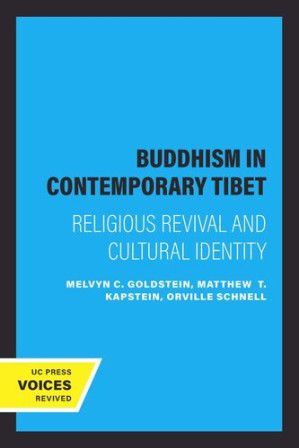
"Following the upheavals of the Cultural Revolution, the People's Republic of China gradually permitted the renewal of religious activity. Tibetans, whose traditional religious and cultural institutions had been decimated during the preceding two decades, took advantage of the decisions of 1978 to begin a Buddhist renewal that is one of the most extensive and dramatic examples of religious revitalization in contemporary China. The nature of that revival is the focus of this book. Four leading specialists in Tibetan anthropology and religion conducted case studies in the Tibet autonomous region and among the Tibetans of Sichuan and Qinghai provinces. There they observed the revival of the Buddhist heritage in monastic communities and among laypersons at popular pilgrimages and festivals. Demonstrating how that revival must contend with tensions between the Chinese state and aspirations for greater Tibetan autonomy, the authors discuss ways that Tibetan Buddhists are restructuring their religion through a complex process of social, political, and economic adaptation. Buddhism has long been the main source of Tibetans' pride in their culture and country. These essays reveal the vibrancy of that ancient religion in contemporary Tibet and also the problems that religion and Tibetan culture in general are facing in a radically altered world."--Back cover
Alternative filename
lgli/10.1525_9780520920057.pdf
Alternative filename
lgrsnf/10.1525_9780520920057.pdf
Alternative author
Melvyn C. Goldstein, Matthew T. Kapstein, Orville Schnell, Matthew T. Kapstein, Matthew Kapstein
Alternative author
Melvyn C. Goldstein (editor); Matthew T. Kapstein (editor)
Alternative author
Goldstein, Melvyn C.; Kapstein, Matthew T.
Alternative edition
University of California Press, Berkeley, 1998
Alternative edition
United States, United States of America
Alternative edition
1, Berkeley, Los Angeles; London, 2023
Alternative edition
Reprint 2019, Berkeley, CA, 1998
Alternative edition
Reprint 2019, 2023
metadata comments
{"edition":"reprint 2019","isbns":["0520920058","9780520920057"],"last_page":235,"publisher":"University of California Press"}
Alternative description
Following the upheavals of the Cultural Revolution, the People's Republic of China gradually permitted the renewal of religious activity. Tibetans, whose traditional religious and cultural institutions had been decimated during the preceding two decades, took advantage of the decisions of 1978 to begin a Buddhist renewal that is one of the most extensive and dramatic examples of religious revitalization in contemporary China. The nature of that revival is the focus of this book. Four leading specialists in Tibetan anthropology and religion conducted case studies in the Tibet autonomous region and among the Tibetans of Sichuan and Qinghai provinces. There they observed the revival of the Buddhist heritage in monastic communities and among laypersons at popular pilgrimages and festivals. Demonstrating how that revival must contend with tensions between the Chinese state and aspirations for greater Tibetan autonomy, the authors discuss ways that Tibetan Buddhists are restructuring their religion through a complex process of social, political, and economic adaptation. Buddhism has long been the main source of Tibetans'pride in their culture and country. These essays reveal the vibrancy of that ancient religion in contemporary Tibet and also the problems that religion and Tibetan culture in general are facing in a radically altered world.This title is part of UC Press's Voices Revived program, which commemorates University of California Press's mission to seek out and cultivate the brightest minds and give them voice, reach, and impact. Drawing on a backlist dating to 1893, Voices Revived makes high-quality, peer-reviewed scholarship accessible once again using print-on-demand technology. This title was originally published in 1998.Following the upheavals of the Cultural Revolution, the People's Republic of China gradually permitted the renewal of religious activity. Tibetans, whose traditional religious and cultural institutions had been decimated during the preceding two decades, </DIV
Repository ID for the 'libgen' repository in Libgen.li. Directly taken from the 'libgen_id' field in the 'files' table. Corresponds to the 'thousands folder' torrents.
Repository ID for the non-fiction ('libgen') repository in Libgen.rs. Directly taken from the 'id' field in the 'updated' table. Corresponds to the 'thousands folder' torrents.
Repository ID for the non-fiction ('libgen') repository in Libgen.rs. Directly taken from the 'id' field in the 'updated' table. Corresponds to the 'thousands folder' torrents.
All download options have the same file, and should be safe to use. That said, always be cautious when downloading files from the internet, especially from sites external to Anna’s Archive. For example, be sure to keep your devices updated.
Support authors and libraries
✍️ If you like this and can afford it, consider buying the original, or supporting the authors directly.
📚 If this is available at your local library, consider borrowing it for free there.
📂 File quality
Help out the community by reporting the quality of this file! 🙌
A “file MD5” is a hash that gets computed from the file contents, and is reasonably unique based on that content. All shadow libraries that we have indexed on here primarily use MD5s to identify files.
A file might appear in multiple shadow libraries. For information about the various datasets that we have compiled, see the Datasets page.