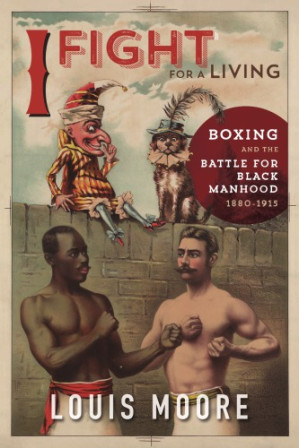
I Fight for a Living: Boxing and the Battle for Black Manhood, 1880-1915 (Sport and Society) 🔍
Louis Moore
University of Illinois Press, Hardcover, 2017
English [en] · PDF · 2.9MB · 2017 · 📘 Book (non-fiction) · 🚀/lgli/lgrs/nexusstc/upload/zlib · Save
description
At its heart, I Fight for a Living is a book about black men who came of age in the Reconstruction and early Jim Crow era--a time when the remaking of white manhood was at its most intense, placing vigor and physicality at the center of the construction of manliness. The book uses the stories of black fighters’ lives, from 1880 to 1915, to explore how working-class black men used prizefighting and the sporting culture to assert their manhood in a country that denied their equality, and to examine the reactions by the black middle class and white middle class toward these black fighters. Through these stories, the book explores how the assertion of this working-class manliness confronted American ideas of race and manliness. While other works on black fighters have explored black boxers as individuals, this book seeks to study these men as a collective group while providing a localized and racialized response to black working-class manhood. It was a tough bargain to risk one’s body to prove manhood, but black men across the globe took that chance.
Alternative filename
nexusstc/I Fight for a Living: Boxing and the Battle for Black Manhood, 1880-1915/70e3ce67b5d3f5d15d4e3e06d9bcfe4d.pdf
Alternative filename
lgli/Louis Moore-I Fight for a Living_Boxing and the Battle for Black Manhood, 1880-1915-University of Illinois Press (2017).pdf
Alternative filename
lgrsnf/Louis Moore-I Fight for a Living_Boxing and the Battle for Black Manhood, 1880-1915-University of Illinois Press (2017).pdf
Alternative title
I Fight for a Living: Boxing and the Battle for Black Manhood, 1880 - 1915
Alternative author
Moore, Louis
Alternative edition
University of Illinois Press, Urbana, 2017
Alternative edition
United States, United States of America
Alternative edition
Sport and society, Baltimore, 2017
Alternative edition
Sport and society, Urbana, 2017
Alternative edition
Sport and society, Urbana, 2018
Alternative edition
Illustrated, 2017
Alternative edition
Sep 11, 2017
Alternative edition
1, PT, 2017
Alternative edition
2017-09-15
metadata comments
0
metadata comments
lg2266802
metadata comments
producers:
Adobe PDF Library 10.0.1
Adobe PDF Library 10.0.1
metadata comments
{"edition":"1","isbns":["0252041348","025209994X","9780252041341","9780252099946"],"last_page":240,"publisher":"University of Illinois Press"}
metadata comments
Source title: I Fight for a Living: Boxing and the Battle for Black Manhood, 1880-1915 (Sport and Society)
Alternative description
The black prizefighter labored in one of the few trades where an African American man could win renown: boxing. His prowess in the ring asserted an independence and powerful masculinity rare for black men in a white-dominated society, allowing him to be a man—and thus truly free.
Louis Moore draws on the life stories of African American fighters active from 1880 to 1915 to explore working-class black manhood. As he details, boxers bought into American ideas about masculinity and free enterprise to prove their equality while using their bodies to become self-made men. The African American middle class, meanwhile, grappled with an expression of public black maleness they saw related to disreputable leisure rather than respectable labor. Moore shows how each fighter conformed to middle-class ideas of masculinity based on his own judgment of what culture would accept. Finally, he argues that African American success in the ring shattered the myth of black inferiority despite media and government efforts to defend white privilege.
|
Cover
Title
Copyright
Contents
Acknowledgments
Introduction
1. Bring Home the Bacon: The Black Proletariat and the Prizefighter
2. Race Man or Race Menace? Pugilists, Patriarchy, and Pathology
3. Black Men and the Business of Boxing
4. Colored Championship and Color Lines
5. Sambos, Savages, and the Shakiness of Whiteness
6. Following the Color Line: Progressive Reform and the Fear of the Black Fighter
Epilogue
Notes
Bibliography
Index
|"Many sports history books in which authors analyze race focus on professional team sports. The history of professional team sports does not represent the full scope of the sporting experience, particularly for African Americans, and particularly during segregation. . . . In I Fight for a Living: Boxing and the Battle for Black Manhood, 1880 1915 , Louis Moore writes about African American male boxers who not only fought but earned a living in the decades before and after the turn of the century." — Journal of African American History
"Immensely readable. . . . I Fight for a Living is essential reading for anyone interested in 'the shadow of the black fist' of racism that loomed over the ring well into the twentieth century, and the African-American fight for equal footing amidst the inception of modern boxing."— Slugfestboston
" I Fight for a Living: Boxing and the Battle for Black Manhood 1880-1915 is a fantastic and necessary contribution to the critical sociology of the race and sports paradigm, advancing conversations on boxing, race, masculinities, labor, and sports cultures. . . . By contextualizing fighting as both labor and a tool to challenge dominant ideologies, Moore broadens scholarly understandings in the sociology of sport and Black studies about the ways in which Black boxers asserted their agency by using sports as a medium to evade a racist job market and their success in the ring to disrupt the myth of Black inferiority." — International Review for Sociology of Sport
| Louis Moore is an associate professor of history at Grand Valley State University. He is the author of We Will Win the Day: The Civil Rights Movement, the Black Athlete, and the Quest for Equality .
Louis Moore draws on the life stories of African American fighters active from 1880 to 1915 to explore working-class black manhood. As he details, boxers bought into American ideas about masculinity and free enterprise to prove their equality while using their bodies to become self-made men. The African American middle class, meanwhile, grappled with an expression of public black maleness they saw related to disreputable leisure rather than respectable labor. Moore shows how each fighter conformed to middle-class ideas of masculinity based on his own judgment of what culture would accept. Finally, he argues that African American success in the ring shattered the myth of black inferiority despite media and government efforts to defend white privilege.
|
Cover
Title
Copyright
Contents
Acknowledgments
Introduction
1. Bring Home the Bacon: The Black Proletariat and the Prizefighter
2. Race Man or Race Menace? Pugilists, Patriarchy, and Pathology
3. Black Men and the Business of Boxing
4. Colored Championship and Color Lines
5. Sambos, Savages, and the Shakiness of Whiteness
6. Following the Color Line: Progressive Reform and the Fear of the Black Fighter
Epilogue
Notes
Bibliography
Index
|"Many sports history books in which authors analyze race focus on professional team sports. The history of professional team sports does not represent the full scope of the sporting experience, particularly for African Americans, and particularly during segregation. . . . In I Fight for a Living: Boxing and the Battle for Black Manhood, 1880 1915 , Louis Moore writes about African American male boxers who not only fought but earned a living in the decades before and after the turn of the century." — Journal of African American History
"Immensely readable. . . . I Fight for a Living is essential reading for anyone interested in 'the shadow of the black fist' of racism that loomed over the ring well into the twentieth century, and the African-American fight for equal footing amidst the inception of modern boxing."— Slugfestboston
" I Fight for a Living: Boxing and the Battle for Black Manhood 1880-1915 is a fantastic and necessary contribution to the critical sociology of the race and sports paradigm, advancing conversations on boxing, race, masculinities, labor, and sports cultures. . . . By contextualizing fighting as both labor and a tool to challenge dominant ideologies, Moore broadens scholarly understandings in the sociology of sport and Black studies about the ways in which Black boxers asserted their agency by using sports as a medium to evade a racist job market and their success in the ring to disrupt the myth of Black inferiority." — International Review for Sociology of Sport
| Louis Moore is an associate professor of history at Grand Valley State University. He is the author of We Will Win the Day: The Civil Rights Movement, the Black Athlete, and the Quest for Equality .
Alternative description
"The black prizefighter labored in one of the few trades where an African American man could win renown: boxing. His prowess in the ring asserted an independence and powerful masculinity rare for black men in a white-dominated society, allowing him to be a man--and thus truly free. Louis Moore draws on the life stories of African American fighters active from 1880 to 1915 to explore working-class black manhood. As he details, boxers bought into American ideas about masculinity and free enterprise to prove their equality while using their bodies to become self-made men. The African American middle class, meanwhile, grappled with an expression of public black maleness they saw related to disreputable leisure rather than respectable labor. Moore shows how each fighter conformed to middle class ideas of masculinity based on his own judgment of what culture would accept. Finally, he argues that African American success in the ring shattered the myth of black inferiority despite media and government efforts to defend white privilege."--Amazon
Alternative description
The black prizefighter labored in one of the few trades where an African American man could win renown: boxing. His prowess in the ring asserted an independence and powerful masculinity rare for black men in a white-dominated society, allowing him to be a man - and thus truly free. Louis Moore draws on the life stories of African American fighters active from 1880 to 1915 to explore working-class black manhood. As he details, boxers bought into American ideas about masculinity and free enterprise to prove their equality while using their bodies to become self-made men. The African American middle class, meanwhile, grappled with an expression of public black maleness they saw related to disreputable leisure rather than respectable labor. Moore shows how each fighter conformed to middle class ideas of masculinity based on his own judgment of what culture would accept. Finally, he argues that African American success in the ring shattered the myth of black inferiority despite media and government efforts to defend white privilege
Alternative description
At its heart, 'I Fight for a Living' is about black men who came of age in the Reconstruction and early Jim Crow era - a time when the remaking of white manhood was at its most intense, placing vigour and physicality at the centre of the construction of manliness. This text uses the stories of black fighters' lives, from 1880 to 1915, to explore how working-class black men used prizefighting and the sporting culture to assert their manhood in a country that denied their equality, and to examine the reactions by the black middle class and white middle class toward these black fighters
Alternative description
Cover 1
Title 4
Copyright 5
Contents 6
Acknowledgments 8
Introduction 12
1. Bring Home the Bacon: The Black Proletariat and the Prizefighter 33
2. Race Man or Race Menace? Pugilists, Patriarchy, and Pathology 55
3. Black Men and the Business of Boxing 76
4. Colored Championship and Color Lines 103
5. Sambos, Savages, and the Shakiness of Whiteness 124
6. Following the Color Line: Progressive Reform and the Fear of the Black Fighter 149
Epilogue 172
Notes 184
Bibliography 216
Index 228
Title 4
Copyright 5
Contents 6
Acknowledgments 8
Introduction 12
1. Bring Home the Bacon: The Black Proletariat and the Prizefighter 33
2. Race Man or Race Menace? Pugilists, Patriarchy, and Pathology 55
3. Black Men and the Business of Boxing 76
4. Colored Championship and Color Lines 103
5. Sambos, Savages, and the Shakiness of Whiteness 124
6. Following the Color Line: Progressive Reform and the Fear of the Black Fighter 149
Epilogue 172
Notes 184
Bibliography 216
Index 228
Alternative description
Introduction -- Bring Home The Bacon : The Black Proletariat And The Prizefighter -- Race Man Or Race Menace? : Pugilists, Patriarchy, And Pathology -- Black Men And The Business Of Boxing -- Colored Championship And Color Lines -- Sambos, Savages, And The Shakiness Of Whiteness -- Following The Color Line : Progressive Reform And The Fear Of The Black Fighter -- Epilogue. Louis Moore. Includes Bibliographical References (pages 173-216) And Index.
date open sourced
2018-09-20
🚀 Fast downloads
Become a member to support the long-term preservation of books, papers, and more. To show our gratitude for your support, you get fast downloads. ❤️
- Fast Partner Server #1 (recommended)
- Fast Partner Server #2 (recommended)
- Fast Partner Server #3 (recommended)
- Fast Partner Server #4 (recommended)
- Fast Partner Server #5 (recommended)
- Fast Partner Server #6 (recommended)
- Fast Partner Server #7
- Fast Partner Server #8
- Fast Partner Server #9
- Fast Partner Server #10
- Fast Partner Server #11
- Fast Partner Server #12
🐢 Slow downloads
From trusted partners. More information in the FAQ. (might require browser verification — unlimited downloads!)
- Slow Partner Server #1 (slightly faster but with waitlist)
- Slow Partner Server #2 (slightly faster but with waitlist)
- Slow Partner Server #3 (slightly faster but with waitlist)
- Slow Partner Server #4 (slightly faster but with waitlist)
- Slow Partner Server #5 (no waitlist, but can be very slow)
- Slow Partner Server #6 (no waitlist, but can be very slow)
- Slow Partner Server #7 (no waitlist, but can be very slow)
- Slow Partner Server #8 (no waitlist, but can be very slow)
- Slow Partner Server #9 (no waitlist, but can be very slow)
- After downloading: Open in our viewer
All download options have the same file, and should be safe to use. That said, always be cautious when downloading files from the internet, especially from sites external to Anna’s Archive. For example, be sure to keep your devices updated.
External downloads
-
For large files, we recommend using a download manager to prevent interruptions.
Recommended download managers: JDownloader -
You will need an ebook or PDF reader to open the file, depending on the file format.
Recommended ebook readers: Anna’s Archive online viewer, ReadEra, and Calibre -
Use online tools to convert between formats.
Recommended conversion tools: CloudConvert and PrintFriendly -
You can send both PDF and EPUB files to your Kindle or Kobo eReader.
Recommended tools: Amazon‘s “Send to Kindle” and djazz‘s “Send to Kobo/Kindle” -
Support authors and libraries
✍️ If you like this and can afford it, consider buying the original, or supporting the authors directly.
📚 If this is available at your local library, consider borrowing it for free there.
Total downloads:
A “file MD5” is a hash that gets computed from the file contents, and is reasonably unique based on that content. All shadow libraries that we have indexed on here primarily use MD5s to identify files.
A file might appear in multiple shadow libraries. For information about the various datasets that we have compiled, see the Datasets page.
For information about this particular file, check out its JSON file. Live/debug JSON version. Live/debug page.