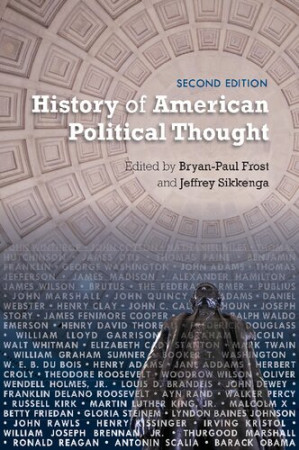
History of American Political Thought 🔍
Frost, Bryan-Paul; Sikkenga, Jeffrey; Alecusan, George; Alvis, John E.; Brand, Donald R.; Carrese, Paul O.; Carrigg, Daniel T.; Cooper, Laurence D.; Dry, Murray; Elshtain, Jean Bethke; Engeman, Thomas S.; Field, Peter S.; Flannery, Christopher; Forde, Steven; Forte, David F.; Foster, David; Fott, David; Franck, Matthew J.; Frost, Bryan-Paul; Hayward, Steven F.; Josephson, Peter B.; Kautz, Steven; Koritansky, John; Lawler, Peter Augustine; Mansfield, Harvey C.; Mattie, Sean; Marks, Jonathan; McClellan, James; Meyers, Peter C.; Morone, James A.; Morel, Lucas E.; Pestritto, Ronald J.; Robinson, Lance; Rosano, Michael J.; Ruderman, Richard S.; Samuelson, Richard; Schaefer, David Lewis; Schotten, Peter; Shankman, Kimberly C.; Sikkenga, Jeffrey; Stoner, James R.; Taylor, Natalie; Tessitore, Aristide; Thomas, William; Tress, Daryl McGowan; Tucker, David; Velásquez, Eduardo A.; Walling, Karl-Friedrich; S. Watson, Bradley C.; Williams, Melissa S.; Yarbrough, Jean M.; Zuckert, Michael
Lexington Books/Fortress Academic, Applications of political theory, 2nd ed, Lanham, 2019
English [en] · PDF · 10.9MB · 2019 · 📘 Book (non-fiction) · 🚀/lgli/lgrs/nexusstc/upload/zlib · Save
description
Revised and updated, this long-awaited second edition provides a comprehensive introduction to what the most thoughtful Americans have said about the American experience from the colonial period to the present. The book examines the political thought of the most important American statesmen, activists, and writers across era and ideologies, helping another generation of students, scholars, and citizens to understand more fully the meaning of America.
This new second edition of the book includes chapters on several additional historical figures, including Walt Whitman, Lyndon Baines Johnson, and Ronald Reagan, as well as a new chapter on Barack Obama, who was not prominent in public life when the first edition was published. Significant revisions and additions have also been made to many of the original chapters, most notably on Antonin Scalia, which now updates his full legacy, increasing the breadth and depth of the collection.
This new second edition of the book includes chapters on several additional historical figures, including Walt Whitman, Lyndon Baines Johnson, and Ronald Reagan, as well as a new chapter on Barack Obama, who was not prominent in public life when the first edition was published. Significant revisions and additions have also been made to many of the original chapters, most notably on Antonin Scalia, which now updates his full legacy, increasing the breadth and depth of the collection.
Alternative filename
nexusstc/History of American Political Thought/73c03680b1e111d99f9f3e7e25d4918c.pdf
Alternative filename
lgli/History of American Political Thought [2nd Ed.] (2019) edited by Bryan-Paul Frost, Jeffrey Sikkenga.pdf
Alternative filename
lgrsnf/History of American Political Thought [2nd Ed.] (2019) edited by Bryan-Paul Frost, Jeffrey Sikkenga.pdf
Alternative author
Bryan-Paul Frost; Jeffrey Sikkenga; George Alecusan; John E. Alvis; Donald R. Brand; Paul O. Carrese; Daniel T. Carrigg; Laurence D. Cooper; Murray Dry; Jean Bethke Elshtain; Thomas S. Engeman; Peter S. Field; Christopher Flannery; Steven Forde; David F. Forte; David Foster; David Fott; Matthew J. Franck; Bryan-Paul Frost; Steven F. Hayward; Peter B. Josephson; Steven Kautz; John Koritansky; Peter Augustine Lawler; Harvey C. Mansfield; Sean Mattie; Jonathan Marks; James McClellan; Peter C. Meyers; James A. Morone; Lucas E. Morel; Ronald J. Pestritto; Lance Robinson; Michael J. Rosano; Richard S. Ruderman; Richard Samuelson; David Lewis Schaefer; Peter Schotten; Kimberly C. Shankman; Jeffrey Sikkenga; James R. Stoner; Natalie Taylor; Aristide Tessitore; William Thomas; Daryl McGowan Tress; David Tucker; Eduardo A. Velásquez; Karl-Friedrich Walling; Bradley C. S. Watson; Melissa S. Williams; Jean M. Yarbrough; Michael Zuckert
Alternative author
Adobe InDesign CC 2017 (Macintosh)
Alternative edition
Applications of political theory, Second edition, Lanham, Maryland, 2019
Alternative edition
Rowman & Littlefield Publishing Group, Inc., Lanham, 2019
Alternative edition
United States, United States of America
metadata comments
producers:
Adobe PDF Library 15.0
Adobe PDF Library 15.0
metadata comments
{"edition":"2","isbns":["1498558704","9781498558709"],"last_page":968,"publisher":"Lexington Books"}
Alternative description
Cover
Advanced Praise
Title
Contents
Preface and Acknowledgments to the Second Edition
Preface and Acknowledgments to the First Edition
Acknowledgments
Introduction: Alexis de Tocqueville’s Democracy in America
Tocqueville’s Trip to America
Tocqueville’s Liberalism
Tocqueville’s Political Science
The Democratic Revolution
Tyranny of the Majority
Pride and Race in America
From the Proud Majority to a Herd
Self-Interest Well Understood
Remedies for Majority Tyranny and Mild Despotism
The Virtue of Women
The Superiority of Practice
Notes
1. John Winthrop, John Cotton, and Nathaniel Niles: The Basic Principles of Puritan Political Thought
John Winthrop on the Model of Christian Charity
John Cotton on the Principles of a Christian Calling
Nathaniel Niles on Christian Liberty and Reform
Notes
2. Thomas Hutchinson and James Otis on Sovereignty, Obedience, and Rebellion
Otis as Constitutional Innovator
Hutchinson the Constitutional Conservative
Otis’s Constitutional Argument Reconsidered
Conclusion
Notes
3. Thomas Paine: The American Radical
Constitutional Thought
Political Economy
Religion
Notes
4. Benjamin Franklin: A Model American and an American Model
I
II
III
IV
V
VI
Notes
5. Liberty, Constitutionalism, and Moderation: George Washington’s Harmonizing of Traditions
The “Liberty and Justice for Which We Contend”: Civil-Military Relations and Character
The “Great Constitutional Charter”: Constitutionalism, Union, and the Aims of Republicanism
“As Our Interest Guided by Justice Shall Counsel”: Statesmanship and Moderation in Domestic and Foreign Affairs
Notes
6. John Adams and the Republic of Laws
I
II
III
IV
V
VI
Notes
7. Legitimate Government, Religion, and Education: The Political Philosophy of Thomas Jefferson
The Nature and Purpose of Legitimate Government
Religion and Politics
Education and Politics
Notes
8. The Political Science of James Madison
I. Political Philosophy
II. Political Science
Notes
9. Alexander Hamilton on the Grand Strategy of Free Government
Revolutionary Constitutionalist
Independence
Union
Energetic Yet Stable and Deliberative Political Institutions
Elder Statesman and Party Leader
Notes
10. America’s Modernity: James Wilson on Natural Law and Natural Rights
From Scotland to America
Discovering the Law of Nature
Conscience and the Instrumental Character of Natural Reason
Scripture
The Law of Nature as the Law of Nations
Sociability
Consent
Conclusion: the Character of Liberal Republicanism
Notes
11. Anti-Federalist Political Thought: Brutus and The Federal Farmer
I. Federalism and Republican Government
II. The Constitution’s Structure of Government
III. The Bill of Rights
Conclusion
Notes
12. The New Constitutionalism of Publius
A New Federalism
A New Republicanism
Separation of Powers
The Legislative
The Executive
The Judiciary
Conclusion: An Improving Science of Politics
Notes
13. Union, Constitutionalism, and the Judicial Defense of Rights: John Marshall
The Language of American Political Science
The Progress of Marshall’s Thought on Judicial Power
Rights, Powers, and the Rule of Law
Judicial Review or Judicial Supremacy?
Notes
14. John Quincy Adams on Principle and Practice
Notes
15. Union and Liberty: The Political Thought of Daniel Webster
Webster’s Historical Case for Union: Republican Tradition
Webster’s Constitutional Case for Union: the Letter and Spirit of the Law
Statesmanship in Webster’s Case for Union
Notes
16. Henry Clay and the Statesmanship of Compromise
Notes
17. For Constitution and Country? John C. Calhoun, American Politics, and the Union
Self-Confidence and Self-Awareness
Human Nature and its Relationship to Government
The Formation of American Government and the Principle of Sovereignty
The Federal Nature and Structure of the American Constitution
The Principles and Operation of a Constitutional Government
Resolving Conflict: Nullification, Amendment, and Secession
Conclusion
Notes
18. The Art of the Judge: Justice Joseph Story and the Founders’ Constitution
Notes
19. James Fenimore Cooper: Nature and Nature’s God
The American Democrat
Cooper’s Fiction
Notes
20. Religion, Nature, and Disobedience in the Thought of Ralph Waldo Emerson and Henry David Thoreau
Transcendentalism
Religion and Religiosity, Christianity and Mysticism
Commerce, Politics, and the Individual as Supreme Lawgiver
Transcendentalism in Practice: Thoreau’s Walden (1854)
From Civil Disobedience to the Brink of Civil War
Notes
21. “Proclaim Liberty throughout the Land”: Frederick Douglass, William Lloyd Garrison, and the Abolition of Slavery
I
II
III
IV
V
Notes
22. Abraham Lincoln: The Moderation of a Democratic Statesman
I
II
III
IV
V
VI
VII
VIII
Notes
23. Walt Whitman and Politics by Other Means
Notes
24. Feminism as an American Project: The Political Thought of Elizabeth Cady Stanton
Notes
25. Mark Twain on the American Character
Tom Sawyer and the Quest for Glory
Huck Finn: Natural Man against American Conventions
Connecticut Yankee: the Problem of Commercial Progress
Notes
26. Pricking the Bubble of Utopian Sentiment: The Political Thought of William Graham Sumner
Notes
27. Booker T. Washington and the “Severe American Crucible”
The Rise of a Statesman
Starting from Slavery
Industrial Education
Washington’s Rhetoric of Hope
Notes
28. Co-workers in the Kingdom of Culture: W. E. B. Du Bois’s Vision of Race Synthesis
“The Problem of the Twentieth Century is the Problem of the Color-Line.”
“A Co-Worker in the Kingdom of Culture.”
“The Negro Race, Like All Races, is Going to Be Saved by its Exceptional Men.”
“I Believe in Communism.”
“I’m through. I Cannot and Will Not Stand America Longer. I’m Off.”
Notes
29.Henry Adams and Our Ancient Faith
Notes
30. Jane Addams as Civic Theorist: Struggling to Reconcile Competing Claims
The Family Claim and the Social Claim
The King Lear of Chicago
The Development of Individual and Social Morality
City Life and the Snare of Vice
City Housekeeping as Experimentation
The Moral Balance Sheet
The First World War and Addams’s Fall from Grace
The Long Road of Woman’s Memory Revisited
Notes
31. Herbert Croly’s Progressive “Liberalism”
A New Nationalism for a New Society
From Patriotic Nationalism to Hard-Boiled Radicalism
The “Progressivism” of the Soviet Republic
Notes
32. Theodore Roosevelt and the Stewardship of the American Presidency
Notes
33. Woodrow Wilson, the Organic State, and American Republicanism
Wilson’s Historicism and Organic Concept of the State
The Social Contract
Democracy Ancient and Modern
Unity and the Modern State
The Separation of Politics and Administration
Popular Leadership and the Political Institutions
Apolitical Administration
Notes
34. The Making of the Modern Supreme Court: Oliver Wendell Holmes, Jr., and Louis D. Brandeis
Social Darwinism and the Common Law in Holmes’s Jurisprudence
Brandeis and the Social Reform of the Constitution
Conclusion
Notes
35. John Dewey’s Alternative Liberalism
Democracy and Science: Dewey’s Critique of the Declaration of Independence
Education and Growth
An Alternative Liberalism
Conclusion
Notes
36. Franklin Delano Roosevelt and the Second Bill of Rights
The Critique of Traditional Liberalism
Roosevelt’s Transformation of Liberalism
Government and the Rights Agenda
Tempering Hyper-Liberalism
The New International Liberal Order
Conclusion
Notes
37. Ayn Rand: Radical for Capitalism
I. Rand’s Significance
II. Rand’s Life and Work
III. Rand’s Political Theory
IV. Rand’s Moral Revolution
V. Conclusion
Notes
38. Walker Percy’s American Thomism
Aliens Are Us
Pop Cartesianism
From the Pursuit of Happiness to the Pursuit of Diversion
Will Barrett’s Wondering and Wandering
The War against Drugs: Chemotherapy versus Psyche-Iatry
Percy versus Prozac
Notes
39. Russell Kirk’s Anglo-American Conservatism
The Conservative Mind
Principles of Conservatism
The Contribution of Edmund Burke
The Roots of American Order
The Legacy of Greece and Rome
The Medieval and Modern Periods
Edmund Burke and the Counterrevolution: “to Restore What Once Was, and So May Be Again”
Epilogue
Notes
40. The Two Revolutions of Martin Luther King, Jr.
I. First Principles
II. The Method of Nonviolent Direct Action
III. Ends: King’s Dream
IV. Critical Reflections
Notes
41. Malcolm X: From Apolitical Acolyte to Political Preacher
African, Not American: the Repudiation of White Hegemony
After the Nation of Islam: Malcolm X and the Meaning of Mecca
The Legacy of Malcolm X
Notes
42. Betty Friedan and Gloria Steinem: The Popular Transformation of American Feminism in the Late Twentieth Century
I
II
Notes
43. “The Secret Heart of America”: Lyndon Baines Johnson’s Bold Synthesis of American Thought
Johnson’s Philosophy
The Freedom Agenda
The Great Society: Soaring Ideals— and More Government
Maximum Feasible Participation
Theoretical Foundations of the Great Society
Foreign Policy
Conclusion: the Legacy of Lbj’s Thought
Notes
44. John Rawls’s “Democratic” Theory of Justice
I
II
III
IV
Notes
45. Henry Kissinger: The Challenge of Statesmanship in Liberal Democracy
The Heroic Statesman
The Problems of Peace
The National Soul
Creating the Future
Notes
46. Irving Kristol and the Reinvigoration of Bourgeois Republicanism
Liberalism, Capitalism, and Bourgeois Society
Liberal Capitalism’s Troubled History
Liberal Capitalism’s Nature and Problematics
Utopianism and its Antidote
Defending Bourgeois Society: Prospects and Tasks
Conclusion
Notes
47. The Jurisprudence of William Joseph Brennan, Jr., and Thurgood Marshall
Schools of Constitutional Interpretation
Brennan’s Organic Individualism
Marshall’s Evolving Constitution
The Progressive Synthesis
Notes
48. Ronald Reagan: Statesman and Original Political Thinker
Reagan’s Turn
Reagan’s Subtle Skills on Display
Reagan’s Boldness
Reagan’s Patient Prudence
Notes
49. The Textualist Jurisprudence of Antonin Scalia
Scalia’s Textualist Jurisprudence
Scalia’s Rejection of Legislative History
Scalia’s Originalism
Scalia’s Reliance on Constitutional Structure
Conclusion
Notes
50. “Yes, We Can”: The Progressive Political Thought of Barack Obama
The Historical Problem for Progressives
A Progressive Governing Philosophy
Progressive Governance in the Twenty-First Century
Patriotic Leadership and the New Progressive Order
Notes
Index
About the Contributors
Advanced Praise
Title
Contents
Preface and Acknowledgments to the Second Edition
Preface and Acknowledgments to the First Edition
Acknowledgments
Introduction: Alexis de Tocqueville’s Democracy in America
Tocqueville’s Trip to America
Tocqueville’s Liberalism
Tocqueville’s Political Science
The Democratic Revolution
Tyranny of the Majority
Pride and Race in America
From the Proud Majority to a Herd
Self-Interest Well Understood
Remedies for Majority Tyranny and Mild Despotism
The Virtue of Women
The Superiority of Practice
Notes
1. John Winthrop, John Cotton, and Nathaniel Niles: The Basic Principles of Puritan Political Thought
John Winthrop on the Model of Christian Charity
John Cotton on the Principles of a Christian Calling
Nathaniel Niles on Christian Liberty and Reform
Notes
2. Thomas Hutchinson and James Otis on Sovereignty, Obedience, and Rebellion
Otis as Constitutional Innovator
Hutchinson the Constitutional Conservative
Otis’s Constitutional Argument Reconsidered
Conclusion
Notes
3. Thomas Paine: The American Radical
Constitutional Thought
Political Economy
Religion
Notes
4. Benjamin Franklin: A Model American and an American Model
I
II
III
IV
V
VI
Notes
5. Liberty, Constitutionalism, and Moderation: George Washington’s Harmonizing of Traditions
The “Liberty and Justice for Which We Contend”: Civil-Military Relations and Character
The “Great Constitutional Charter”: Constitutionalism, Union, and the Aims of Republicanism
“As Our Interest Guided by Justice Shall Counsel”: Statesmanship and Moderation in Domestic and Foreign Affairs
Notes
6. John Adams and the Republic of Laws
I
II
III
IV
V
VI
Notes
7. Legitimate Government, Religion, and Education: The Political Philosophy of Thomas Jefferson
The Nature and Purpose of Legitimate Government
Religion and Politics
Education and Politics
Notes
8. The Political Science of James Madison
I. Political Philosophy
II. Political Science
Notes
9. Alexander Hamilton on the Grand Strategy of Free Government
Revolutionary Constitutionalist
Independence
Union
Energetic Yet Stable and Deliberative Political Institutions
Elder Statesman and Party Leader
Notes
10. America’s Modernity: James Wilson on Natural Law and Natural Rights
From Scotland to America
Discovering the Law of Nature
Conscience and the Instrumental Character of Natural Reason
Scripture
The Law of Nature as the Law of Nations
Sociability
Consent
Conclusion: the Character of Liberal Republicanism
Notes
11. Anti-Federalist Political Thought: Brutus and The Federal Farmer
I. Federalism and Republican Government
II. The Constitution’s Structure of Government
III. The Bill of Rights
Conclusion
Notes
12. The New Constitutionalism of Publius
A New Federalism
A New Republicanism
Separation of Powers
The Legislative
The Executive
The Judiciary
Conclusion: An Improving Science of Politics
Notes
13. Union, Constitutionalism, and the Judicial Defense of Rights: John Marshall
The Language of American Political Science
The Progress of Marshall’s Thought on Judicial Power
Rights, Powers, and the Rule of Law
Judicial Review or Judicial Supremacy?
Notes
14. John Quincy Adams on Principle and Practice
Notes
15. Union and Liberty: The Political Thought of Daniel Webster
Webster’s Historical Case for Union: Republican Tradition
Webster’s Constitutional Case for Union: the Letter and Spirit of the Law
Statesmanship in Webster’s Case for Union
Notes
16. Henry Clay and the Statesmanship of Compromise
Notes
17. For Constitution and Country? John C. Calhoun, American Politics, and the Union
Self-Confidence and Self-Awareness
Human Nature and its Relationship to Government
The Formation of American Government and the Principle of Sovereignty
The Federal Nature and Structure of the American Constitution
The Principles and Operation of a Constitutional Government
Resolving Conflict: Nullification, Amendment, and Secession
Conclusion
Notes
18. The Art of the Judge: Justice Joseph Story and the Founders’ Constitution
Notes
19. James Fenimore Cooper: Nature and Nature’s God
The American Democrat
Cooper’s Fiction
Notes
20. Religion, Nature, and Disobedience in the Thought of Ralph Waldo Emerson and Henry David Thoreau
Transcendentalism
Religion and Religiosity, Christianity and Mysticism
Commerce, Politics, and the Individual as Supreme Lawgiver
Transcendentalism in Practice: Thoreau’s Walden (1854)
From Civil Disobedience to the Brink of Civil War
Notes
21. “Proclaim Liberty throughout the Land”: Frederick Douglass, William Lloyd Garrison, and the Abolition of Slavery
I
II
III
IV
V
Notes
22. Abraham Lincoln: The Moderation of a Democratic Statesman
I
II
III
IV
V
VI
VII
VIII
Notes
23. Walt Whitman and Politics by Other Means
Notes
24. Feminism as an American Project: The Political Thought of Elizabeth Cady Stanton
Notes
25. Mark Twain on the American Character
Tom Sawyer and the Quest for Glory
Huck Finn: Natural Man against American Conventions
Connecticut Yankee: the Problem of Commercial Progress
Notes
26. Pricking the Bubble of Utopian Sentiment: The Political Thought of William Graham Sumner
Notes
27. Booker T. Washington and the “Severe American Crucible”
The Rise of a Statesman
Starting from Slavery
Industrial Education
Washington’s Rhetoric of Hope
Notes
28. Co-workers in the Kingdom of Culture: W. E. B. Du Bois’s Vision of Race Synthesis
“The Problem of the Twentieth Century is the Problem of the Color-Line.”
“A Co-Worker in the Kingdom of Culture.”
“The Negro Race, Like All Races, is Going to Be Saved by its Exceptional Men.”
“I Believe in Communism.”
“I’m through. I Cannot and Will Not Stand America Longer. I’m Off.”
Notes
29.Henry Adams and Our Ancient Faith
Notes
30. Jane Addams as Civic Theorist: Struggling to Reconcile Competing Claims
The Family Claim and the Social Claim
The King Lear of Chicago
The Development of Individual and Social Morality
City Life and the Snare of Vice
City Housekeeping as Experimentation
The Moral Balance Sheet
The First World War and Addams’s Fall from Grace
The Long Road of Woman’s Memory Revisited
Notes
31. Herbert Croly’s Progressive “Liberalism”
A New Nationalism for a New Society
From Patriotic Nationalism to Hard-Boiled Radicalism
The “Progressivism” of the Soviet Republic
Notes
32. Theodore Roosevelt and the Stewardship of the American Presidency
Notes
33. Woodrow Wilson, the Organic State, and American Republicanism
Wilson’s Historicism and Organic Concept of the State
The Social Contract
Democracy Ancient and Modern
Unity and the Modern State
The Separation of Politics and Administration
Popular Leadership and the Political Institutions
Apolitical Administration
Notes
34. The Making of the Modern Supreme Court: Oliver Wendell Holmes, Jr., and Louis D. Brandeis
Social Darwinism and the Common Law in Holmes’s Jurisprudence
Brandeis and the Social Reform of the Constitution
Conclusion
Notes
35. John Dewey’s Alternative Liberalism
Democracy and Science: Dewey’s Critique of the Declaration of Independence
Education and Growth
An Alternative Liberalism
Conclusion
Notes
36. Franklin Delano Roosevelt and the Second Bill of Rights
The Critique of Traditional Liberalism
Roosevelt’s Transformation of Liberalism
Government and the Rights Agenda
Tempering Hyper-Liberalism
The New International Liberal Order
Conclusion
Notes
37. Ayn Rand: Radical for Capitalism
I. Rand’s Significance
II. Rand’s Life and Work
III. Rand’s Political Theory
IV. Rand’s Moral Revolution
V. Conclusion
Notes
38. Walker Percy’s American Thomism
Aliens Are Us
Pop Cartesianism
From the Pursuit of Happiness to the Pursuit of Diversion
Will Barrett’s Wondering and Wandering
The War against Drugs: Chemotherapy versus Psyche-Iatry
Percy versus Prozac
Notes
39. Russell Kirk’s Anglo-American Conservatism
The Conservative Mind
Principles of Conservatism
The Contribution of Edmund Burke
The Roots of American Order
The Legacy of Greece and Rome
The Medieval and Modern Periods
Edmund Burke and the Counterrevolution: “to Restore What Once Was, and So May Be Again”
Epilogue
Notes
40. The Two Revolutions of Martin Luther King, Jr.
I. First Principles
II. The Method of Nonviolent Direct Action
III. Ends: King’s Dream
IV. Critical Reflections
Notes
41. Malcolm X: From Apolitical Acolyte to Political Preacher
African, Not American: the Repudiation of White Hegemony
After the Nation of Islam: Malcolm X and the Meaning of Mecca
The Legacy of Malcolm X
Notes
42. Betty Friedan and Gloria Steinem: The Popular Transformation of American Feminism in the Late Twentieth Century
I
II
Notes
43. “The Secret Heart of America”: Lyndon Baines Johnson’s Bold Synthesis of American Thought
Johnson’s Philosophy
The Freedom Agenda
The Great Society: Soaring Ideals— and More Government
Maximum Feasible Participation
Theoretical Foundations of the Great Society
Foreign Policy
Conclusion: the Legacy of Lbj’s Thought
Notes
44. John Rawls’s “Democratic” Theory of Justice
I
II
III
IV
Notes
45. Henry Kissinger: The Challenge of Statesmanship in Liberal Democracy
The Heroic Statesman
The Problems of Peace
The National Soul
Creating the Future
Notes
46. Irving Kristol and the Reinvigoration of Bourgeois Republicanism
Liberalism, Capitalism, and Bourgeois Society
Liberal Capitalism’s Troubled History
Liberal Capitalism’s Nature and Problematics
Utopianism and its Antidote
Defending Bourgeois Society: Prospects and Tasks
Conclusion
Notes
47. The Jurisprudence of William Joseph Brennan, Jr., and Thurgood Marshall
Schools of Constitutional Interpretation
Brennan’s Organic Individualism
Marshall’s Evolving Constitution
The Progressive Synthesis
Notes
48. Ronald Reagan: Statesman and Original Political Thinker
Reagan’s Turn
Reagan’s Subtle Skills on Display
Reagan’s Boldness
Reagan’s Patient Prudence
Notes
49. The Textualist Jurisprudence of Antonin Scalia
Scalia’s Textualist Jurisprudence
Scalia’s Rejection of Legislative History
Scalia’s Originalism
Scalia’s Reliance on Constitutional Structure
Conclusion
Notes
50. “Yes, We Can”: The Progressive Political Thought of Barack Obama
The Historical Problem for Progressives
A Progressive Governing Philosophy
Progressive Governance in the Twenty-First Century
Patriotic Leadership and the New Progressive Order
Notes
Index
About the Contributors
date open sourced
2023-04-20
🚀 Fast downloads
Become a member to support the long-term preservation of books, papers, and more. To show our gratitude for your support, you get fast downloads. ❤️
- Fast Partner Server #1 (recommended)
- Fast Partner Server #2 (recommended)
- Fast Partner Server #3 (recommended)
- Fast Partner Server #4 (recommended)
- Fast Partner Server #5 (recommended)
- Fast Partner Server #6 (recommended)
- Fast Partner Server #7
- Fast Partner Server #8
- Fast Partner Server #9
- Fast Partner Server #10
- Fast Partner Server #11
- Fast Partner Server #12
🐢 Slow downloads
From trusted partners. More information in the FAQ. (might require browser verification — unlimited downloads!)
- Slow Partner Server #1 (slightly faster but with waitlist)
- Slow Partner Server #2 (slightly faster but with waitlist)
- Slow Partner Server #3 (slightly faster but with waitlist)
- Slow Partner Server #4 (slightly faster but with waitlist)
- Slow Partner Server #5 (no waitlist, but can be very slow)
- Slow Partner Server #6 (no waitlist, but can be very slow)
- Slow Partner Server #7 (no waitlist, but can be very slow)
- Slow Partner Server #8 (no waitlist, but can be very slow)
- Slow Partner Server #9 (no waitlist, but can be very slow)
- After downloading: Open in our viewer
All download options have the same file, and should be safe to use. That said, always be cautious when downloading files from the internet, especially from sites external to Anna’s Archive. For example, be sure to keep your devices updated.
External downloads
-
For large files, we recommend using a download manager to prevent interruptions.
Recommended download managers: JDownloader -
You will need an ebook or PDF reader to open the file, depending on the file format.
Recommended ebook readers: Anna’s Archive online viewer, ReadEra, and Calibre -
Use online tools to convert between formats.
Recommended conversion tools: CloudConvert and PrintFriendly -
You can send both PDF and EPUB files to your Kindle or Kobo eReader.
Recommended tools: Amazon‘s “Send to Kindle” and djazz‘s “Send to Kobo/Kindle” -
Support authors and libraries
✍️ If you like this and can afford it, consider buying the original, or supporting the authors directly.
📚 If this is available at your local library, consider borrowing it for free there.
Total downloads:
A “file MD5” is a hash that gets computed from the file contents, and is reasonably unique based on that content. All shadow libraries that we have indexed on here primarily use MD5s to identify files.
A file might appear in multiple shadow libraries. For information about the various datasets that we have compiled, see the Datasets page.
For information about this particular file, check out its JSON file. Live/debug JSON version. Live/debug page.