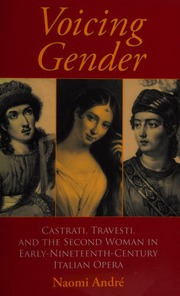
Voicing Gender: Castrati, Travesti, And The Second Woman In Early-nineteenth-century Italian Opera (musical Meaning And Interpretation) 🔍
André, Naomi Adele
Bloomington : Indiana University Press, Musical meaning and interpretation, Bloomington ; Indianapolis, 2006
English [en] · PDF · 11.2MB · 2006 · 📗 Book (unknown) · 🚀/ia/zlib · Save
description
xiii, 230 pages : 25 cm, Includes bibliographical references (pages 213-222) and index, Prelude : hearing voices -- Sounding voices : modeling voice and the period ear -- Haunting legacies : the castrato in the nineteenth century -- Meyerbeer in Italy : the crusader, the castrato, and the disguised second woman -- Interlude : queens, hybridity, and the diva -- Taming women's voices : from hero to pageboy -- Women's voices in motion : voices behind the romantic heroine -- Coda : looking ahead to risorgimento heroism
Alternative title
Voicing Gender: Castrati, Travesti, And the Second Woman in Early Nineteenth-Century Italian Opera (Musical Meaning and Interpretation)
Alternative author
Naomi Adele André
Alternative author
Naomi Adele Andre
Alternative publisher
Quarry Books
Alternative edition
Musical meaning and interpretation, Bloomington, Ind, Indiana, 2006
Alternative edition
United States, United States of America
Alternative edition
Bloomington, IN, United States, 2006
metadata comments
Includes bibliographical references and index.
Alternative description
<p><P>The early 19th century was a period of acute transition in operatic tradition and style, when time-honored practices gave way to the developing aesthetics of Romanticism, the rise of the tenor overtook the falling stars of the castrati, and the heroic, the masculine, and the feminine were profoundly reconfigured. These transformations resounded in operatic plot structures as well; the happy resolution of the 18th century twisted into a tragic 19th-century finale with the death of the helpless and innocent heroine — and frequently her tenor hero along with her. Female voices which formerly had sung en travesti, or basically in male drag, opposite their female character counterparts then took on roles of the second woman, a companion and foil to the death-bound heroine rather than her romantic partner. In Voicing Gender, Naomi André skillfully traces the development of female characters in these first decades of the century, weaving in and around these changes in voicings and plot lines, to define an emergent legacy in operatic roles.</P></p>
Alternative description
The early 19th century was a period of acute transition in operatic tradition and style, when time-honored practices gave way to the developing aesthetics of Romanticism, the rise of the tenor overtook the falling stars of the castrati, and the heroic, the masculine, and the feminine were profoundly reconfigured. These transformations resounded in operatic plot structures as well; the happy resolution of the 18th century twisted into a tragic 19th-century finale with the death of the helpless and innocent heroine--and frequently her tenor hero along with her. Female voices which formerly had sung en travesti, or basically in male drag, opposite their female character counterparts then took on roles of the second woman, a companion and foil to the death-bound heroine rather than her romantic partner. This book skillfully traces the development of female characters in these first decades of the century, weaving in and around these changes in voicings and plot lines, to define an emergent legacy in operatic roles
Alternative description
Prelude : Hearing Voices -- Sounding Voices : Modeling Voice And The Period Ear -- Haunting Legacies : The Castrato In The Nineteenth Century -- Meyerbeer In Italy : The Crusader, The Castrato, And The Disguised Second Woman -- Interlude : Queens, Hybridity, And The Diva -- Taming Women's Voices : From Hero To Pageboy -- Women's Voices In Motion : Voices Behind The Romantic Heroine -- Coda : Looking Ahead To Risorgimento Heroism. Naomi André. Includes Bibliographical References (p. [183]-222) And Index.
Alternative description
Introduction : hearing voices
Sounding voices : modeling voice and the period ear
Haunting legacies : the castrato in the nineteenth century
Meyerbeer in Italy : the crusader, the castrato, and the disguised second woman
Interlude : queens, hybridity, and the diva
Taming women's voices : from hero to pageboy
Women's voices in motion : voices behind the romantic heroine
Coda : looking ahead to risorgimento heroism.
Sounding voices : modeling voice and the period ear
Haunting legacies : the castrato in the nineteenth century
Meyerbeer in Italy : the crusader, the castrato, and the disguised second woman
Interlude : queens, hybridity, and the diva
Taming women's voices : from hero to pageboy
Women's voices in motion : voices behind the romantic heroine
Coda : looking ahead to risorgimento heroism.
Alternative description
The early 19th century was a period of acute transition in operatic tradition and style, when time-honoured practices gave way to the developing aesthetics of Romanticism, and the heroic, the masculine, and the feminine were profoundly reconfigured. This book traces the development of female characters in these first decades of the century.
Alternative description
Documents the changes in approaches to gender in opera in the early 19th century
date open sourced
2023-06-28
🚀 Fast downloads
Become a member to support the long-term preservation of books, papers, and more. To show our gratitude for your support, you get fast downloads. ❤️
- Fast Partner Server #1 (recommended)
- Fast Partner Server #2 (recommended)
- Fast Partner Server #3 (recommended)
- Fast Partner Server #4 (recommended)
- Fast Partner Server #5 (recommended)
- Fast Partner Server #6 (recommended)
- Fast Partner Server #7
- Fast Partner Server #8
- Fast Partner Server #9
- Fast Partner Server #10
- Fast Partner Server #11
- Fast Partner Server #12
🐢 Slow downloads
From trusted partners. More information in the FAQ. (might require browser verification — unlimited downloads!)
- Slow Partner Server #1 (slightly faster but with waitlist)
- Slow Partner Server #2 (slightly faster but with waitlist)
- Slow Partner Server #3 (slightly faster but with waitlist)
- Slow Partner Server #4 (slightly faster but with waitlist)
- Slow Partner Server #5 (no waitlist, but can be very slow)
- Slow Partner Server #6 (no waitlist, but can be very slow)
- Slow Partner Server #7 (no waitlist, but can be very slow)
- Slow Partner Server #8 (no waitlist, but can be very slow)
- Slow Partner Server #9 (no waitlist, but can be very slow)
- After downloading: Open in our viewer
All download options have the same file, and should be safe to use. That said, always be cautious when downloading files from the internet, especially from sites external to Anna’s Archive. For example, be sure to keep your devices updated.
External downloads
-
For large files, we recommend using a download manager to prevent interruptions.
Recommended download managers: JDownloader -
You will need an ebook or PDF reader to open the file, depending on the file format.
Recommended ebook readers: Anna’s Archive online viewer, ReadEra, and Calibre -
Use online tools to convert between formats.
Recommended conversion tools: CloudConvert and PrintFriendly -
You can send both PDF and EPUB files to your Kindle or Kobo eReader.
Recommended tools: Amazon‘s “Send to Kindle” and djazz‘s “Send to Kobo/Kindle” -
Support authors and libraries
✍️ If you like this and can afford it, consider buying the original, or supporting the authors directly.
📚 If this is available at your local library, consider borrowing it for free there.
Total downloads:
A “file MD5” is a hash that gets computed from the file contents, and is reasonably unique based on that content. All shadow libraries that we have indexed on here primarily use MD5s to identify files.
A file might appear in multiple shadow libraries. For information about the various datasets that we have compiled, see the Datasets page.
For information about this particular file, check out its JSON file. Live/debug JSON version. Live/debug page.