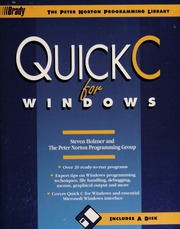
Quick C For Windows (the Peter Norton Programming Series) 🔍
Holzner, Steven, None, Peter Norton Computing Corporation
New York : Brady, The Peter Norton Programming Library, New York, 1992
English [en] · PDF · 31.8MB · 1992 · 📗 Book (unknown) · 🚀/ia/zlib · Save
description
xiii, 448 pages : 24 cm +, System requirements for computer disk: PC; Microsoft Windows 3.0 or later; Microsoft QuickC for Windows; mouse or other pointing device, Includes index
Alternative title
Quick C for Windows/Book and Disk (The Peter Norton Programming Library)
Alternative author
Steve Holzner [and] the Peter Norton Computing Group
Alternative author
Holzner, Steve, Peter Norton Computing Group
Alternative author
Steven Holzner, Peter Norton Computing Group
Alternative publisher
Globe Fearon Educational Publishing
Alternative publisher
Longman Publishing
Alternative publisher
Brady Publishing
Alternative publisher
Cengage Gale
Alternative edition
United States, United States of America
Alternative edition
New York, New York State, 1992
Alternative edition
Har/Dsk edition, February 1992
metadata comments
[curator]associate-michael-wankoff@archive.org[/curator][date]20181219213039[/date]
metadata comments
System requirements for computer disk: PC; Microsoft Windows 3.0 or later; Microsoft QuickC for Windows; mouse or other pointing device.
Includes index.
Includes index.
Alternative description
This package of a book/computer disk deals with Quick C for programmers who need to write powerful Windows applications. It offers a variety of tips on techniques for bug-free, modular code design. A sample application disk includes a mouse-driven paint program, pop-up notepad and more.
date open sourced
2023-06-28
🚀 Fast downloads
Become a member to support the long-term preservation of books, papers, and more. To show our gratitude for your support, you get fast downloads. ❤️
- Fast Partner Server #1 (recommended)
- Fast Partner Server #2 (recommended)
- Fast Partner Server #3 (recommended)
- Fast Partner Server #4 (recommended)
- Fast Partner Server #5 (recommended)
- Fast Partner Server #6 (recommended)
- Fast Partner Server #7
- Fast Partner Server #8
- Fast Partner Server #9
- Fast Partner Server #10
- Fast Partner Server #11
- Fast Partner Server #12
🐢 Slow downloads
From trusted partners. More information in the FAQ. (might require browser verification — unlimited downloads!)
- Slow Partner Server #1 (slightly faster but with waitlist)
- Slow Partner Server #2 (slightly faster but with waitlist)
- Slow Partner Server #3 (slightly faster but with waitlist)
- Slow Partner Server #4 (slightly faster but with waitlist)
- Slow Partner Server #5 (no waitlist, but can be very slow)
- Slow Partner Server #6 (no waitlist, but can be very slow)
- Slow Partner Server #7 (no waitlist, but can be very slow)
- Slow Partner Server #8 (no waitlist, but can be very slow)
- Slow Partner Server #9 (no waitlist, but can be very slow)
- After downloading: Open in our viewer
All download options have the same file, and should be safe to use. That said, always be cautious when downloading files from the internet, especially from sites external to Anna’s Archive. For example, be sure to keep your devices updated.
External downloads
-
For large files, we recommend using a download manager to prevent interruptions.
Recommended download managers: JDownloader -
You will need an ebook or PDF reader to open the file, depending on the file format.
Recommended ebook readers: Anna’s Archive online viewer, ReadEra, and Calibre -
Use online tools to convert between formats.
Recommended conversion tools: CloudConvert and PrintFriendly -
You can send both PDF and EPUB files to your Kindle or Kobo eReader.
Recommended tools: Amazon‘s “Send to Kindle” and djazz‘s “Send to Kobo/Kindle” -
Support authors and libraries
✍️ If you like this and can afford it, consider buying the original, or supporting the authors directly.
📚 If this is available at your local library, consider borrowing it for free there.
Total downloads:
A “file MD5” is a hash that gets computed from the file contents, and is reasonably unique based on that content. All shadow libraries that we have indexed on here primarily use MD5s to identify files.
A file might appear in multiple shadow libraries. For information about the various datasets that we have compiled, see the Datasets page.
For information about this particular file, check out its JSON file. Live/debug JSON version. Live/debug page.