upload/cgiym_more/Classists Data Dump/Bibliotheca Alexandrina [UPDATED FEB 2023]/5. Ancient & Classical Civilizations Series/Archaeopress/Archaeopress Roman Archaeology/76. Alexander Rubel - Experiencing the Frontier and the Frontier of Experience (Archaeopress Roman Archaeology, Book 76) [Retail].pdf
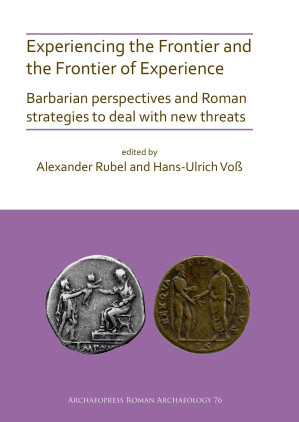
Experiencing the Frontier and the Frontier of Experience. Barbarian perspectives and Roman strategies to deal with new threats 🔍
Alexander Rubel & Hans-Ulrich Voß & editors
2021
English [en] · PDF · 16.9MB · 2021 · 📗 Book (unknown) · 🚀/upload/zlib · Save
description
Experiencing the Frontier and the Frontier of Experience deals with the Roman Empire’s responses to the threats which were caused by the new geostrategic situation brought on by the crisis of the 3rd century AD, induced by the ‘barbarians’ who – often already part of Roman military structures as mercenaries and auxiliaries – became a veritable menace for the Empire. Rome adopted different strategies: they oscillated between inclusion, warfare and other means of exerting influence. The contributions to this volume explore the archaeological evidence for Roman practice and especially the varying strategies of power and influence in the central regions on the one hand, and the south-eastern parts of the European ‘Barbaricum’ on the other. They show how ‘Divide et impera’ functioned as practical policy based on alliances, as well as consequent warfare, and diplomatic initiatives, which are traceable by prestige-goods and subsidia treasures found in the Barbaricum. The comparison of Roman imports in different parts of Iron-Age Europe can help understand better a complex process of shifting power and influence in an emerging new Europe, which transformed the Empire towards medieval ‘Herrschaft’ and social structure.
Cover 1
Title Page 3
Copyright page 4
Contents Page 5
Preface 7
Beyond the fringes of Empire: new approaches concerning Roman influence and power in the Barbaricum. An introduction 8
Alexander Rubel and Hans-Ulrich Voß 8
Roman limes in military campaigns of the Barbarians 13
Krzysztof Narloch 13
Figure 1. The Lower Danubian Limes (A. Miernik). 15
Claus-Michael Hüssen, Balázs Komoróczy, Ján Rajtár, Marek Vlach 22
Figure 1. Distribution of the Germanic settlements on the both sides of the Little Carpathians (Institute of Archaeology of the Czech Academy of Sciences Brno). 23
Archaeological footprints of a superpower in hostile territory 23
Figure 2. Distribution of the verified temporary camps and indirect indications of the Roman military presence on the both sides of the Little Carpathians (Institute of Archaeology of the Czech Academy of Sciences Brno). 24
Figure 3. Dislocation of the Roman military installations within the wider Mušov region (Institute of Archaeology of the Czech Academy of Sciences Brno). 26
Figure 4. Distribution of the verified temporary camps and indirect indications of the Roman military presence to the west of the Little Carpathians (Institute of Archaeology of the Czech Academy of Sciences Brno). 27
Figure 5. Charvátská Nová Ves. The layout of the camp 1a and its geomorphological context (LiDAR ©ČÚZK, Institute of Archaeology of the Czech Academy of Sciences Brno). 28
Figure 6. Mušov-Na Pískách. Layout of the evidenced temporary camps with multiple reduction of the largest structure - camp 1 (orthophoto ©ĆÚZK, WMS, Institute of Archaeology of the Czech Academy of Sciences Brno). 29
Figure 7. Přibice. The layout of the camps and their geomorphological context (LiDAR ©ČÚZK, Institute of Archaeology of the Czech Academy of Sciences Brno). 30
Figure 8. Charvátská Nová Ves. A standard section trench of the fortification ditch in the northern central part of the camp (Institute of Archaeology of the Czech Academy of Sciences Brno). 31
Figure 9. Charvátská Nová Ves. Terrain research of the area of the northern gate. Excavation of a bipartite filed oven (Institute of Archaeology of the Czech Academy of Sciences Brno). 32
Figure 10. Outline of the available radiocarbon dates from the temporary camps within the chronological boundaries of the La Tène and Roman Periods (Komoróczy et al. 2019, Figure 4). 33
Figure 11. Distribution of the evidences of the Roman military presence to the west of the Little Carpathians complemented with the modelled cumulative least-cost corridors of movement between the verified temporary camps (Institute of Archaeology of the 34
Figure 12. Schematic ground plan of the permanent fort in Iža with the distinguished northern section of fortification ditches and southern build-up area of the previous timber-earth phase. At the bottom a detail of the barracks ground plans (Institute of 35
Figure 13. Iža. Location of the fort and the total of ten temporary camps from the period of Marcomannic wars (for orthophoto source see right-bottom corner, Institute of Archaeology of the Slovak Academy of Sciences Nitra). 37
Figure 14. Radvaň nad Dunajom-Virt. Layout of the evidenced temporary camps (for orthophoto source see right-bottom corner, Institute of Archaeology of the Slovak Academy of Sciences Nitra). 38
Figure 15. Vráble. Layout of the evidenced temporary camps (for orthophoto source see right-bottom corner, Institute of Archaeology of the Slovak Academy of Sciences Nitra). 39
Figure 16. Hviezdoslavov. Layout of the evidenced temporary camp (for orthophoto source see right-bottom corner, Institute of Archaeology of the Slovak Academy of Sciences Nitra). 40
Figure 17. Cífer-Pác. Layout of the evidenced temporary camps (for orthophoto source see right-bottom corner, Institute of Archaeology of the Slovak Academy of Sciences Nitra). 40
Figure 18. Comparison of size and structure of the temporary camps from the Quadian territory to the east of the Little Carpathians (Institute of Archaeology of the Slovak Academy of Sciences Nitra). 41
Jan Bulas 49
Figure 1. Roman coins depicting Roman-Barbarian relations in the eye of Roman propaganda: a) Revers of the Denarius of Augustus (RIC I 201a) showing handover of child-hostage (Copyright Classical Numismatic Group, Triton XI, Lot: 855, https://www.cngcoin 51
Friend or foe? 51
Figure 2. Pakoszówka, Sanok county, site 33. Inventory of the cremation grave no. 5 (fot. by D. Szuwalski). 53
Figure 3. Chronological profiles of the coin finds from: a) area of nowadays Poland (after: Dymowski 2013: 114, fig. 3) and b) Dacia (after: Gaždac 2008: 271, fig. 1). 54
Figure 4. Trade routes through the Upper Tisa Basin in the 3rd century AD. 59
Figure 5. Model of relations between the Roman state and the Vandals in the aftermath of Marcomannic Wars in the 3rd century AD (based on: Roymans 2017: 69, fig. 9). 60
The Limes Germanicus trade and the Roman army 68
Dan-Alexandru Suharoschi, Iulia Dumitrache, Roxana-Gabriela Curcă 68
Coriolan Horațiu Opreanu, Sorin Cociș, Vlad-Andrei Lăzărescu 79
Figure 1. Brooches discovered in the Porolissum – ‘Sub Ferice’ site. 1–3, 7: Type Cociș 8b2b2; 4: Type Cociș 8b3c1; 5–6: Type Cociș 8a11a1. 81
Barbarian brooches in Roman context 81
Figure 2. Brooches discovered in the Porolissum – ‘Sub Ferice’ site. 8–9: Type Cociș 8b2b2 (?); 10: Type Almgren 41; 11: Type Almgren 94; 12: Type Iván 3.4.4.2 – group 8; 13: Type Iván 3.4.4.1. 82
Figure 3. Brooches discovered in the Porolissum – ‘Sub Ferice’ site. 14–15: Type Iván 3.4.4.1; 16: Type Cociș – Bârcă A VII/I/A; 17: Type Cociș – Bârcă A VII/I/B1; 18-20: Type Cociș – Bârcă A VII/I/B2. 83
Figure 4. Brooches discovered in the Porolissum – ‘Sub Ferice’ site. 21–23: Type Cociș – Bârcă A VII/I/B2; 24: Type Cociș 24b1; 25: Type Cociș 24a5a. 85
Figure 5. Brooches discovered in the Porolissum – ‘Sub Ferice’ site. 26–30: Type Cociș 37a8; 31: Type Cociș 37a5d2. 86
Figure 6. Brooches discovered in the Porolissum – ‘Sub Ferice’ site. 32–36: Type Cociș 36b. 87
Figure 7. Brooches discovered in the Porolissum – ‘Sub Ferice’ site. 37–40: Type Cociș 36b; 41: Unidentified type; 42: Type Cociș 8a11a1; 43: Type Cociș 39b1a1. 88
Figure 8. Coins and brooches presented according to the archaeological context they were recovered from. 89
Figure 9. Spatial distribution of the coins and brooches from the site Porolissum – ‘Sub Ferice’. 90
Figure 10. Spatial distribution of the brooches and coins (heatmap) found in contexts 64 and 86. 91
Figure 11. Spatial distribution of the brooches and coins (heatmap) found in contexts 27, 69 and 107. 91
Figure 12. Spatial distribution of the brooches and coins (heatmap) found in context 7. 92
Figure 13. Spatial distribution of the types of brooches found at Porolissum – ‘Sub Ferice’. 92
Figure 14. Comparative graph illustrating the chronological distribution of coins and brooches from Porolissum – ‘Sub Ferice’. 93
Figure 15. Typological and chronological correlation graph between the coins and brooches found at Porolissum – ‘Sub Ferice’. 93
Figure 16. Distribution map of the brooches type Almgren 41. 95
Figure 17. Distribution map of the so-called ‘Sarmatian’ brooches. 96
List 1. Coins and brooches found in context 7. 99
List 2. Coins and brooches found in context 27. 100
List 3. Coins and brooches found in context 64. 100
List 4. Coins and brooches found in context 69. 100
List 5. Coins and brooches found in context 86. 100
List 6. Coins and brooches found in context 107. 100
List 7. List of archaeological contexts from which both brooches and coins were recovered. 101
Luxury tableware? Terra sigillata in the coastal region of the northern Netherlands 106
Annet Nieuwhof 106
Figure 1. The northern part of the Netherlands, with early-Roman forts and outposts (black rectangles). 107
Figure 2. Palaeographical map of the situation around AD 100, with Roman imports from the first period of contact, 12 BC-AD 47. 1: Winsum-Bruggeburen; 2: Tolsum; 3: Englum; 4: Ezinge; 5: Wijnaldum. Map A. Nieuwhof, on palaeographical map basis from Vos & 109
Figure 3. Distribution of TS sherds in the terp region of the present province of Friesland on the palaeogeographical map c. 100 AD. Number are terp numbers from Volkers 2016. Map A. Nieuwhof, based on the latest palaeogeographical map by P.C. Vos and S. 110
Figure 4. The distribution of TS north of the Roman Empire. Finds from after 1987 are not included. Map from Lund Hansen 1987, fig. 127. Reproduced with permission. 111
Table 1. Production and context dates of TS from Ezinge. 112
Figure 5. Pendant made of a rim fragment of an Arretine plate (type Conspectus 11 (Haltern 1b/Service Ia)) and dated to late 1st century BC. Found in the terp of Englum, prov. of Groningen, in a 1st-century AD context. Photo A. Nieuwhof. 112
Figure 6. Worked TS fragments from the Groningen terp of Ezinge. Photos from Volkers 2014; Reproduced with permission. 113
Figure 7. Sherds from one Dr. 37 bowl, from the terp of Oostum in the province of Groningen. Three sherds were worked, two of them into playing counters. From Glasbergen 1944. 113
Figure 8. Selection of TS sherds from the province of Friesland, showing traces of use and working: a. partly smoothened break; b. smoothened all around; c. the coating is worn along the break; d. impact damage from a tool; e. notches on the break line; f 114
Table 2. Deposits including 2nd-3rd century TS fragments in Ezinge. MNI: Minimum number of individuals. Small amounts of handmade potsherds are not mentioned. * With traces of use or manipulation. 28: not available. Second phase data from Nieuwhof 2015, 3 115
Table 3. Deposits including second- and third-phase TS fragments in Ezinge, all from settlement contexts. MNI: Minimum number of individuals. Small amounts of handmade potsherds are not mentioned. * With traces of use or manipulation. 116
Septentrional encounters – another revisit to Roman vessels from Scandinavian sites 123
Tove Hjørungdal 123
Figure 1. The Apollo Grannus vase found in Fycklinge, Västmanland, Sweden (SMH 425). Photo: Sören Hallgren, Swedish History Museum, Stockholm. 124
Figure 2. The prototype Vestland cauldron, R 353 (Rygh 1885: no. 353). 124
Figure 3. Key sites of the article. © Tove Hjørungdal, University of Gothenburg 126
Figure 4. Eastland cauldron R 347; originally a Roman temple vessel (Rygh 1885: no. 347). 129
Figure 5. Life history of a Vestland cauldron. 129
Westerholt ‘An der Mühle’- A Roman Iron Age site on the North Sea coast. A preliminary report 134
Jan F. Kegler 134
Figure 1. Above: Location of the site Westerholt - An der Mühle at the North Sea coast, with the East Frisia region (grey area) (Graph: Ines Reese/Ostfriesische Landschaft). 135
Below: Excavation plan of the investigated area (Graph: Heike Reimann/Ostfriesische Landschaft). 135
Figure 2. Floor plan of a building of type Fochteloo B from the Roman Iron Age in the northwest of the excavation area (Graph: Ines Reese, Heike Reimann/ Ostfriesische Landschaft). 137
Figure 3. Floors plans of two superimposed buildings (after Bärenfänger 2010). 137
a) Section of the excavation plan; b) older building phase; c) younger building phase. Graphic: (Ines Reese, Heike Reimann/Ostfriesische Landschaft). 137
Figure 4. Well 3036 with a construction of an almost square shaft made from birch trunks 138
(Photo: Matthias Kastrop/Ostfriesische Landschaft). 138
Figure 5. Well 4761 was built with an asymmetrically funnel-shaped well shaft, and a square box-shaped edging of the well, made of oak wood. 139
(Photo: Matthias Kastrop/Ostfriesische Landschaft). 139
Figure 6. The rectangular feature 5760 proved to be a grave pit, with the decomposed remains of a wooden coffin. 140
(Photo: Matthias Kastrop/Ostfriesische Landschaft). 140
Figure 7. Round-bellied vessels from grave pit 5760 (Photo: Ines Reese/Ostfriesische Landschaft). 141
Figure 8. The backfilling of linear pit 4289 shows some potsherds in the lower layers as well as a remarkable amount of loam and charcoal in the upper backfilling layers. 142
(Photo: Matthias Kastrop/Ostfriesische Landschaft). 142
Figure 9. Overview of the common shapes of vessels from the Roman Iron Age site at Westerholt. Scale 1:4. 143
(Drawings: Barbara Kluczkowski/Ostfriesische Landschaft). 143
Figure 10. Thread distributor, in which individual threads are guided through nozzles and twisted in the middle to form a thicker band. 144
(Drawing: Barbara Kluczkowski/Ostfriesische Landschaft). 144
Figure 11. Left shoe made from cowhide, decorated elaborately with circular eyes, three-point patterns and semi-arches. (Photo: Christina Kohnen/Ostfriesische Landschaft). 144
Figure 12. Wooden finds from feature 2214. 144
(Photo: Christina Kohnen/Ostfriesische Landschaft). 144
Figure 13. One of the two bow fibulae from the grave pit feature 2969. 145
(Photo: Christina Kohnen/Ostfriesische Landschaft). 145
Figure 14. Bottom of a Terra-Sigillata bowl, with a potter’s or owner’s mark. 145
(Photo: Christina Kohnen/Ostfriesische Landschaft). 145
Beyond Hadrian’s Wall: considerations on the massive terrets 150
Luisa Di Pastena 150
Figure 1. Massive terret (ID: LANCUM-1F06E0. Copyright: Portable Antiquity Scheme). 150
Figure 2. Typologies of massive terrets (Livens 1986, fig. 2). 151
Figure 3. Terret from Nanterre (Duval 1968, fig. 4.3). 152
Figure 4. Rhynie terret (Jope 2000, fig. 291 g). 152
Figure 5. Suggested mounting for a massive terret (MacGregor 1976, fig. 3.4). 153
Figure 6. Massive terrets distribution (Hunter 2010, fig. 11.5 d). 153
Lucian Munteanu, George-Dan Hânceanu 156
Figure 1. The location of the site from Roșiori – ‘Țarina Veche’ point 157
(Municipality of Dulcești, Neamț County). 157
Figure 2. The bank of the river Moldova, with the location of the site. 157
Pierced Roman coins from the ‘Free Dacians’ settlement 157
Figure 3. The general plan of the excavations from the site of Roşiori (the place of coin discoveries is marked). 158
Figure 4. Pierced and looped denarii discovered in the sites from western Moldavia: 1–2. Roșiori; 3. Călinești; 4–5. Dămienești; 6. Văleni. 160
Jens-Peter Schmidt and Hans-Ulrich Voß 168
Figure 1. The sites of Pasewalk and Papendorf on the river Uecker, west of Pasewalk, district Vorpommern-Greifswald, Mecklenburg-Vorpommern. (Landesamt für Kultur und Denkmalpflege Mecklenburg-Vorpommern – Landesarchäologie). 169
Mars on the River Uecker in Western Pomerania 169
Figure 2. Pasewalk and Papendorf. Concentrations of finds on the river Uecker in the area of the sites Papendorf 16 to Papendorf 23 with human skeletal remains and horse bones (red signature) as well as finds of the Roman Iron Age. (Landesamt für Kultur u 170
Figure 3. ‘Laschenkopfbügel’ for fastening the scabbard to the sword belt (balteus), Papendorf 26. (Photo: Landesamt für Kultur und Denkmalpflege Mecklenburg-Vorpommern – Landesarchäologie). 171
Figure 4. Sword chape Novaesium type, small form, from the settlement Pasewalk 36 directly on the Uecker lowlands. Distribution after Matešić 2015, deposits of military equipment and Pasewalk highlighted. Open Signatures: Roman military facilities. (Base 172
Mussel shaped belt fitting from Pasewalk 249, district Vorpommern-Greifswald. (Photo: S. Suhr, Landesamt für Kultur und Denkmalpflege Mecklenburg-Vorpommern – Landesarchäologie). 172
Figure 6. Distribution of sword blades with Mars Ultor- and/or eagle-depiction from the North Atlantic to the Black See. ◆ – water find; ◼ – grave; • – Roman fort/settlement; ▲ – single find; in combination with + – region, find spot unknown.1 Illerup, Mi 173
Figure 7. General map of the Marcomannic Wars with important cemeteries on the connecting route between the lower Elbe region and the war zone north of the middle Danube. 174
Figure 8. Distribution of belt buckels with two prongs (‘Gabeldornschnallen’) and combinations with strap-ends with ring (red signatur) and additionally with swords (dot circle). Deposits of military equipment highlighted (star-shaped signature). (Base ma 175
Figure 9. Region of origin of equipment sacrificed in the deposit 1 of the Thorsberg bog find during or shortly after the end of the Marcomannic Wars (after Blankenfeldt 2015). 176
Figure 10. Distribution of early Roman Iron Age sites in Mecklenburg-Vorpommern, sites of the 2nd century AD highlighted in red. Secondary map: Distribution of early Roman Iron Age sites in Mecklenburg-Vorpommern, weapon graves of the 2nd century AD highl 177
South-eastern Transylvania during the Late Roman period
(3rd-4th centuries AD) 181
József Puskás 181
Figure 1.The study area (up) and the distribution of the Sântana de Mureş–Chernyakhov settlements and burials (bottom). 182
Figure 2. The two surface dwellings discovered at Sfântu Gheorghe–Eprestető 2 (after Székely 1969, 35, Fig. 9, 38, Fig. 10). 184
Figure 3. Storage vessels discovered at Albiş. 185
Figure 4. Cup (Cernat) and bone comb (Târgu Secuiesc) coming from possible burials. 186
Figure 5. The pottery kiln discovered at Cozmeni. 188
Mariusz Drzewiecki 191
Figure 1. Map of the region with the location of the Middle Nile valley forts (prepared by Mariusz Drzewiecki). 191
Figure 2. Umm Marrahi fort (prepared by Mariusz Drzewiecki). 192
Figure 3. Fields and village along the Nile (photo. Mariusz Drzewiecki). 193
Roman type forts in the Middle Nile valley 193
Figure 4. The Middle Nile forts (prepared by Mariusz Drzewiecki). 194
Figure 5. Mikeisir fort in 2008 (photo Marta Błażejewska). 195
Figure 6. Gandeisi fort interior in 2008 (photo Urszula Stępień). 195
Figure 7. Fort on top of Jebel Nakhara (photo. Mariusz Drzewiecki). 196
Figure 8. Wad Mukhtar fort (arrow indicated) at the northern end of the Sixth Cataract (photo Paweł Polkowski). 196
Figure 9. Location of Abu Nafisa fort (photo. Mariusz Drzewiecki). 197
Figure 10. Hosh el-Kab fort in 2018. A large modern irrigation channel cuts the site (photo. Mariusz Drzewiecki). 197
Figure 11. Plan of Hosh el-Kab fort (prepared by Łukasz Banaszek and Mariusz Drzewiecki). 198
Figure 12. Umm Marrahi fort with well visible L-shape gate (photo Mariusz Drzewiecki). 199
Figure 13. Vertical Masonry in Mikeisir fort (photo. Urszula Stępień). 201
Figure 14. Results of geophysical survey at Hosh el-Kab (prepared by Robert Ryndziewicz). 201
Lavinia Grumeza 205
Figure. 1. The Roman limes in Romania. 2. The area under researched (After www.limesromania.ro with additions of the author). 206
New threats or new friends? 207
Figure 2. Statistics: domestic animals in Sarmatian settlements (after Istvánovits, Kulcsár 2015). 209
Figure 3. Distribution of alae and sagittarii on Pannonian limes (adapted after Kreković 2001). 210
Figure 4. Possible sources of the army supply on the western limes Dacicus. 211
Figure 5. Ptolemy’s Map. 1. Sarmatiae Asiae; 2. Sarmatiae Europae (www.dpg.lib.berkeley.edu). 213
Figure 6. Tabula Peutingeriana. Segmentum V–VIII (adapted after: www.hs-augsburg.de and www.cambridge.org). 214
Figure 7. Tabula Peutingeriana. Segmentum IX–X (adapted after: www.hs-augsburg.de and www.cambridge.org). 215
Figure 8. 1. Example of a Sarmatian cemetery and settlement (Giarmata – Site 10, Timiș county/RO). 216
2. Example of a sunken house (adapted after Grumeza 2014). 216
Figure 9. Example of a Sarmatian female grave and parts of its inventory (Hunedoara Timișeană, grave 3; Bârcă 2014). 217
Alexander Rubel 220
Figure 1. Map of Scythia Minor (drawing by S. Caliniuc). 221
The town of (L)Ibida/Slava Rusă (Scythia Minor) 221
Figure 2. Plan of Ibida according to aerial photography (courtesy of A. Stefan). 222
Figure 3. Northern curtain wall (Curtina G) with foundations of building (extra muros1st – 2nd century AD), photo: M. Iacob/D. Paraschiv. 223
Figure 4. The surroundings of the settlement (drawing by M. Iacob). 224
Figure 5. chambered tomb, 4th—6th century AD (photo M. Iacob/D. Paraschiv). 225
Figure 6. North-western part of the settlement, drawing based on magnetometric data by C. Mischka. 227
Figure 7. Profile of ‘tower no. 10’, drawing by L. Mihailescu-Bîrliba and R. Ionescu. 230
1. Ground covering, 2. Layer of debris, 3. Ash layer, 4. Massive burnt layer (rest of beams), damaging floor level II, 5. floor level II reddish burnt pisé, 6. Burnt layer, 7. floor level I. 230
Short biographies of contributors 241
Archaeopress Roman Archaeology 76,3rd century AD,Roman Empire’s responses to the threats
Cover 1
Title Page 3
Copyright page 4
Contents Page 5
Preface 7
Beyond the fringes of Empire: new approaches concerning Roman influence and power in the Barbaricum. An introduction 8
Alexander Rubel and Hans-Ulrich Voß 8
Roman limes in military campaigns of the Barbarians 13
Krzysztof Narloch 13
Figure 1. The Lower Danubian Limes (A. Miernik). 15
Claus-Michael Hüssen, Balázs Komoróczy, Ján Rajtár, Marek Vlach 22
Figure 1. Distribution of the Germanic settlements on the both sides of the Little Carpathians (Institute of Archaeology of the Czech Academy of Sciences Brno). 23
Archaeological footprints of a superpower in hostile territory 23
Figure 2. Distribution of the verified temporary camps and indirect indications of the Roman military presence on the both sides of the Little Carpathians (Institute of Archaeology of the Czech Academy of Sciences Brno). 24
Figure 3. Dislocation of the Roman military installations within the wider Mušov region (Institute of Archaeology of the Czech Academy of Sciences Brno). 26
Figure 4. Distribution of the verified temporary camps and indirect indications of the Roman military presence to the west of the Little Carpathians (Institute of Archaeology of the Czech Academy of Sciences Brno). 27
Figure 5. Charvátská Nová Ves. The layout of the camp 1a and its geomorphological context (LiDAR ©ČÚZK, Institute of Archaeology of the Czech Academy of Sciences Brno). 28
Figure 6. Mušov-Na Pískách. Layout of the evidenced temporary camps with multiple reduction of the largest structure - camp 1 (orthophoto ©ĆÚZK, WMS, Institute of Archaeology of the Czech Academy of Sciences Brno). 29
Figure 7. Přibice. The layout of the camps and their geomorphological context (LiDAR ©ČÚZK, Institute of Archaeology of the Czech Academy of Sciences Brno). 30
Figure 8. Charvátská Nová Ves. A standard section trench of the fortification ditch in the northern central part of the camp (Institute of Archaeology of the Czech Academy of Sciences Brno). 31
Figure 9. Charvátská Nová Ves. Terrain research of the area of the northern gate. Excavation of a bipartite filed oven (Institute of Archaeology of the Czech Academy of Sciences Brno). 32
Figure 10. Outline of the available radiocarbon dates from the temporary camps within the chronological boundaries of the La Tène and Roman Periods (Komoróczy et al. 2019, Figure 4). 33
Figure 11. Distribution of the evidences of the Roman military presence to the west of the Little Carpathians complemented with the modelled cumulative least-cost corridors of movement between the verified temporary camps (Institute of Archaeology of the 34
Figure 12. Schematic ground plan of the permanent fort in Iža with the distinguished northern section of fortification ditches and southern build-up area of the previous timber-earth phase. At the bottom a detail of the barracks ground plans (Institute of 35
Figure 13. Iža. Location of the fort and the total of ten temporary camps from the period of Marcomannic wars (for orthophoto source see right-bottom corner, Institute of Archaeology of the Slovak Academy of Sciences Nitra). 37
Figure 14. Radvaň nad Dunajom-Virt. Layout of the evidenced temporary camps (for orthophoto source see right-bottom corner, Institute of Archaeology of the Slovak Academy of Sciences Nitra). 38
Figure 15. Vráble. Layout of the evidenced temporary camps (for orthophoto source see right-bottom corner, Institute of Archaeology of the Slovak Academy of Sciences Nitra). 39
Figure 16. Hviezdoslavov. Layout of the evidenced temporary camp (for orthophoto source see right-bottom corner, Institute of Archaeology of the Slovak Academy of Sciences Nitra). 40
Figure 17. Cífer-Pác. Layout of the evidenced temporary camps (for orthophoto source see right-bottom corner, Institute of Archaeology of the Slovak Academy of Sciences Nitra). 40
Figure 18. Comparison of size and structure of the temporary camps from the Quadian territory to the east of the Little Carpathians (Institute of Archaeology of the Slovak Academy of Sciences Nitra). 41
Jan Bulas 49
Figure 1. Roman coins depicting Roman-Barbarian relations in the eye of Roman propaganda: a) Revers of the Denarius of Augustus (RIC I 201a) showing handover of child-hostage (Copyright Classical Numismatic Group, Triton XI, Lot: 855, https://www.cngcoin 51
Friend or foe? 51
Figure 2. Pakoszówka, Sanok county, site 33. Inventory of the cremation grave no. 5 (fot. by D. Szuwalski). 53
Figure 3. Chronological profiles of the coin finds from: a) area of nowadays Poland (after: Dymowski 2013: 114, fig. 3) and b) Dacia (after: Gaždac 2008: 271, fig. 1). 54
Figure 4. Trade routes through the Upper Tisa Basin in the 3rd century AD. 59
Figure 5. Model of relations between the Roman state and the Vandals in the aftermath of Marcomannic Wars in the 3rd century AD (based on: Roymans 2017: 69, fig. 9). 60
The Limes Germanicus trade and the Roman army 68
Dan-Alexandru Suharoschi, Iulia Dumitrache, Roxana-Gabriela Curcă 68
Coriolan Horațiu Opreanu, Sorin Cociș, Vlad-Andrei Lăzărescu 79
Figure 1. Brooches discovered in the Porolissum – ‘Sub Ferice’ site. 1–3, 7: Type Cociș 8b2b2; 4: Type Cociș 8b3c1; 5–6: Type Cociș 8a11a1. 81
Barbarian brooches in Roman context 81
Figure 2. Brooches discovered in the Porolissum – ‘Sub Ferice’ site. 8–9: Type Cociș 8b2b2 (?); 10: Type Almgren 41; 11: Type Almgren 94; 12: Type Iván 3.4.4.2 – group 8; 13: Type Iván 3.4.4.1. 82
Figure 3. Brooches discovered in the Porolissum – ‘Sub Ferice’ site. 14–15: Type Iván 3.4.4.1; 16: Type Cociș – Bârcă A VII/I/A; 17: Type Cociș – Bârcă A VII/I/B1; 18-20: Type Cociș – Bârcă A VII/I/B2. 83
Figure 4. Brooches discovered in the Porolissum – ‘Sub Ferice’ site. 21–23: Type Cociș – Bârcă A VII/I/B2; 24: Type Cociș 24b1; 25: Type Cociș 24a5a. 85
Figure 5. Brooches discovered in the Porolissum – ‘Sub Ferice’ site. 26–30: Type Cociș 37a8; 31: Type Cociș 37a5d2. 86
Figure 6. Brooches discovered in the Porolissum – ‘Sub Ferice’ site. 32–36: Type Cociș 36b. 87
Figure 7. Brooches discovered in the Porolissum – ‘Sub Ferice’ site. 37–40: Type Cociș 36b; 41: Unidentified type; 42: Type Cociș 8a11a1; 43: Type Cociș 39b1a1. 88
Figure 8. Coins and brooches presented according to the archaeological context they were recovered from. 89
Figure 9. Spatial distribution of the coins and brooches from the site Porolissum – ‘Sub Ferice’. 90
Figure 10. Spatial distribution of the brooches and coins (heatmap) found in contexts 64 and 86. 91
Figure 11. Spatial distribution of the brooches and coins (heatmap) found in contexts 27, 69 and 107. 91
Figure 12. Spatial distribution of the brooches and coins (heatmap) found in context 7. 92
Figure 13. Spatial distribution of the types of brooches found at Porolissum – ‘Sub Ferice’. 92
Figure 14. Comparative graph illustrating the chronological distribution of coins and brooches from Porolissum – ‘Sub Ferice’. 93
Figure 15. Typological and chronological correlation graph between the coins and brooches found at Porolissum – ‘Sub Ferice’. 93
Figure 16. Distribution map of the brooches type Almgren 41. 95
Figure 17. Distribution map of the so-called ‘Sarmatian’ brooches. 96
List 1. Coins and brooches found in context 7. 99
List 2. Coins and brooches found in context 27. 100
List 3. Coins and brooches found in context 64. 100
List 4. Coins and brooches found in context 69. 100
List 5. Coins and brooches found in context 86. 100
List 6. Coins and brooches found in context 107. 100
List 7. List of archaeological contexts from which both brooches and coins were recovered. 101
Luxury tableware? Terra sigillata in the coastal region of the northern Netherlands 106
Annet Nieuwhof 106
Figure 1. The northern part of the Netherlands, with early-Roman forts and outposts (black rectangles). 107
Figure 2. Palaeographical map of the situation around AD 100, with Roman imports from the first period of contact, 12 BC-AD 47. 1: Winsum-Bruggeburen; 2: Tolsum; 3: Englum; 4: Ezinge; 5: Wijnaldum. Map A. Nieuwhof, on palaeographical map basis from Vos & 109
Figure 3. Distribution of TS sherds in the terp region of the present province of Friesland on the palaeogeographical map c. 100 AD. Number are terp numbers from Volkers 2016. Map A. Nieuwhof, based on the latest palaeogeographical map by P.C. Vos and S. 110
Figure 4. The distribution of TS north of the Roman Empire. Finds from after 1987 are not included. Map from Lund Hansen 1987, fig. 127. Reproduced with permission. 111
Table 1. Production and context dates of TS from Ezinge. 112
Figure 5. Pendant made of a rim fragment of an Arretine plate (type Conspectus 11 (Haltern 1b/Service Ia)) and dated to late 1st century BC. Found in the terp of Englum, prov. of Groningen, in a 1st-century AD context. Photo A. Nieuwhof. 112
Figure 6. Worked TS fragments from the Groningen terp of Ezinge. Photos from Volkers 2014; Reproduced with permission. 113
Figure 7. Sherds from one Dr. 37 bowl, from the terp of Oostum in the province of Groningen. Three sherds were worked, two of them into playing counters. From Glasbergen 1944. 113
Figure 8. Selection of TS sherds from the province of Friesland, showing traces of use and working: a. partly smoothened break; b. smoothened all around; c. the coating is worn along the break; d. impact damage from a tool; e. notches on the break line; f 114
Table 2. Deposits including 2nd-3rd century TS fragments in Ezinge. MNI: Minimum number of individuals. Small amounts of handmade potsherds are not mentioned. * With traces of use or manipulation. 28: not available. Second phase data from Nieuwhof 2015, 3 115
Table 3. Deposits including second- and third-phase TS fragments in Ezinge, all from settlement contexts. MNI: Minimum number of individuals. Small amounts of handmade potsherds are not mentioned. * With traces of use or manipulation. 116
Septentrional encounters – another revisit to Roman vessels from Scandinavian sites 123
Tove Hjørungdal 123
Figure 1. The Apollo Grannus vase found in Fycklinge, Västmanland, Sweden (SMH 425). Photo: Sören Hallgren, Swedish History Museum, Stockholm. 124
Figure 2. The prototype Vestland cauldron, R 353 (Rygh 1885: no. 353). 124
Figure 3. Key sites of the article. © Tove Hjørungdal, University of Gothenburg 126
Figure 4. Eastland cauldron R 347; originally a Roman temple vessel (Rygh 1885: no. 347). 129
Figure 5. Life history of a Vestland cauldron. 129
Westerholt ‘An der Mühle’- A Roman Iron Age site on the North Sea coast. A preliminary report 134
Jan F. Kegler 134
Figure 1. Above: Location of the site Westerholt - An der Mühle at the North Sea coast, with the East Frisia region (grey area) (Graph: Ines Reese/Ostfriesische Landschaft). 135
Below: Excavation plan of the investigated area (Graph: Heike Reimann/Ostfriesische Landschaft). 135
Figure 2. Floor plan of a building of type Fochteloo B from the Roman Iron Age in the northwest of the excavation area (Graph: Ines Reese, Heike Reimann/ Ostfriesische Landschaft). 137
Figure 3. Floors plans of two superimposed buildings (after Bärenfänger 2010). 137
a) Section of the excavation plan; b) older building phase; c) younger building phase. Graphic: (Ines Reese, Heike Reimann/Ostfriesische Landschaft). 137
Figure 4. Well 3036 with a construction of an almost square shaft made from birch trunks 138
(Photo: Matthias Kastrop/Ostfriesische Landschaft). 138
Figure 5. Well 4761 was built with an asymmetrically funnel-shaped well shaft, and a square box-shaped edging of the well, made of oak wood. 139
(Photo: Matthias Kastrop/Ostfriesische Landschaft). 139
Figure 6. The rectangular feature 5760 proved to be a grave pit, with the decomposed remains of a wooden coffin. 140
(Photo: Matthias Kastrop/Ostfriesische Landschaft). 140
Figure 7. Round-bellied vessels from grave pit 5760 (Photo: Ines Reese/Ostfriesische Landschaft). 141
Figure 8. The backfilling of linear pit 4289 shows some potsherds in the lower layers as well as a remarkable amount of loam and charcoal in the upper backfilling layers. 142
(Photo: Matthias Kastrop/Ostfriesische Landschaft). 142
Figure 9. Overview of the common shapes of vessels from the Roman Iron Age site at Westerholt. Scale 1:4. 143
(Drawings: Barbara Kluczkowski/Ostfriesische Landschaft). 143
Figure 10. Thread distributor, in which individual threads are guided through nozzles and twisted in the middle to form a thicker band. 144
(Drawing: Barbara Kluczkowski/Ostfriesische Landschaft). 144
Figure 11. Left shoe made from cowhide, decorated elaborately with circular eyes, three-point patterns and semi-arches. (Photo: Christina Kohnen/Ostfriesische Landschaft). 144
Figure 12. Wooden finds from feature 2214. 144
(Photo: Christina Kohnen/Ostfriesische Landschaft). 144
Figure 13. One of the two bow fibulae from the grave pit feature 2969. 145
(Photo: Christina Kohnen/Ostfriesische Landschaft). 145
Figure 14. Bottom of a Terra-Sigillata bowl, with a potter’s or owner’s mark. 145
(Photo: Christina Kohnen/Ostfriesische Landschaft). 145
Beyond Hadrian’s Wall: considerations on the massive terrets 150
Luisa Di Pastena 150
Figure 1. Massive terret (ID: LANCUM-1F06E0. Copyright: Portable Antiquity Scheme). 150
Figure 2. Typologies of massive terrets (Livens 1986, fig. 2). 151
Figure 3. Terret from Nanterre (Duval 1968, fig. 4.3). 152
Figure 4. Rhynie terret (Jope 2000, fig. 291 g). 152
Figure 5. Suggested mounting for a massive terret (MacGregor 1976, fig. 3.4). 153
Figure 6. Massive terrets distribution (Hunter 2010, fig. 11.5 d). 153
Lucian Munteanu, George-Dan Hânceanu 156
Figure 1. The location of the site from Roșiori – ‘Țarina Veche’ point 157
(Municipality of Dulcești, Neamț County). 157
Figure 2. The bank of the river Moldova, with the location of the site. 157
Pierced Roman coins from the ‘Free Dacians’ settlement 157
Figure 3. The general plan of the excavations from the site of Roşiori (the place of coin discoveries is marked). 158
Figure 4. Pierced and looped denarii discovered in the sites from western Moldavia: 1–2. Roșiori; 3. Călinești; 4–5. Dămienești; 6. Văleni. 160
Jens-Peter Schmidt and Hans-Ulrich Voß 168
Figure 1. The sites of Pasewalk and Papendorf on the river Uecker, west of Pasewalk, district Vorpommern-Greifswald, Mecklenburg-Vorpommern. (Landesamt für Kultur und Denkmalpflege Mecklenburg-Vorpommern – Landesarchäologie). 169
Mars on the River Uecker in Western Pomerania 169
Figure 2. Pasewalk and Papendorf. Concentrations of finds on the river Uecker in the area of the sites Papendorf 16 to Papendorf 23 with human skeletal remains and horse bones (red signature) as well as finds of the Roman Iron Age. (Landesamt für Kultur u 170
Figure 3. ‘Laschenkopfbügel’ for fastening the scabbard to the sword belt (balteus), Papendorf 26. (Photo: Landesamt für Kultur und Denkmalpflege Mecklenburg-Vorpommern – Landesarchäologie). 171
Figure 4. Sword chape Novaesium type, small form, from the settlement Pasewalk 36 directly on the Uecker lowlands. Distribution after Matešić 2015, deposits of military equipment and Pasewalk highlighted. Open Signatures: Roman military facilities. (Base 172
Mussel shaped belt fitting from Pasewalk 249, district Vorpommern-Greifswald. (Photo: S. Suhr, Landesamt für Kultur und Denkmalpflege Mecklenburg-Vorpommern – Landesarchäologie). 172
Figure 6. Distribution of sword blades with Mars Ultor- and/or eagle-depiction from the North Atlantic to the Black See. ◆ – water find; ◼ – grave; • – Roman fort/settlement; ▲ – single find; in combination with + – region, find spot unknown.1 Illerup, Mi 173
Figure 7. General map of the Marcomannic Wars with important cemeteries on the connecting route between the lower Elbe region and the war zone north of the middle Danube. 174
Figure 8. Distribution of belt buckels with two prongs (‘Gabeldornschnallen’) and combinations with strap-ends with ring (red signatur) and additionally with swords (dot circle). Deposits of military equipment highlighted (star-shaped signature). (Base ma 175
Figure 9. Region of origin of equipment sacrificed in the deposit 1 of the Thorsberg bog find during or shortly after the end of the Marcomannic Wars (after Blankenfeldt 2015). 176
Figure 10. Distribution of early Roman Iron Age sites in Mecklenburg-Vorpommern, sites of the 2nd century AD highlighted in red. Secondary map: Distribution of early Roman Iron Age sites in Mecklenburg-Vorpommern, weapon graves of the 2nd century AD highl 177
South-eastern Transylvania during the Late Roman period
(3rd-4th centuries AD) 181
József Puskás 181
Figure 1.The study area (up) and the distribution of the Sântana de Mureş–Chernyakhov settlements and burials (bottom). 182
Figure 2. The two surface dwellings discovered at Sfântu Gheorghe–Eprestető 2 (after Székely 1969, 35, Fig. 9, 38, Fig. 10). 184
Figure 3. Storage vessels discovered at Albiş. 185
Figure 4. Cup (Cernat) and bone comb (Târgu Secuiesc) coming from possible burials. 186
Figure 5. The pottery kiln discovered at Cozmeni. 188
Mariusz Drzewiecki 191
Figure 1. Map of the region with the location of the Middle Nile valley forts (prepared by Mariusz Drzewiecki). 191
Figure 2. Umm Marrahi fort (prepared by Mariusz Drzewiecki). 192
Figure 3. Fields and village along the Nile (photo. Mariusz Drzewiecki). 193
Roman type forts in the Middle Nile valley 193
Figure 4. The Middle Nile forts (prepared by Mariusz Drzewiecki). 194
Figure 5. Mikeisir fort in 2008 (photo Marta Błażejewska). 195
Figure 6. Gandeisi fort interior in 2008 (photo Urszula Stępień). 195
Figure 7. Fort on top of Jebel Nakhara (photo. Mariusz Drzewiecki). 196
Figure 8. Wad Mukhtar fort (arrow indicated) at the northern end of the Sixth Cataract (photo Paweł Polkowski). 196
Figure 9. Location of Abu Nafisa fort (photo. Mariusz Drzewiecki). 197
Figure 10. Hosh el-Kab fort in 2018. A large modern irrigation channel cuts the site (photo. Mariusz Drzewiecki). 197
Figure 11. Plan of Hosh el-Kab fort (prepared by Łukasz Banaszek and Mariusz Drzewiecki). 198
Figure 12. Umm Marrahi fort with well visible L-shape gate (photo Mariusz Drzewiecki). 199
Figure 13. Vertical Masonry in Mikeisir fort (photo. Urszula Stępień). 201
Figure 14. Results of geophysical survey at Hosh el-Kab (prepared by Robert Ryndziewicz). 201
Lavinia Grumeza 205
Figure. 1. The Roman limes in Romania. 2. The area under researched (After www.limesromania.ro with additions of the author). 206
New threats or new friends? 207
Figure 2. Statistics: domestic animals in Sarmatian settlements (after Istvánovits, Kulcsár 2015). 209
Figure 3. Distribution of alae and sagittarii on Pannonian limes (adapted after Kreković 2001). 210
Figure 4. Possible sources of the army supply on the western limes Dacicus. 211
Figure 5. Ptolemy’s Map. 1. Sarmatiae Asiae; 2. Sarmatiae Europae (www.dpg.lib.berkeley.edu). 213
Figure 6. Tabula Peutingeriana. Segmentum V–VIII (adapted after: www.hs-augsburg.de and www.cambridge.org). 214
Figure 7. Tabula Peutingeriana. Segmentum IX–X (adapted after: www.hs-augsburg.de and www.cambridge.org). 215
Figure 8. 1. Example of a Sarmatian cemetery and settlement (Giarmata – Site 10, Timiș county/RO). 216
2. Example of a sunken house (adapted after Grumeza 2014). 216
Figure 9. Example of a Sarmatian female grave and parts of its inventory (Hunedoara Timișeană, grave 3; Bârcă 2014). 217
Alexander Rubel 220
Figure 1. Map of Scythia Minor (drawing by S. Caliniuc). 221
The town of (L)Ibida/Slava Rusă (Scythia Minor) 221
Figure 2. Plan of Ibida according to aerial photography (courtesy of A. Stefan). 222
Figure 3. Northern curtain wall (Curtina G) with foundations of building (extra muros1st – 2nd century AD), photo: M. Iacob/D. Paraschiv. 223
Figure 4. The surroundings of the settlement (drawing by M. Iacob). 224
Figure 5. chambered tomb, 4th—6th century AD (photo M. Iacob/D. Paraschiv). 225
Figure 6. North-western part of the settlement, drawing based on magnetometric data by C. Mischka. 227
Figure 7. Profile of ‘tower no. 10’, drawing by L. Mihailescu-Bîrliba and R. Ionescu. 230
1. Ground covering, 2. Layer of debris, 3. Ash layer, 4. Massive burnt layer (rest of beams), damaging floor level II, 5. floor level II reddish burnt pisé, 6. Burnt layer, 7. floor level I. 230
Short biographies of contributors 241
Archaeopress Roman Archaeology 76,3rd century AD,Roman Empire’s responses to the threats
Alternative filename
upload/alexandrina/5. Ancient & Classical Civilizations Series/Archaeopress/Archaeopress Roman Archaeology/76. Alexander Rubel - Experiencing the Frontier and the Frontier of Experience (Archaeopress Roman Archaeology, Book 76) [Retail].pdf
Alternative author
Rubel, Alexander; Voß, Hans-Ulrich;
metadata comments
producers:
Adobe PDF Library 15.0
Adobe PDF Library 15.0
date open sourced
2024-06-27
🚀 Fast downloads
Become a member to support the long-term preservation of books, papers, and more. To show our gratitude for your support, you get fast downloads. ❤️
- Fast Partner Server #1 (recommended)
- Fast Partner Server #2 (recommended)
- Fast Partner Server #3 (recommended)
- Fast Partner Server #4 (recommended)
- Fast Partner Server #5 (recommended)
- Fast Partner Server #6 (recommended)
- Fast Partner Server #7
- Fast Partner Server #8
- Fast Partner Server #9
- Fast Partner Server #10
- Fast Partner Server #11
- Fast Partner Server #12
- Fast Partner Server #13
- Fast Partner Server #14
- Fast Partner Server #15
- Fast Partner Server #16
- Fast Partner Server #17
- Fast Partner Server #18
- Fast Partner Server #19
- Fast Partner Server #20
- Fast Partner Server #21
- Fast Partner Server #22
- Fast Partner Server #23
- Fast Partner Server #24
🐢 Slow downloads
From trusted partners. More information in the FAQ. (might require browser verification — unlimited downloads!)
- Slow Partner Server #1 (slightly faster but with waitlist)
- Slow Partner Server #2 (slightly faster but with waitlist)
- Slow Partner Server #3 (slightly faster but with waitlist)
- Slow Partner Server #4 (slightly faster but with waitlist)
- Slow Partner Server #5 (no waitlist, but can be very slow)
- Slow Partner Server #6 (no waitlist, but can be very slow)
- Slow Partner Server #7 (no waitlist, but can be very slow)
- Slow Partner Server #8 (no waitlist, but can be very slow)
- Slow Partner Server #9 (no waitlist, but can be very slow)
- Slow Partner Server #10 (slightly faster but with waitlist)
- Slow Partner Server #11 (slightly faster but with waitlist)
- Slow Partner Server #12 (slightly faster but with waitlist)
- Slow Partner Server #13 (slightly faster but with waitlist)
- Slow Partner Server #14 (no waitlist, but can be very slow)
- Slow Partner Server #15 (no waitlist, but can be very slow)
- Slow Partner Server #16 (no waitlist, but can be very slow)
- Slow Partner Server #17 (no waitlist, but can be very slow)
- Slow Partner Server #18 (no waitlist, but can be very slow)
- After downloading: Open in our viewer
All download options have the same file, and should be safe to use. That said, always be cautious when downloading files from the internet, especially from sites external to Anna’s Archive. For example, be sure to keep your devices updated.
External downloads
-
For large files, we recommend using a download manager to prevent interruptions.
Recommended download managers: JDownloader -
You will need an ebook or PDF reader to open the file, depending on the file format.
Recommended ebook readers: Anna’s Archive online viewer, ReadEra, and Calibre -
Use online tools to convert between formats.
Recommended conversion tools: CloudConvert and PrintFriendly -
You can send both PDF and EPUB files to your Kindle or Kobo eReader.
Recommended tools: Amazon‘s “Send to Kindle” and djazz‘s “Send to Kobo/Kindle” -
Support authors and libraries
✍️ If you like this and can afford it, consider buying the original, or supporting the authors directly.
📚 If this is available at your local library, consider borrowing it for free there.
Total downloads:
A “file MD5” is a hash that gets computed from the file contents, and is reasonably unique based on that content. All shadow libraries that we have indexed on here primarily use MD5s to identify files.
A file might appear in multiple shadow libraries. For information about the various datasets that we have compiled, see the Datasets page.
For information about this particular file, check out its JSON file. Live/debug JSON version. Live/debug page.