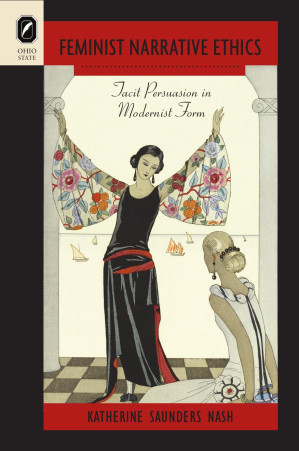
upload/alexandrina/Collections/Project-Muse/The Ohio State University Press/Feminist Narrative Ethics- Tacit Persuasion in Modernist Form.pdf
Feminist Narrative Ethics: Tacit Persuasion in Modernist Form (THEORY INTERPRETATION NARRATIV) 🔍
Nash, Katherine Saunders
The Ohio State University Press, Theory and interpretation of narrative series; collections on Project MUSE; UPCC collections on Project MUSE. Literature, 2014
English [en] · PDF · 2.3MB · 2014 · 📘 Book (non-fiction) · 🚀/lgli/upload/zlib · Save
description
Feminist Narrative Tacit Persuasion in Modernist Form establishes a new theory of narrative ethics by analyzing rhetorical techniques prompt readers of novels to reconsider their ethical convictions about womens rights. Katherine Saunders Nash proposes four new theoretical the ethics of persuasion (Virginia Woolf), of fair play (Dorothy L. Sayers), of distance (E. M. Forster), and of attention (John Cowper Powys). While offering close readings of novels by each author, this book also provides a new, interdisciplinary basis for coordinating feminist and rhetorical theories, history, and narrative technique.
Despite pronouncements by many theorists about the difficultyeven the impossibilityof doing justice in a single study to both history and form, Feminist Narrative Ethics proves that they can be mutually illuminating. Its approach is not only resolutely rhetorical, but resolutely historical as well. It strikes a felicitous balance between history and form that affords new understanding of the implied author concept.
Feminist Narrative Ethics makes a persuasive case for the necessity of locating authorial agency in the implied (rather than the actual) author and cogently explains why rhetorical theory insists on the concept of an implied (rather than an inferred) author. And it proposes a new facet of agency that rhetorical theorists have heretofore the ethics of progressive revisions to a project in manuscript.
Despite pronouncements by many theorists about the difficultyeven the impossibilityof doing justice in a single study to both history and form, Feminist Narrative Ethics proves that they can be mutually illuminating. Its approach is not only resolutely rhetorical, but resolutely historical as well. It strikes a felicitous balance between history and form that affords new understanding of the implied author concept.
Feminist Narrative Ethics makes a persuasive case for the necessity of locating authorial agency in the implied (rather than the actual) author and cogently explains why rhetorical theory insists on the concept of an implied (rather than an inferred) author. And it proposes a new facet of agency that rhetorical theorists have heretofore the ethics of progressive revisions to a project in manuscript.
Alternative filename
lgli/R:\Project-Muse\md5_rep\9DE1670A4C736BA5D0A6545A34B9B8CC.pdf
Alternative author
Project MUSE (https://muse.jhu.edu/)
Alternative author
Katherine Saunders Nash
Alternative edition
Theory and interpretation of narrative series, Columbus, 2014
Alternative edition
United States, United States of America
Alternative edition
1, PT, 2014
metadata comments
producers:
Muse-DL/1.1.0
Muse-DL/1.1.0
Alternative description
Cover 1
Title page, Copyright, Dedication 2
Contents 8
Acknowledgments 10
Introduction 12
1. The Ethics of Distance 31
2. The Ethics of Fair Play 65
3. The Ethics of Persuasion 101
4. The Ethics of Attention 128
Conclusion 154
Notes 158
Bibliography 177
Index 184
Other Titles in the Series 190
Publisher:The Ohio State University Press,Published:2013,ISBN:9780814275771,Related ISBN:9780814212424,Language:English,OCLC:899261043
Feminist Narrative Ethics: Tacit Persuasion in Modernist Form establishes a new theory of narrative ethics by analyzing how rhetorical techniques can prompt readers of novels to reconsider their ethical convictions about women’s rights. Katherine Saunders Nash proposes four new theoretical paradigms: the ethics of persuasion (Virginia Woolf), of fair play (Dorothy L. Sayers), of distance (E.€M. Forster), and of attention (John Cowper Powys). While offering close readings of novels by each author, this book also provides a new, interdisciplinary basis for coordinating feminist and rhetorical theories, history, and narrative technique. Despite pronouncements by many theorists about the difficulty—even the impossibility—of doing justice in a single study to both history and form, Feminist Narrative Ethics proves that they can be mutually illuminating. Its approach is not only resolutely rhetorical, but resolutely historical as well. It strikes a felicitous balance between history and form that affords new understanding of the implied author concept. Feminist Narrative Ethics makes a persuasive case for the necessity of locating authorial agency in the implied (rather than the actual) author and cogently explains why rhetorical theory insists on the concept of an implied (rather than an inferred) author. And it proposes a new facet of agency that rhetorical theorists have heretofore neglected: the ethics of progressive revisions to a project in manuscript.
Title page, Copyright, Dedication 2
Contents 8
Acknowledgments 10
Introduction 12
1. The Ethics of Distance 31
2. The Ethics of Fair Play 65
3. The Ethics of Persuasion 101
4. The Ethics of Attention 128
Conclusion 154
Notes 158
Bibliography 177
Index 184
Other Titles in the Series 190
Publisher:The Ohio State University Press,Published:2013,ISBN:9780814275771,Related ISBN:9780814212424,Language:English,OCLC:899261043
Feminist Narrative Ethics: Tacit Persuasion in Modernist Form establishes a new theory of narrative ethics by analyzing how rhetorical techniques can prompt readers of novels to reconsider their ethical convictions about women’s rights. Katherine Saunders Nash proposes four new theoretical paradigms: the ethics of persuasion (Virginia Woolf), of fair play (Dorothy L. Sayers), of distance (E.€M. Forster), and of attention (John Cowper Powys). While offering close readings of novels by each author, this book also provides a new, interdisciplinary basis for coordinating feminist and rhetorical theories, history, and narrative technique. Despite pronouncements by many theorists about the difficulty—even the impossibility—of doing justice in a single study to both history and form, Feminist Narrative Ethics proves that they can be mutually illuminating. Its approach is not only resolutely rhetorical, but resolutely historical as well. It strikes a felicitous balance between history and form that affords new understanding of the implied author concept. Feminist Narrative Ethics makes a persuasive case for the necessity of locating authorial agency in the implied (rather than the actual) author and cogently explains why rhetorical theory insists on the concept of an implied (rather than an inferred) author. And it proposes a new facet of agency that rhetorical theorists have heretofore neglected: the ethics of progressive revisions to a project in manuscript.
Alternative description
"Feminist Narrative Ethics: Tacit Persuasion in Modernist Form establishes a new theory of narrative ethics by analyzing how rhetorical techniques can prompt readers of novels to reconsider their ethical convictions about women's rights. Katherine Saunders Nash proposes four new theoretical paradigms: the ethics of persuasion (Virginia Woolf), of fair play (Dorothy L. Sayers), of distance (E.M. Forster), and of attention (John Cowper Powys). While offering close readings of novels by each author, this book also provides a new, interdisciplinary basis for coordinating feminist and rhetorical theories, history, and narrative technique. Despite pronouncements by many theorists about the difficulty--even the impossibility--of doing justice in a single study to both history and form, Feminist Narrative Ethics proves that they can be mutually illuminating. Its approach is not only resolutely rhetorical, but resolutely historical as well. It strikes a felicitous balance between history and form that affords new understanding of the implied author concept. Feminist Narrative Ethics makes a persuasive case for the necessity of locating authorial agency in the implied (rather than the actual) author and cogently explains why rhetorical theory insists on the concept of an implied (rather than an inferred) author. And it proposes a new facet of agency that rhetorical theorists have heretofore neglected: the ethics of progressive revisions to a project in manuscript."--Publisher's description
date open sourced
2022-03-08
🚀 Fast downloads
Become a member to support the long-term preservation of books, papers, and more. To show our gratitude for your support, you get fast downloads. ❤️
- Fast Partner Server #1 (recommended)
- Fast Partner Server #2 (recommended)
- Fast Partner Server #3 (recommended)
- Fast Partner Server #4 (recommended)
- Fast Partner Server #5 (recommended)
- Fast Partner Server #6 (recommended)
- Fast Partner Server #7
- Fast Partner Server #8
- Fast Partner Server #9
- Fast Partner Server #10
- Fast Partner Server #11
- Fast Partner Server #12
🐢 Slow downloads
From trusted partners. More information in the FAQ. (might require browser verification — unlimited downloads!)
- Slow Partner Server #1 (slightly faster but with waitlist)
- Slow Partner Server #2 (slightly faster but with waitlist)
- Slow Partner Server #3 (slightly faster but with waitlist)
- Slow Partner Server #4 (slightly faster but with waitlist)
- Slow Partner Server #5 (no waitlist, but can be very slow)
- Slow Partner Server #6 (no waitlist, but can be very slow)
- Slow Partner Server #7 (no waitlist, but can be very slow)
- Slow Partner Server #8 (no waitlist, but can be very slow)
- Slow Partner Server #9 (no waitlist, but can be very slow)
- After downloading: Open in our viewer
All download options have the same file, and should be safe to use. That said, always be cautious when downloading files from the internet, especially from sites external to Anna’s Archive. For example, be sure to keep your devices updated.
External downloads
-
For large files, we recommend using a download manager to prevent interruptions.
Recommended download managers: JDownloader -
You will need an ebook or PDF reader to open the file, depending on the file format.
Recommended ebook readers: Anna’s Archive online viewer, ReadEra, and Calibre -
Use online tools to convert between formats.
Recommended conversion tools: CloudConvert and PrintFriendly -
You can send both PDF and EPUB files to your Kindle or Kobo eReader.
Recommended tools: Amazon‘s “Send to Kindle” and djazz‘s “Send to Kobo/Kindle” -
Support authors and libraries
✍️ If you like this and can afford it, consider buying the original, or supporting the authors directly.
📚 If this is available at your local library, consider borrowing it for free there.
Total downloads:
A “file MD5” is a hash that gets computed from the file contents, and is reasonably unique based on that content. All shadow libraries that we have indexed on here primarily use MD5s to identify files.
A file might appear in multiple shadow libraries. For information about the various datasets that we have compiled, see the Datasets page.
For information about this particular file, check out its JSON file. Live/debug JSON version. Live/debug page.