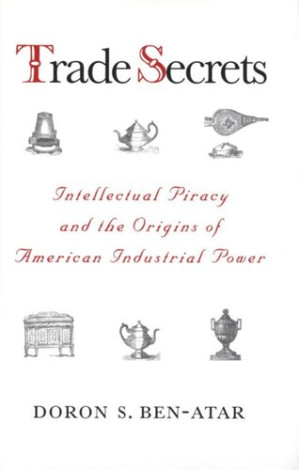
Trade Secrets : Intellectual Piracy and the Origins of American Industrial Power 🔍
Doron S. Ben-Atar
Yale University Press, New Haven, CT, 2008
English [en] · PDF · 1.0MB · 2008 · 📘 Book (non-fiction) · 🚀/lgli/lgrs/nexusstc/upload/zlib · Save
description
During the first decades of America’s existence as a nation, private citizens, voluntary associations, and government officials encouraged the smuggling of European inventions and artisans to the New World. At the same time, the young republic was developing policies that set new standards for protecting industrial innovations. This book traces the evolution of America’s contradictory approach to intellectual property rights from the colonial period to the age of Jackson.
During the seventeenth and early eighteenth centuries Britain shared technological innovations selectively with its American colonies. It became less willing to do so once America’s fledgling industries grew more competitive. After the Revolution, the leaders of the republic supported the piracy of European technology in order to promote the economic strength and political independence of the new nation. By the middle of the nineteenth century, the United States became a leader among industrializing nations and a major exporter of technology. It erased from national memory its years of piracy and became the world’s foremost advocate of international laws regulating intellectual property.
During the seventeenth and early eighteenth centuries Britain shared technological innovations selectively with its American colonies. It became less willing to do so once America’s fledgling industries grew more competitive. After the Revolution, the leaders of the republic supported the piracy of European technology in order to promote the economic strength and political independence of the new nation. By the middle of the nineteenth century, the United States became a leader among industrializing nations and a major exporter of technology. It erased from national memory its years of piracy and became the world’s foremost advocate of international laws regulating intellectual property.
Alternative filename
nexusstc/Trade Secrets: Intellectual Piracy and the Origins of American Industrial Power/aaf01c4477d9fb8d16edf2d254a2fddc.pdf
Alternative filename
lgli/10.12987_9780300127218.pdf
Alternative filename
lgrsnf/10.12987_9780300127218.pdf
Alternative author
Ben-Atar, Doron S.
Alternative publisher
San Francisco Museum of Modern Art
Alternative publisher
Brandywine River Museum
Alternative publisher
Mariners' Museum, The
Alternative edition
Yale University Press, New Haven, CT, 2004
Alternative edition
United States, United States of America
Alternative edition
1, 2004
Alternative edition
2017
metadata comments
producers:
iTextSharp 5.0.6 (c) 1T3XT BVBA
iTextSharp 5.0.6 (c) 1T3XT BVBA
metadata comments
{"isbns":["0300127219","9780300127218"],"last_page":304,"publisher":"Yale University Press"}
Alternative description
<p>In this original book, B. Kumaravadivelu presents a macrostrategic framework designed to help both beginning and experienced teachers develop a systematic, coherent, and personal theory of practice. His book provides the tools a teacher needs in order to self-observe, self-analyze, and self-evaluate his or her own teaching acts.</p>
<p>The framework consists of ten macrostrategies based on current theoretical, empirical, and experiential knowledge of second language and foreign language teaching. These strategies enable teachers to evaluate classroom practices and to generate techniques and activities for realizing teaching goals. With checklists, surveys, projects, and reflective tasks to encourage critical thinking, the book is both practical and accessible. Teachers and future teachers, researchers, and teacher educators will find the volume indispensable.</p>
<p>The framework consists of ten macrostrategies based on current theoretical, empirical, and experiential knowledge of second language and foreign language teaching. These strategies enable teachers to evaluate classroom practices and to generate techniques and activities for realizing teaching goals. With checklists, surveys, projects, and reflective tasks to encourage critical thinking, the book is both practical and accessible. Teachers and future teachers, researchers, and teacher educators will find the volume indispensable.</p>
Alternative description
"This book traces the evolution of America's contradictory approach to intellectual property rights from the colonial period to the age of Jackson." "During the seventeenth and early eighteenth centuries Britain shared technological innovations selectively with its American colonies. It became less willing to do so once America's fledgling industries grew more competitive. After the Revolution, the leaders of the republic supported the piracy of European technology in order to promote the economic strength and political independence of the new nation. By the middle of the nineteenth century, the United States became a leader among industrializing nations and a major exporter of technology. It erased from national memory its years of piracy and became the world's foremost advocate of international laws regulating intellectual property."--Jacket.
Alternative description
Contents 7
Acknowledgments 9
Introduction 13
Chapter 1. Knowledge as Property in the International State System 23
Chapter 2. The Battle over Technology within the Empire 40
Chapter 3. Benjamin Franklin and America’s Technology Deficit 66
Chapter 4. After the Revolution: ‘‘The American Seduction of Machines and Artisans’’ 100
Chapter 5. Official Orchestration of Technology Smuggling 126
Chapter 6. Constructing the American Understanding of Intellectual Property 164
Chapter 7. The Path to Crystal Palace 206
Notes 237
Index 291
Acknowledgments 9
Introduction 13
Chapter 1. Knowledge as Property in the International State System 23
Chapter 2. The Battle over Technology within the Empire 40
Chapter 3. Benjamin Franklin and America’s Technology Deficit 66
Chapter 4. After the Revolution: ‘‘The American Seduction of Machines and Artisans’’ 100
Chapter 5. Official Orchestration of Technology Smuggling 126
Chapter 6. Constructing the American Understanding of Intellectual Property 164
Chapter 7. The Path to Crystal Palace 206
Notes 237
Index 291
Alternative description
During the first decades of America's existence as a nation private citizens, voluntary associations, & government officials encouraged the smuggling of European inventions & artisans to the New World. At the same time the new US was setting new standards for the protection of industrial innovations
date open sourced
2023-05-30
🚀 Fast downloads
Become a member to support the long-term preservation of books, papers, and more. To show our gratitude for your support, you get fast downloads. ❤️
- Fast Partner Server #1 (recommended)
- Fast Partner Server #2 (recommended)
- Fast Partner Server #3 (recommended)
- Fast Partner Server #4 (recommended)
- Fast Partner Server #5 (recommended)
- Fast Partner Server #6 (recommended)
- Fast Partner Server #7
- Fast Partner Server #8
- Fast Partner Server #9
- Fast Partner Server #10
- Fast Partner Server #11
- Fast Partner Server #12
🐢 Slow downloads
From trusted partners. More information in the FAQ. (might require browser verification — unlimited downloads!)
- Slow Partner Server #1 (slightly faster but with waitlist)
- Slow Partner Server #2 (slightly faster but with waitlist)
- Slow Partner Server #3 (slightly faster but with waitlist)
- Slow Partner Server #4 (slightly faster but with waitlist)
- Slow Partner Server #5 (no waitlist, but can be very slow)
- Slow Partner Server #6 (no waitlist, but can be very slow)
- Slow Partner Server #7 (no waitlist, but can be very slow)
- Slow Partner Server #8 (no waitlist, but can be very slow)
- Slow Partner Server #9 (no waitlist, but can be very slow)
- After downloading: Open in our viewer
All download options have the same file, and should be safe to use. That said, always be cautious when downloading files from the internet, especially from sites external to Anna’s Archive. For example, be sure to keep your devices updated.
External downloads
-
For large files, we recommend using a download manager to prevent interruptions.
Recommended download managers: JDownloader -
You will need an ebook or PDF reader to open the file, depending on the file format.
Recommended ebook readers: Anna’s Archive online viewer, ReadEra, and Calibre -
Use online tools to convert between formats.
Recommended conversion tools: CloudConvert and PrintFriendly -
You can send both PDF and EPUB files to your Kindle or Kobo eReader.
Recommended tools: Amazon‘s “Send to Kindle” and djazz‘s “Send to Kobo/Kindle” -
Support authors and libraries
✍️ If you like this and can afford it, consider buying the original, or supporting the authors directly.
📚 If this is available at your local library, consider borrowing it for free there.
Total downloads:
A “file MD5” is a hash that gets computed from the file contents, and is reasonably unique based on that content. All shadow libraries that we have indexed on here primarily use MD5s to identify files.
A file might appear in multiple shadow libraries. For information about the various datasets that we have compiled, see the Datasets page.
For information about this particular file, check out its JSON file. Live/debug JSON version. Live/debug page.