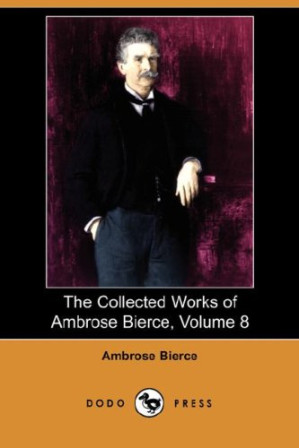
The Collected Works Of Ambrose Bierce, Volume 8 (dodo Press) 🔍
Ambrose Bierce
Dodo Press, 2008
English [en] · PDF · 0.8MB · 2008 · 📘 Book (non-fiction) · 🚀/lgli/lgrs/nexusstc/zlib · Save
description
Ambrose Gwinnett Bierce (1842-1914) was an American editorialist, journalist, short-story writer and satirist, today best known for his The Devil's Dictionary (1911). He wrote some of his books under the pseudonyms Dod Grile and J. Milton Sloluck. Bierce's lucid, unsentimental style has kept him popular when many of his contemporaries have been consigned to oblivion. His dark, sardonic views and vehemence as a critic earned him the nickname, "Bitter Bierce. " Such was his reputation that it was said his judgment on any piece of prose or poetry could make or break a writer's career. His short stories are considered among the best of the 19th century, providing a popular following based on his roots. He wrote realistically of the terrible things he had seen in the war in such stories as An Occurrence at Owl Creek Bridge, Killed at Resaca, and Chickamauga. His works include: The Fiend's Delight (1873), Cobwebs from an Empty Skull (1874), Black Beetles in Amber (1892), Fantastic Fables (1899), Shapes of Clay (1903), A Son of the Gods, and A Horseman in the Sky (1907), Write It Right (1909) and A Cynic Looks at Life (1912).
Alternative filename
lgrsnf/D:\!genesis\library.nu\af\_204838.af06fe25a308b585ef6e98f583d2cff9.pdf
Alternative filename
nexusstc/The Collected Works of Ambrose Bierce, Volume 8/af06fe25a308b585ef6e98f583d2cff9.pdf
Alternative edition
United Kingdom and Ireland, United Kingdom
metadata comments
до 2011-01
metadata comments
lg506082
metadata comments
{"isbns":["1406595888","9781406595888"],"last_page":204}
date open sourced
2011-06-04
🚀 Fast downloads
Become a member to support the long-term preservation of books, papers, and more. To show our gratitude for your support, you get fast downloads. ❤️
- Fast Partner Server #1 (recommended)
- Fast Partner Server #2 (recommended)
- Fast Partner Server #3 (recommended)
- Fast Partner Server #4 (recommended)
- Fast Partner Server #5 (recommended)
- Fast Partner Server #6 (recommended)
- Fast Partner Server #7
- Fast Partner Server #8
- Fast Partner Server #9
- Fast Partner Server #10
- Fast Partner Server #11
- Fast Partner Server #12
🐢 Slow downloads
From trusted partners. More information in the FAQ. (might require browser verification — unlimited downloads!)
- Slow Partner Server #1 (slightly faster but with waitlist)
- Slow Partner Server #2 (slightly faster but with waitlist)
- Slow Partner Server #3 (slightly faster but with waitlist)
- Slow Partner Server #4 (slightly faster but with waitlist)
- Slow Partner Server #5 (no waitlist, but can be very slow)
- Slow Partner Server #6 (no waitlist, but can be very slow)
- Slow Partner Server #7 (no waitlist, but can be very slow)
- Slow Partner Server #8 (no waitlist, but can be very slow)
- Slow Partner Server #9 (no waitlist, but can be very slow)
- After downloading: Open in our viewer
All download options have the same file, and should be safe to use. That said, always be cautious when downloading files from the internet, especially from sites external to Anna’s Archive. For example, be sure to keep your devices updated.
External downloads
-
For large files, we recommend using a download manager to prevent interruptions.
Recommended download managers: JDownloader -
You will need an ebook or PDF reader to open the file, depending on the file format.
Recommended ebook readers: Anna’s Archive online viewer, ReadEra, and Calibre -
Use online tools to convert between formats.
Recommended conversion tools: CloudConvert and PrintFriendly -
You can send both PDF and EPUB files to your Kindle or Kobo eReader.
Recommended tools: Amazon‘s “Send to Kindle” and djazz‘s “Send to Kobo/Kindle” -
Support authors and libraries
✍️ If you like this and can afford it, consider buying the original, or supporting the authors directly.
📚 If this is available at your local library, consider borrowing it for free there.
Total downloads:
A “file MD5” is a hash that gets computed from the file contents, and is reasonably unique based on that content. All shadow libraries that we have indexed on here primarily use MD5s to identify files.
A file might appear in multiple shadow libraries. For information about the various datasets that we have compiled, see the Datasets page.
For information about this particular file, check out its JSON file. Live/debug JSON version. Live/debug page.