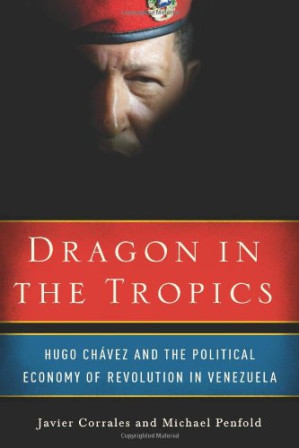
upload/misc/turkish_books2/Kütüphaneler/Kütüphane 9 (2)/Javier Corrales-Michael Penfold-Michael Penfold-Becerra Brookings Institution. Latin America Initiative Dragon in the tropics Hugo Chávez and the political economy of revolution in Venezuela.pdf
Dragon in the tropics: Hugo Chávez and the political economy of revolution in Venezuela 🔍
Javier Corrales, Michael Penfold, Michael Penfold-Becerra, Brookings Institution. Latin America Initiative
Brookings Institution Press, Original, FR, 2011
English [en] · PDF · 2.8MB · 2011 · 📘 Book (non-fiction) · 🚀/lgli/lgrs/nexusstc/upload/zlib · Save
description
Since he was first elected in 1999, Venezuelan President Hugo Ch?vez Frias has reshaped a frail but nonetheless pluralistic democracy into a semi-authoritarian regime—an outcome achieved with spectacularly high oil income and widespread electoral support. This eye-opening book illuminates one of the most sweeping and unexpected political transformations in contemporary Latin America. Based on more than fifteen years’ experience in researching and writing about Venezuela, Javier Corrales and Michael Penfold have crafted a comprehensive account of how the Ch?vez regime has revamped the nation, with a particular focus on its political transformation. Throughout, they take issue with conventional explanations. First, they argue persuasively that liberal democracy as an institution was not to blame for the rise of chavismo. Second, they assert that the nation's economic ailments were not caused by neoliberalism. Instead they blame other factors, including a dependence on oil, which caused macroeconomic volatility; political party fragmentation, which triggered infighting; government mismanagement of the banking crisis, which led to more centralization of power; and the Asian crisis of 1997, which devastated Venezuela's economy at the same time that Ch?vez ran for president. It is perhaps on the role of oil that the authors take greatest issue with prevailing opinion. They do not dispute that dependence on oil can generate political and economic distortions—the “resource curse” or “paradox of plenty” arguments—but they counter that oil alone fails to explain Ch?vez’s rise. Instead they single out a weak framework of checks and balances that allowed the executive branch to extract oil rents and distribute them to the populace. The real culprit behind Ch?vez’s success, they write, was the asymmetry of political power.
Alternative filename
nexusstc/Dragon in the tropics: Hugo Chávez and the political economy of revolution in Venezuela/ba0682a985e75c63a70bc34d26a2c7f8.pdf
Alternative filename
lgli/_461982.ba0682a985e75c63a70bc34d26a2c7f8.pdf
Alternative filename
lgrsnf/_461982.ba0682a985e75c63a70bc34d26a2c7f8.pdf
Alternative title
Dragon in the Tropics: Hugo Chavez and the Political Economy of Revolution in Venezuela (Brookings Latin America Initiative)
Alternative author
Javier Corrales, Javier Corrales, Michael Penfold
Alternative author
Corrales, Javier.,Penfold-Becerra, Michael.
Alternative author
Corrales, Javier, Penfold, Michael
Alternative author
Acrobat 9.0.0
Alternative edition
The Latin America initiative at Brookings, Washington, D.C, ©2011
Alternative edition
Brookings Latin America Initiative book, Washington, D.C, ©2011
Alternative edition
Rowman & Littlefield Publishing, Washington, D.C., 2011
Alternative edition
Washington, D.C, District of Columbia, 2011
Alternative edition
United States, United States of America
Alternative edition
Washington, D.C, United States, 2011
metadata comments
2011 12 30
metadata comments
lg768812
metadata comments
producers:
Adobe PDF Library 9.0
Adobe PDF Library 9.0
metadata comments
{"isbns":["0815704976","9780815704973"],"last_page":209,"publisher":"Brookings Institution Press"}
metadata comments
Includes bibliographical references (p. 163-179) and index.
metadata comments
РГБ
metadata comments
Russian State Library [rgb] MARC:
=001 005443888
=005 20120626141957.0
=008 101007s2011\\\\xxua\\\\\b\\\\001\0\eng\\
=017 \\ $a И4005-12
=020 \\ $a 9780815704973 (pbk. : alk. paper)
=040 \\ $a DLC $c DLC $d DLC $d RuMoRGB
=041 0\ $a eng
=043 \\ $a s-ve---
=044 \\ $a xxu
=084 \\ $a Т3(7В)64,02 $2 rubbk
=100 1\ $a Corrales, Javier $d 1966-
=245 00 $a Dragon in the tropics : $b Hugo Chávez and the political economy of revolution in Venezuela / $c Javier Corrales, Michael Penfold.
=260 \\ $a Washington, D.C. : $b Brookings Institution Press, $c cop. 2011.
=300 \\ $a x, 195 с. : $b ил. ; $c 23 см
=504 \\ $a Includes bibliographical references (p. 163-179) and index.
=600 10 $a Chávez Frías, Hugo $d 1954-
=650 \7 $a История. Исторические науки -- История зарубежных стран -- Венесуэла -- 1991- $2 rubbk
=700 1\ $a Penfold-Becerra, Michael $d 1970-
=852 4\ $a РГБ $b FB $j 5 12-6/90 $x 90
=001 005443888
=005 20120626141957.0
=008 101007s2011\\\\xxua\\\\\b\\\\001\0\eng\\
=017 \\ $a И4005-12
=020 \\ $a 9780815704973 (pbk. : alk. paper)
=040 \\ $a DLC $c DLC $d DLC $d RuMoRGB
=041 0\ $a eng
=043 \\ $a s-ve---
=044 \\ $a xxu
=084 \\ $a Т3(7В)64,02 $2 rubbk
=100 1\ $a Corrales, Javier $d 1966-
=245 00 $a Dragon in the tropics : $b Hugo Chávez and the political economy of revolution in Venezuela / $c Javier Corrales, Michael Penfold.
=260 \\ $a Washington, D.C. : $b Brookings Institution Press, $c cop. 2011.
=300 \\ $a x, 195 с. : $b ил. ; $c 23 см
=504 \\ $a Includes bibliographical references (p. 163-179) and index.
=600 10 $a Chávez Frías, Hugo $d 1954-
=650 \7 $a История. Исторические науки -- История зарубежных стран -- Венесуэла -- 1991- $2 rubbk
=700 1\ $a Penfold-Becerra, Michael $d 1970-
=852 4\ $a РГБ $b FB $j 5 12-6/90 $x 90
Alternative description
Since he was first elected in 1999, Venezuelan President Hugo Chávez Frías has reshaped a frail but nonetheless pluralistic democracy into a semi-authoritarian regimean outcome achieved with spectacularly high oil income and widespread electoral support. This eye-opening book illuminates one of the most sweeping and unexpected political transformations in contemporary Latin America.Based on more than fifteen years'experience in researching and writing about Venezuela, Javier Corrales and Michael Penfold have crafted a comprehensive account of how the Chávez regime has revamped the nation, with a particular focus on its political transformation. Throughout, they take issue with conventional explanations. First, they argue persuasively that liberal democracy as an institution was not to blame for the rise of chavismo. Second, they assert that the nation's economic ailments were not caused by neoliberalism. Instead they blame other factors, including a dependence on oil, which caused macroeconomic volatility; political party fragmentation, which triggered infighting; government mismanagement of the banking crisis, which led to more centralization of power; and the Asian crisis of 1997, which devastated Venezuela's economy at the same time that Chávez ran for president.It is perhaps on the role of oil that the authors take greatest issue with prevailing opinion. They do not dispute that dependence on oil can generate political and economic distortionsthe'resource curse'or'paradox of plenty'argumentsbut they counter that oil alone fails to explain Chávez's rise. Instead they single out a weak framework of checks and balances that allowed the executive branch to extract oil rents and distribute them to the populace. The real culprit behind Chávez's success, they write, was the asymmetry of political power.
Alternative description
A Study Of The Venezuelan Revolution Headed By Hugo Chávez, First Elected President In 1999, With Emphasis On How Chávez Took A Frail But Still Pluralistic Democracy And Turned It Into A Semi-authoritarian Regime, Achieving Political Transformation At Great Cost To The Country's Institutions, Including Its Oil Industry--provided By Publisher. Introduction : The Chávez Revolution In Perspective -- Power Grabbing And The Rise Of A Hybrid Regime In Venezuela, 1999-2009 -- Economic Policy And The Oil Honey Pot -- Institutional Resource Curse : Seizing Political Control Of Pdvsa -- Venezuela's New Foreign Policy : Soft-balancing And Social Power Diplomacy -- Hybrid Regimes And Populism In Venezuela And Beyond. Javier Corrales, Michael Penfold. At Head Of Title: A Brookings Latin America Initiative Book. Includes Bibliographical References (p.163-179) And Index.
Alternative description
Copyright Information
......Page 5
Table of Contents
......Page 8
Acknowledgments
......Page 10
Introduction: The Chavez Revolution in Perspective
......Page 12
Power Grabbing and the Rise of a Hybrid Regime in Venezuela, 1999-2009
......Page 25
Economic Policy and the Oil Honey Pot
......Page 58
Institutional Resource Curse: Seizing Political Control of PDVSA
......Page 82
Venezuela's New Foreign Policy: Soft-Balancing and Social-Power Diplomacy
......Page 109
Conclusion: Hybrid Regimes and Populism in Venezuela and Beyond
......Page 148
Notes
......Page 174
Index
......Page 192
Back Cover
......Page 209
......Page 5
Table of Contents
......Page 8
Acknowledgments
......Page 10
Introduction: The Chavez Revolution in Perspective
......Page 12
Power Grabbing and the Rise of a Hybrid Regime in Venezuela, 1999-2009
......Page 25
Economic Policy and the Oil Honey Pot
......Page 58
Institutional Resource Curse: Seizing Political Control of PDVSA
......Page 82
Venezuela's New Foreign Policy: Soft-Balancing and Social-Power Diplomacy
......Page 109
Conclusion: Hybrid Regimes and Populism in Venezuela and Beyond
......Page 148
Notes
......Page 174
Index
......Page 192
Back Cover
......Page 209
Alternative description
Copyright Information
5
Table of Contents
8
Acknowledgments
10
Introduction: The Chavez Revolution in Perspective
12
Power Grabbing and the Rise of a Hybrid Regime in Venezuela, 1999-2009
25
Economic Policy and the Oil Honey Pot
58
Institutional Resource Curse: Seizing Political Control of PDVSA
82
Venezuela's New Foreign Policy: Soft-Balancing and Social-Power Diplomacy
109
Conclusion: Hybrid Regimes and Populism in Venezuela and Beyond
148
Notes
174
Index
192
Back Cover
209
9780815704973
Brookings Institution Press
5
Table of Contents
8
Acknowledgments
10
Introduction: The Chavez Revolution in Perspective
12
Power Grabbing and the Rise of a Hybrid Regime in Venezuela, 1999-2009
25
Economic Policy and the Oil Honey Pot
58
Institutional Resource Curse: Seizing Political Control of PDVSA
82
Venezuela's New Foreign Policy: Soft-Balancing and Social-Power Diplomacy
109
Conclusion: Hybrid Regimes and Populism in Venezuela and Beyond
148
Notes
174
Index
192
Back Cover
209
9780815704973
Brookings Institution Press
Alternative description
Introduction : new lessons from the Chavez revolution
Power grabbing in democracy and the rise of a hybrid regime in Venezuela
Economic policy and the oil honey pot
Institutional resource curse : seizing political control of PDVSA
Soft-balancing and social power diplomacy : Venezuela's new foreign policy and its contradictions
Conclusion : hybrid regimes and populism in Venezuela and beyond.
Power grabbing in democracy and the rise of a hybrid regime in Venezuela
Economic policy and the oil honey pot
Institutional resource curse : seizing political control of PDVSA
Soft-balancing and social power diplomacy : Venezuela's new foreign policy and its contradictions
Conclusion : hybrid regimes and populism in Venezuela and beyond.
Alternative description
Since he was first elected in 1999, Venezuelan President Hugo Chavez Frias has reshaped a frail but nonetheless pluralistic democracy into a semi-authoritarian regime --an outcome achieved with spectacularly high oil income and widespread electoral support.
date open sourced
2012-02-04
🚀 Fast downloads
Become a member to support the long-term preservation of books, papers, and more. To show our gratitude for your support, you get fast downloads. ❤️
- Fast Partner Server #1 (recommended)
- Fast Partner Server #2 (recommended)
- Fast Partner Server #3 (recommended)
- Fast Partner Server #4 (recommended)
- Fast Partner Server #5 (recommended)
- Fast Partner Server #6 (recommended)
- Fast Partner Server #7
- Fast Partner Server #8
- Fast Partner Server #9
- Fast Partner Server #10
- Fast Partner Server #11
- Fast Partner Server #12
🐢 Slow downloads
From trusted partners. More information in the FAQ. (might require browser verification — unlimited downloads!)
- Slow Partner Server #1 (slightly faster but with waitlist)
- Slow Partner Server #2 (slightly faster but with waitlist)
- Slow Partner Server #3 (slightly faster but with waitlist)
- Slow Partner Server #4 (slightly faster but with waitlist)
- Slow Partner Server #5 (no waitlist, but can be very slow)
- Slow Partner Server #6 (no waitlist, but can be very slow)
- Slow Partner Server #7 (no waitlist, but can be very slow)
- Slow Partner Server #8 (no waitlist, but can be very slow)
- Slow Partner Server #9 (no waitlist, but can be very slow)
- After downloading: Open in our viewer
All download options have the same file, and should be safe to use. That said, always be cautious when downloading files from the internet, especially from sites external to Anna’s Archive. For example, be sure to keep your devices updated.
External downloads
-
For large files, we recommend using a download manager to prevent interruptions.
Recommended download managers: JDownloader -
You will need an ebook or PDF reader to open the file, depending on the file format.
Recommended ebook readers: Anna’s Archive online viewer, ReadEra, and Calibre -
Use online tools to convert between formats.
Recommended conversion tools: CloudConvert and PrintFriendly -
You can send both PDF and EPUB files to your Kindle or Kobo eReader.
Recommended tools: Amazon‘s “Send to Kindle” and djazz‘s “Send to Kobo/Kindle” -
Support authors and libraries
✍️ If you like this and can afford it, consider buying the original, or supporting the authors directly.
📚 If this is available at your local library, consider borrowing it for free there.
Total downloads:
A “file MD5” is a hash that gets computed from the file contents, and is reasonably unique based on that content. All shadow libraries that we have indexed on here primarily use MD5s to identify files.
A file might appear in multiple shadow libraries. For information about the various datasets that we have compiled, see the Datasets page.
For information about this particular file, check out its JSON file. Live/debug JSON version. Live/debug page.