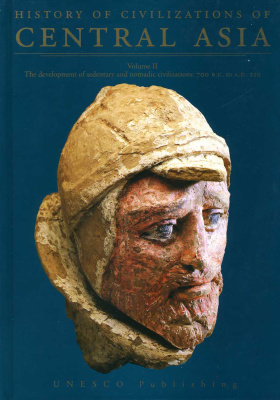
History of civilizations of Central Asia. Volume II. The development of sedentary and nomadic civilizations: 700 B.C. to A.D. 250 🔍
Ahmad Hasan Dani; V. M Masson; J Harmatta; Baij Nath Puri; G. F Etemadi; B. A Litvinskiĭ; Guangda Zhang; R. Shabani Samghabadi; Muḣammad Osimī; Clifford Edmund Bosworth; C Adle; Irfan Habib; Madhavan K Palat; Anara Tabyshalieva; Unesco
Unesco Regional Office for, Multiple history series, Paris, 1992-2005
English [en] · PDF · 19.2MB · 1992 · 📘 Book (non-fiction) · 🚀/lgli/lgrs/nexusstc/zlib · Save
description
Harmatta J. (Ed.) — Paris: UNESCO Publishing, 1996. — 573 pp. — ISBN 92-3-102846-4. Volume II of the History of Civilizations of Central Asia presents an account of various movements of populations and the interrelations of their cultures in this region between 700 B.C. and A.D. 250. This period saw the emergence of several nomadic and sedentary civilizations who lived partly in the steppe zone and partly in the oasis zone. The contrast between them was accentuated by the rise of the Achaemenid Empire. The invasion of Alexander the Great transformed the scene. The nomads were driven back, sedentary civilization was strengthened and became rapidly predominant. With the rise of the Graeco-Bactrian kingdom, the civilizations of Central Asia underwent a fundamental change by a progressive syncretism between Zoroastrianism, Greek religion and Buddhism, which formed the basis of the civilizations of Central Asia up to the Arab conquest. In the first century B.C. the Sakas established a series of kingdoms in eastern Iran and north-western India, but in the first century A.D. these territories came under the control of the Parthians who ruled an empire that stretched from Sistan to the Indus and beyond. Meanwhile, the Kushan Empire was emerging, overthrowing the Parthians and annexing their Indian provinces. A rich and prosperous trade developed between the Mediterranean and China through Central Asia by what is known as the Silk Route. Traversed by caravans of Bactrian camels, this international highway remained in use for several centuries despite the development of the sea routes. It was only in about A.D. 234 that the Kushan Empire faced a new powerful enemy - Sasanian Iran - who led to its disintegration. Introduction (J. Harmatta).
Ancient Iranian nomads in western Central Asia (A. Abetekov and H. Yusupov).
Media and Achaemenid Iran (M. A. Dandamayev).
Alexander and his successors in Central Asia (A. H. Dani and P. Bernard).
The Greek kingdoms of Central Asia (P. Bernard).
Parthia (G. A. Koshelenko and V. N. Pilipko).
Nomads in eastern Central Asia (N. Ishjamts).
The Yüeh-chih and their migrations (K. Enoki, G. A. Koshelenko and Z. Haidary).
The Sakas and Indo-Parthians (B. N. Puri).
The culture of the Xinjiang region (Ma Yong and Wang Binghua).
The Western Regions under the Hsiung-nu and the Han (Ma Yong and Sun Yutang).
The Kushans (B. N. Puri).
Economy and social system in Central Asia in the Kushan age (A. R. Mukhamedjanov).
Cities and urban life in the Kushan kingdom (B. A. Litvinsky).
Religions in the Kushan Empire (J. Harmatta, with the contributions of B. N. Puri, L. Lelekov, S. Humayun and D. C. Sircar).
Kushan art (G. A. Pugachenkova, S. R. Dar, R. C. Sharma and M. A. Joyenda, in collaboration with H. Siddiqi).
Languages and scripts in Graeco-Bactria and the Saka kingdoms (J. Harmatta).
Languages and literature in the Kushan Empire (J. Harmatta).
States in north-western Central Asia (N. N. Negmatov).
The nomads of northern Central Asia after the invasion of Alexander (Y. A. Zadneprovskiy).
The rise of Sasanian Iran (B. A. Litvinsky, with the contributions of M. Hussain Shah and R. Shabani Samghabadi).
Conclusion (J. Harmatta).
Maps.
Ancient Iranian nomads in western Central Asia (A. Abetekov and H. Yusupov).
Media and Achaemenid Iran (M. A. Dandamayev).
Alexander and his successors in Central Asia (A. H. Dani and P. Bernard).
The Greek kingdoms of Central Asia (P. Bernard).
Parthia (G. A. Koshelenko and V. N. Pilipko).
Nomads in eastern Central Asia (N. Ishjamts).
The Yüeh-chih and their migrations (K. Enoki, G. A. Koshelenko and Z. Haidary).
The Sakas and Indo-Parthians (B. N. Puri).
The culture of the Xinjiang region (Ma Yong and Wang Binghua).
The Western Regions under the Hsiung-nu and the Han (Ma Yong and Sun Yutang).
The Kushans (B. N. Puri).
Economy and social system in Central Asia in the Kushan age (A. R. Mukhamedjanov).
Cities and urban life in the Kushan kingdom (B. A. Litvinsky).
Religions in the Kushan Empire (J. Harmatta, with the contributions of B. N. Puri, L. Lelekov, S. Humayun and D. C. Sircar).
Kushan art (G. A. Pugachenkova, S. R. Dar, R. C. Sharma and M. A. Joyenda, in collaboration with H. Siddiqi).
Languages and scripts in Graeco-Bactria and the Saka kingdoms (J. Harmatta).
Languages and literature in the Kushan Empire (J. Harmatta).
States in north-western Central Asia (N. N. Negmatov).
The nomads of northern Central Asia after the invasion of Alexander (Y. A. Zadneprovskiy).
The rise of Sasanian Iran (B. A. Litvinsky, with the contributions of M. Hussain Shah and R. Shabani Samghabadi).
Conclusion (J. Harmatta).
Maps.
Alternative filename
lgrsnf/F:\twirpx\_19\_9\1873621\1history_of_civilizations_of_central_asia_volume_ii_the_devel.pdf
Alternative filename
nexusstc/History of civilizations of Central Asia. Volume II. The development of sedentary and nomadic civilizations: 700 B.C. to A.D. 250/bdf8f1732c6e9adefce6acff7c20bbf0.pdf
Alternative title
History of Civilizations of Central Asia: The Development of Sedentary and Nomadic Civilizations : 700 B.C. to A.D. 250 (History of Civilizations of Central Asia)
Alternative author
Ahmad Hasan Dani; V. M Masson; J Harmatta; Boris Anatolevich Litvinskii; Clifford Edmund Bosworth; M. S Asimov; Unesco
Alternative author
Harmatta János, Puri B.N., Etemadi G.F.
Alternative publisher
Unesco Publishing
Alternative edition
August 1994
Alternative edition
FR, 1994
Alternative edition
1, 1994
metadata comments
1873621
metadata comments
twirpx
metadata comments
lg1859341
Alternative description
Volume II presents an account of various population movements and cultural exchanges in Central Asia between 700 B.C. and 250 A.D. Important nomadic tribal cultures such as the Kushans emerged during this period. Contacts between the Mediterranean and the Indus Valley were reinforced by the campaigns of Alexander the Great and, under his successors, the progressive syncretism between Zoroastrianism, Greek religion and Buddhism gave rise to a new civilization instituted by the Parthians, known for its artistic creations. Under Kushan rule, Central Asia became the crossroads of a prosperous trade between the Mediterranean and China along the Silk Route.
date open sourced
2017-08-07
🚀 Fast downloads
Become a member to support the long-term preservation of books, papers, and more. To show our gratitude for your support, you get fast downloads. ❤️
- Fast Partner Server #1 (recommended)
- Fast Partner Server #2 (recommended)
- Fast Partner Server #3 (recommended)
- Fast Partner Server #4 (recommended)
- Fast Partner Server #5 (recommended)
- Fast Partner Server #6 (recommended)
- Fast Partner Server #7
- Fast Partner Server #8
- Fast Partner Server #9
- Fast Partner Server #10
- Fast Partner Server #11
- Fast Partner Server #12
🐢 Slow downloads
From trusted partners. More information in the FAQ. (might require browser verification — unlimited downloads!)
- Slow Partner Server #1 (slightly faster but with waitlist)
- Slow Partner Server #2 (slightly faster but with waitlist)
- Slow Partner Server #3 (slightly faster but with waitlist)
- Slow Partner Server #4 (slightly faster but with waitlist)
- Slow Partner Server #5 (no waitlist, but can be very slow)
- Slow Partner Server #6 (no waitlist, but can be very slow)
- Slow Partner Server #7 (no waitlist, but can be very slow)
- Slow Partner Server #8 (no waitlist, but can be very slow)
- Slow Partner Server #9 (no waitlist, but can be very slow)
- After downloading: Open in our viewer
All download options have the same file, and should be safe to use. That said, always be cautious when downloading files from the internet, especially from sites external to Anna’s Archive. For example, be sure to keep your devices updated.
External downloads
-
For large files, we recommend using a download manager to prevent interruptions.
Recommended download managers: JDownloader -
You will need an ebook or PDF reader to open the file, depending on the file format.
Recommended ebook readers: Anna’s Archive online viewer, ReadEra, and Calibre -
Use online tools to convert between formats.
Recommended conversion tools: CloudConvert and PrintFriendly -
You can send both PDF and EPUB files to your Kindle or Kobo eReader.
Recommended tools: Amazon‘s “Send to Kindle” and djazz‘s “Send to Kobo/Kindle” -
Support authors and libraries
✍️ If you like this and can afford it, consider buying the original, or supporting the authors directly.
📚 If this is available at your local library, consider borrowing it for free there.
Total downloads:
A “file MD5” is a hash that gets computed from the file contents, and is reasonably unique based on that content. All shadow libraries that we have indexed on here primarily use MD5s to identify files.
A file might appear in multiple shadow libraries. For information about the various datasets that we have compiled, see the Datasets page.
For information about this particular file, check out its JSON file. Live/debug JSON version. Live/debug page.