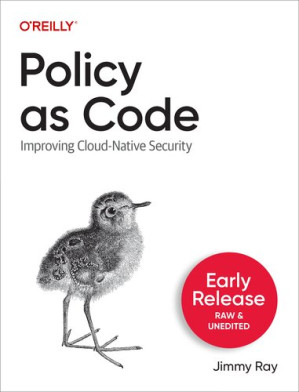
Policy As Code: Improving Cloud-native Security 🔍
Jimmy Ray
O'Reilly Media, Incorporated, Early Release, 2024
English [en] · EPUB · 3.5MB · 2024 · 📘 Book (non-fiction) · 🚀/lgli/lgrs/nexusstc/zlib · Save
description
In today's cloud native world, where we automate as much as possible, everything is code. With this practical guide, you'll learn how policy as code (PaC) provides the means to manage the policies that guide our responses as well as the systems we maintain—Kubernetes, cloud security, software supply-chain security, infrastructure-as-code, and microservices authorization, among others.
Author Jimmy Ray, a developer advocate on the Amazon Web Services Kubernetes team, provides a practical approach to integrating PaC solutions into your systems, with plenty of real-world examples and important hands-on guidance. DevOps and DevSecOps engineers, Kubernetes developers, and cloud engineers will understand how to choose and then implement the most appropriate solutions.
* Understand PaC theory, best practices, and use cases for security
* Learn how to choose and use the correct PaC solution for your needs
* Explore PaC tooling and deployment options for writing and managing PaC policies
* Apply PaC to DevOps, IaC, Kubernetes, and AuthN/AuthZ
* Examine how you can use PaC to implement security controls
* Verify that your PaC solution is providing the desired result
* Create auditable artifacts to satisfy internal and external regulatory requirements
Author Jimmy Ray, a developer advocate on the Amazon Web Services Kubernetes team, provides a practical approach to integrating PaC solutions into your systems, with plenty of real-world examples and important hands-on guidance. DevOps and DevSecOps engineers, Kubernetes developers, and cloud engineers will understand how to choose and then implement the most appropriate solutions.
* Understand PaC theory, best practices, and use cases for security
* Learn how to choose and use the correct PaC solution for your needs
* Explore PaC tooling and deployment options for writing and managing PaC policies
* Apply PaC to DevOps, IaC, Kubernetes, and AuthN/AuthZ
* Examine how you can use PaC to implement security controls
* Verify that your PaC solution is providing the desired result
* Create auditable artifacts to satisfy internal and external regulatory requirements
Alternative filename
lgli/Policy as Code (Third Release).epub
Alternative filename
lgrsnf/Policy as Code (Third Release).epub
Alternative edition
United States, United States of America
Alternative edition
O'Reilly Media, Sebastopol, CA, 2024
Alternative edition
1, US, 2024
metadata comments
{"edition":"Early Release","isbns":["1098139127","1098139186","9781098139124","9781098139186"],"publisher":"O'Reilly Media"}
Alternative description
In today's cloud native world, where we automate as much as possible, everything is code. With this practical guide, you'll learn how Policy as Code (PaC) provides the means to manage the policies, related data, and responses to events that occur within the systems we maintain—Kubernetes, cloud security, software supply chain security, infrastructure as code, and microservices authorization, among others.Author Jimmy Ray provides a practical approach to integrating PaC solutions into your systems, with plenty of real-world examples and important hands-on guidance. DevOps and DevSecOps engineers, Kubernetes developers, and cloud engineers will understand how to choose and then implement the most appropriate solutions.Understand PaC theory, best practices, and use cases for securityLearn how to choose and use the correct PaC solution for your needsExplore PaC tooling and deployment options for writing and managing PaC policiesApply PaC to DevOps, IaC, Kubernetes, and AuthN/AuthZExamine how you can use PaC to implement security controlsVerify that your PaC solution is providing the desired resultCreate auditable artifacts to satisfy internal and external regulatory requirements
date open sourced
2023-06-15
🚀 Fast downloads
Become a member to support the long-term preservation of books, papers, and more. To show our gratitude for your support, you get fast downloads. ❤️
- Fast Partner Server #1 (recommended)
- Fast Partner Server #2 (recommended)
- Fast Partner Server #3 (recommended)
- Fast Partner Server #4 (recommended)
- Fast Partner Server #5 (recommended)
- Fast Partner Server #6 (recommended)
- Fast Partner Server #7
- Fast Partner Server #8
- Fast Partner Server #9
- Fast Partner Server #10
- Fast Partner Server #11
- Fast Partner Server #12
🐢 Slow downloads
From trusted partners. More information in the FAQ. (might require browser verification — unlimited downloads!)
- Slow Partner Server #1 (slightly faster but with waitlist)
- Slow Partner Server #2 (slightly faster but with waitlist)
- Slow Partner Server #3 (slightly faster but with waitlist)
- Slow Partner Server #4 (slightly faster but with waitlist)
- Slow Partner Server #5 (no waitlist, but can be very slow)
- Slow Partner Server #6 (no waitlist, but can be very slow)
- Slow Partner Server #7 (no waitlist, but can be very slow)
- Slow Partner Server #8 (no waitlist, but can be very slow)
- Slow Partner Server #9 (no waitlist, but can be very slow)
- After downloading: Open in our viewer
All download options have the same file, and should be safe to use. That said, always be cautious when downloading files from the internet, especially from sites external to Anna’s Archive. For example, be sure to keep your devices updated.
External downloads
-
For large files, we recommend using a download manager to prevent interruptions.
Recommended download managers: JDownloader -
You will need an ebook or PDF reader to open the file, depending on the file format.
Recommended ebook readers: Anna’s Archive online viewer, ReadEra, and Calibre -
Use online tools to convert between formats.
Recommended conversion tools: CloudConvert and PrintFriendly -
You can send both PDF and EPUB files to your Kindle or Kobo eReader.
Recommended tools: Amazon‘s “Send to Kindle” and djazz‘s “Send to Kobo/Kindle” -
Support authors and libraries
✍️ If you like this and can afford it, consider buying the original, or supporting the authors directly.
📚 If this is available at your local library, consider borrowing it for free there.
Total downloads:
A “file MD5” is a hash that gets computed from the file contents, and is reasonably unique based on that content. All shadow libraries that we have indexed on here primarily use MD5s to identify files.
A file might appear in multiple shadow libraries. For information about the various datasets that we have compiled, see the Datasets page.
For information about this particular file, check out its JSON file. Live/debug JSON version. Live/debug page.