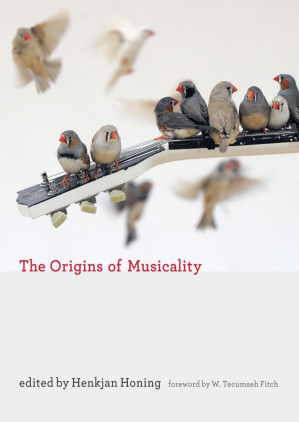
The Origins of Musicality (The MIT Press) 🔍
W Tecumseh Fitch; Bjö Merker; Iain Morley; Willem Zuidema; Laurel Trainor; Aniruddh Patel; Sandra E Trehub; Judith Becker; Marisa Hoeschele; Henkjan Honing
The MIT Press, MIT Press, Cambridge, Massachusetts, 2018
English [en] · PDF · 5.0MB · 2018 · 📘 Book (non-fiction) · 🚀/zlib · Save
description
Interdisciplinary perspectives on the capacity to perceive, appreciate, and make music.ISBN : 9780262037457
Alternative author
W Tecumseh Fitch; Bjö Merker; Iain Morley; Willem Zuidema; Laurel Trainor; Aniruddh Patel; Sandra E Trehub; Judith Becker; Marisa Hoeschele; Henkjan Honing
Alternative author
Henkjan Honing, W. Tecumseh Fitch, Bjö Merker, Iain Morley, Willem Zuidema
Alternative author
Henkjan Honing; William Tecumseh Fitch
Alternative publisher
AAAI Press
Alternative edition
United States, United States of America
Alternative edition
MIT Press Ser, Cambridge, 2018
Alternative edition
Illustrated, PS, 2018
Alternative description
Interdisciplinary perspectives on the capacity to perceive, appreciate, and make music.Research shows that all humans have a predisposition for music, just as they do for language. All of us can perceive and enjoy music, even if we can't carry a tune and consider ourselves “unmusical.” This volume offers interdisciplinary perspectives on the capacity to perceive, appreciate, and make music. Scholars from biology, musicology, neurology, genetics, computer science, anthropology, psychology, and other fields consider what music is for and why every human culture has it; whether musicality is a uniquely human capacity; and what biological and cognitive mechanisms underlie it.Contributors outline a research program in musicality, and discuss issues in studying the evolution of music; consider principles, constraints, and theories of origins; review musicality from cross-cultural, cross-species, and cross-domain perspectives; discuss the computational modeling of animal song and creativity; and offer a historical context for the study of musicality. The volume aims to identify the basic neurocognitive mechanisms that constitute musicality (and effective ways to study these in human and nonhuman animals) and to develop a method for analyzing musical phenotypes that point to the biological basis of musicality.ContributorsJorge L. Armony, Judith Becker, Simon E. Fisher, W. Tecumseh Fitch, Bruno Gingras, Jessica Grahn, Yuko Hattori, Marisa Hoeschele, Henkjan Honing, David Huron, Dieuwke Hupkes, Yukiko Kikuchi, Julia Kursell, Marie-Élaine Lagrois, Hugo Merchant, Björn Merker, Iain Morley, Aniruddh D. Patel, Isabelle Peretz, Martin Rohrmeier, Constance Scharff, Carel ten Cate, Laurel J. Trainor, Sandra E. Trehub, Peter Tyack, Dominique Vuvan, Geraint Wiggins, Willem Zuidema
Alternative description
Interdisciplinary perspectives on the capacity to perceive, appreciate, and make music. Research shows that all humans have a predisposition for music, just as they do for language. All of us can perceive and enjoy music, even if we can't carry a tune and consider ourselves unmusical. This volume offers interdisciplinary perspectives on the capacity to perceive, appreciate, and make music. Scholars from biology, musicology, neurology, genetics, computer science, anthropology, psychology, and other fields consider what music is for and why every human culture has it; whether musicality is a uniquely human capacity; and what biological and cognitive mechanisms underlie it. Contributors outline a research program in musicality, and discuss issues in studying the evolution of music; consider principles, constraints, and theories of origins; review musicality from cross-cultural, cross-species, and cross-domain perspectives; discuss the computational modeling of animal song and creativity; and offer a historical context for the study of musicality. The volume aims to identify the basic neurocognitive mechanisms that constitute musicality (and effective ways to study these in human and nonhuman animals) and to develop a method for analyzing musical phenotypes that point to the biological basis of musicality. Contributors
Jorge L. Armony, Judith Becker, Simon E. Fisher, W. Tecumseh Fitch, Bruno Gingras, Jessica Grahn, Yuko Hattori, Marisa Hoeschele, Henkjan Honing, David Huron, Dieuwke Hupkes, Yukiko Kikuchi, Julia Kursell, Marie-laine Lagrois, Hugo Merchant, Bjrn Merker, Iain Morley, Aniruddh D. Patel, Isabelle Peretz, Martin Rohrmeier, Constance Scharff, Carel ten Cate, Laurel J. Trainor, Sandra E. Trehub, Peter Tyack, Dominique Vuvan, Geraint Wiggins, Willem Zuidema
Jorge L. Armony, Judith Becker, Simon E. Fisher, W. Tecumseh Fitch, Bruno Gingras, Jessica Grahn, Yuko Hattori, Marisa Hoeschele, Henkjan Honing, David Huron, Dieuwke Hupkes, Yukiko Kikuchi, Julia Kursell, Marie-laine Lagrois, Hugo Merchant, Bjrn Merker, Iain Morley, Aniruddh D. Patel, Isabelle Peretz, Martin Rohrmeier, Constance Scharff, Carel ten Cate, Laurel J. Trainor, Sandra E. Trehub, Peter Tyack, Dominique Vuvan, Geraint Wiggins, Willem Zuidema
Alternative description
Research shows that all humans have a predisposition for music, just as they do for language. All of us can perceive and enjoy music, even if we can't carry a tune and consider ourselves unmusical. This volume offers interdisciplinary perspectives on the capacity to perceive, appreciate, and make music. Scholars from biology, musicology, neurology, genetics, computer science, anthropology, psychology, and other fields consider what music is for and why every human culture has it; whether musicality is a uniquely human capacity; and what biological and cognitive mechanisms underlie it. Contributors outline a research program in musicality, and discuss issues in studying the evolution of music; consider principles, constraints, and theories of origins; review musicality from cross-cultural, cross-species, and cross-domain perspectives; discuss the computational modeling of animal song and creativity; and offer a historical context for the study of musicality. The volume aims to identify the basic neurocognitive mechanisms that constitute musicality (and effective ways to study these in human and nonhuman animals) and to develop a method for analyzing musical phenotypes that point to the biological basis of musicality. - Henkjan Honing is Professor of Music Cognition at the University of Amsterdam
Alternative description
Research shows that all humans have a predisposition for music, just as they do for language. All of us can perceive and enjoy music, even if we can't carry a tune and consider ourselves "unmusical." This volume offers interdisciplinary perspectives on the capacity to perceive, appreciate, and make music. Scholars from biology, musicology, neurology, genetics, computer science, anthropology, psychology, and other fields consider what music is for and why every human culture has it; whether musicality is a uniquely human capacity; and what biological and cognitive mechanisms underlie it. Contributors outline a research program in musicality, and discuss issues in studying the evolution of music; consider principles, constraints, and theories of origins; review musicality from cross-cultural, cross-species, and cross-domain perspectives; discuss the computational modeling of animal song and creativity; and offer a historical context for the study of musicality. The volume aims to identify the basic neurocognitive mechanisms that constitute musicality (and effective ways to study these in human and nonhuman animals) and to develop a method for analyzing musical phenotypes that point to the biological basis of musicality [Publisher description]
Alternative description
Intro -- Title page -- Copyright page -- Table of Contents -- Foreword -- Preface -- I#Introduction -- 1#Musicality as an Upbeat to Music: Introduction and Research Agenda -- II#Origins, Principles, and Constraints -- 2#Four Principles of Biomusicology -- 3#Five Fundamental Constraints on Theories of the Origins of Music -- 4#The Origins of Music: Auditory Scene Analysis, Evolution, and Culture in Musical Creation -- 5#Music as a Transformative Technology of the Mind: An Update -- III#Cross-Cultural, Cross-Species, and Cross-Domain Studies -- 6#Cross-Cultural Perspectives on Music and Musicality -- 7#Searching for the Origins of Musicality across Species -- 8#Finding the Beat: A Neural Perspective across Humans and Nonhuman Primates -- 9#Neural Overlap in Processing Music and Speech -- 10#Defining the Biological Bases of Individual Differences in Musicality -- IV#Structure, Affect, and History -- 11#Formal Models of Structure Building in Music, Language, and Animal Song -- 12#The Evolutionary Roots of Creativity: Mechanisms and Motivations -- 13#Affect Induction through Musical Sounds: An Ethological Perspective -- 14#Carl Stumpf and the Beginnings of Research in Musicality -- Contributors -- Index
Alternative description
Edited By Henkjan Honing. Includes Bibliographical References And Index.
date open sourced
2024-03-30
🚀 Fast downloads
Become a member to support the long-term preservation of books, papers, and more. To show our gratitude for your support, you get fast downloads. ❤️
- Fast Partner Server #1 (recommended)
- Fast Partner Server #2 (recommended)
- Fast Partner Server #3 (recommended)
- Fast Partner Server #4 (recommended)
- Fast Partner Server #5 (recommended)
- Fast Partner Server #6 (recommended)
- Fast Partner Server #7
- Fast Partner Server #8
- Fast Partner Server #9
- Fast Partner Server #10
- Fast Partner Server #11
- Fast Partner Server #12
🐢 Slow downloads
From trusted partners. More information in the FAQ. (might require browser verification — unlimited downloads!)
- Slow Partner Server #1 (slightly faster but with waitlist)
- Slow Partner Server #2 (slightly faster but with waitlist)
- Slow Partner Server #3 (slightly faster but with waitlist)
- Slow Partner Server #4 (slightly faster but with waitlist)
- Slow Partner Server #5 (no waitlist, but can be very slow)
- Slow Partner Server #6 (no waitlist, but can be very slow)
- Slow Partner Server #7 (no waitlist, but can be very slow)
- Slow Partner Server #8 (no waitlist, but can be very slow)
- Slow Partner Server #9 (no waitlist, but can be very slow)
- After downloading: Open in our viewer
All download options have the same file, and should be safe to use. That said, always be cautious when downloading files from the internet, especially from sites external to Anna’s Archive. For example, be sure to keep your devices updated.
External downloads
-
For large files, we recommend using a download manager to prevent interruptions.
Recommended download managers: JDownloader -
You will need an ebook or PDF reader to open the file, depending on the file format.
Recommended ebook readers: Anna’s Archive online viewer, ReadEra, and Calibre -
Use online tools to convert between formats.
Recommended conversion tools: CloudConvert and PrintFriendly -
You can send both PDF and EPUB files to your Kindle or Kobo eReader.
Recommended tools: Amazon‘s “Send to Kindle” and djazz‘s “Send to Kobo/Kindle” -
Support authors and libraries
✍️ If you like this and can afford it, consider buying the original, or supporting the authors directly.
📚 If this is available at your local library, consider borrowing it for free there.
Total downloads:
A “file MD5” is a hash that gets computed from the file contents, and is reasonably unique based on that content. All shadow libraries that we have indexed on here primarily use MD5s to identify files.
A file might appear in multiple shadow libraries. For information about the various datasets that we have compiled, see the Datasets page.
For information about this particular file, check out its JSON file. Live/debug JSON version. Live/debug page.