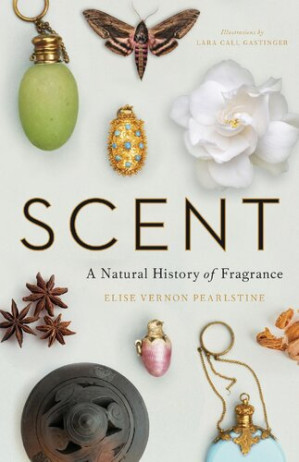
Scent : A Natural History of Fragrance 🔍
Elise Vernon Pearlstine; Lara Call Gastinger
Yale University Press, Yale University Press, New Haven, CT, 2022
English [en] · EPUB · 1.2MB · 2022 · 📘 Book (non-fiction) · 🚀/lgli/lgrs/nexusstc/zlib · Save
description
A fascinating exploration of the natural history of scent and human perceptions of fragrance from the viewpoint of plant and pollinator“An evocative journey that awakens one’s curiosity to an oft-forgotten sense.”—Dana Dunham, Plants have long harnessed the chemical characteristics of aromatic compounds to shape the world around them. Frankincense resin from the genus seals injured tissues and protects trees from invading pathogens. Jasmine produces a molecule called linalool that attracts pollinating moths with its flowery scent. Tobacco uses a similarly sweet-smelling compound called benzyl acetone to attract pollinators. Only recently in the evolutionary history of plants, however, have humans learned to co-opt their fragrances to seduce, heal, protect, and alter moods themselves.
In this wide-ranging and accessible new book, biologist-turned-perfumer Elise Vernon Pearlstine turns our human-centered perception of fragrance on its head and investigates plants' evolutionary reasons for creating aromatic molecules. Delving into themes of spirituality, wealth, power, addiction, royalty, fantasy, and more, Pearlstine uncovers the natural history of aromatic substances and their intersection with human culture and civilization.
In this wide-ranging and accessible new book, biologist-turned-perfumer Elise Vernon Pearlstine turns our human-centered perception of fragrance on its head and investigates plants' evolutionary reasons for creating aromatic molecules. Delving into themes of spirituality, wealth, power, addiction, royalty, fantasy, and more, Pearlstine uncovers the natural history of aromatic substances and their intersection with human culture and civilization.
Alternative filename
lgli/Scent_by_Elise_Vernon_Pearlstine.epub
Alternative filename
lgrsnf/Scent_by_Elise_Vernon_Pearlstine.epub
Alternative author
Pearlstine, Elise Vernon; Gastinger, Lara Call
Alternative publisher
San Francisco Museum of Modern Art
Alternative publisher
Brandywine River Museum
Alternative publisher
Mariners' Museum, The
Alternative edition
United States, United States of America
Alternative edition
First Edition, PS, 2022
Alternative edition
New Haven, USA, 2022
Alternative edition
1, 20220524
metadata comments
Mobilism
metadata comments
{"content":{"parsed_at":1697844220,"source_extension":"epub"},"isbns":["030024696X","0300265573","2021948038","9780300246964","9780300265576"],"last_page":288,"publisher":"Yale University Press"}
Alternative description
<B>A fascinating exploration of the natural history of scent and human perceptions of fragrance from the viewpoint of plant and pollinator</B><BR /><BR /> Plants have long harnessed the chemical characteristics of aromatic compounds to shape the world around them. Frankincense resin from the genus <I>Boswellia</I> seals injured tissues and protects trees from invading pathogens. Jasmine produces a molecule called linalool that attracts pollinating moths with its flowery scent. Tobacco uses a similarly sweet-smelling compound called benzyl acetone to attract pollinators. Only recently in the evolutionary history of plants, however, have humans learned to co-opt their fragrances to seduce, heal, protect, and alter moods themselves.<BR /> <BR /> In this wide-ranging and accessible new book, biologist-turned-perfumer Elise Vernon Pearlstine turns our human-centered perception of fragrance on its head and investigates plants' evolutionary reasons for creating aromatic molecules. Delving into themes of spirituality, wealth, power, addiction, royalty, fantasy, and more, Pearlstine uncovers the natural history of aromatic substances and their intersection with human culture and civilization.
Alternative description
"Plants have long harnessed the chemical characteristics of aromatic compounds to shape the world around them. Frankincense resin from the genus Boswellia seals injured tissues and protects trees from invading pathogens. Jasmine produces a molecule called linalool that attracts pollinating moths with its flowery scent. Tobacco uses a similarly sweet-smelling compound called benzyl acetone to attract pollinators. Only recently in the evolutionary history of plants, however, have humans learned to co-opt their fragrances to seduce, heal, protect, and alter moods themselves. In this wide-ranging and accessible new book, biologist-turned-perfumer Elise Vernon Pearlstine turns our human-centered perception of fragrance on its head and investigates plants' evolutionary reasons for creating aromatic molecules. Delving into themes of spirituality, wealth, power, addiction, royalty, fantasy, and more, Pearlstine uncovers the natural history of aromatic substances and their intersection with human culture and civilization"--Publisher's description
Alternative description
Plants have long harnessed the chemical characteristics of aromatic compounds to shape the world around them. In this accessible new book, biologist-turned-perfumer Elise Pearlstine investigates plants' evolutionary reasons for creating aromatic molecules. At the same time, she uncovers the natural history of aromatic substances and their intersection with human civilization.
date open sourced
2022-10-23
🚀 Fast downloads
Become a member to support the long-term preservation of books, papers, and more. To show our gratitude for your support, you get fast downloads. ❤️
- Fast Partner Server #1 (recommended)
- Fast Partner Server #2 (recommended)
- Fast Partner Server #3 (recommended)
- Fast Partner Server #4 (recommended)
- Fast Partner Server #5 (recommended)
- Fast Partner Server #6 (recommended)
- Fast Partner Server #7
- Fast Partner Server #8
- Fast Partner Server #9
- Fast Partner Server #10
- Fast Partner Server #11
- Fast Partner Server #12
🐢 Slow downloads
From trusted partners. More information in the FAQ. (might require browser verification — unlimited downloads!)
- Slow Partner Server #1 (slightly faster but with waitlist)
- Slow Partner Server #2 (slightly faster but with waitlist)
- Slow Partner Server #3 (slightly faster but with waitlist)
- Slow Partner Server #4 (slightly faster but with waitlist)
- Slow Partner Server #5 (no waitlist, but can be very slow)
- Slow Partner Server #6 (no waitlist, but can be very slow)
- Slow Partner Server #7 (no waitlist, but can be very slow)
- Slow Partner Server #8 (no waitlist, but can be very slow)
- Slow Partner Server #9 (no waitlist, but can be very slow)
- After downloading: Open in our viewer
All download options have the same file, and should be safe to use. That said, always be cautious when downloading files from the internet, especially from sites external to Anna’s Archive. For example, be sure to keep your devices updated.
External downloads
-
For large files, we recommend using a download manager to prevent interruptions.
Recommended download managers: JDownloader -
You will need an ebook or PDF reader to open the file, depending on the file format.
Recommended ebook readers: Anna’s Archive online viewer, ReadEra, and Calibre -
Use online tools to convert between formats.
Recommended conversion tools: CloudConvert and PrintFriendly -
You can send both PDF and EPUB files to your Kindle or Kobo eReader.
Recommended tools: Amazon‘s “Send to Kindle” and djazz‘s “Send to Kobo/Kindle” -
Support authors and libraries
✍️ If you like this and can afford it, consider buying the original, or supporting the authors directly.
📚 If this is available at your local library, consider borrowing it for free there.
Total downloads:
A “file MD5” is a hash that gets computed from the file contents, and is reasonably unique based on that content. All shadow libraries that we have indexed on here primarily use MD5s to identify files.
A file might appear in multiple shadow libraries. For information about the various datasets that we have compiled, see the Datasets page.
For information about this particular file, check out its JSON file. Live/debug JSON version. Live/debug page.