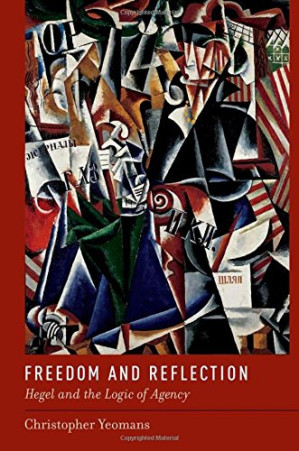
Freedom And Reflection: Hegel And The Logic Of Agency University Press Scholarship Online 🔍
Christopher Yeomans
Oxford University Press, USA, 1, PS, 2011
English [en] · PDF · 1.8MB · 2011 · 📘 Book (non-fiction) · 🚀/lgli/lgrs/nexusstc/upload/zlib · Save
description
There are many insightful discussions of Hegel's practical philosophy that emphasize the uniqueness of his expressivist and social theory of agency, but few recognize that these two aspects of Hegel's theory of the will are insufficient to avoid the traditional problem of free will. In fact, the problem can easily be shown to recur in the very language used to express why Hegel's theory is a theory of freedom at all. In part, this lack of recognition results from the fact that there has not yet been a study of Hegel's theory of the will that has formulated the problem against the background of the contemporary literature on free will, where basic concerns about the explicability of action loom large. By using the continuity between the contemporary concerns and those of Hegel's predecessors (particularly Kant), Yeomans shows the necessity of reference to the Logic in order to supplement Hegel's own practical philosophy and the scholarship based on it. In addition to adding significantly to our understanding of Hegel's theory of agency and recapturing its significance with respect to continuing modern reflection on free will, this study also shows that Hegel's Logic can do some real philosophical work on a specific problem.
Though Hegel's logical terminology is notorious for its impenetrability, Yeomans translates Hegel's jargon into a more easily comprehensible vocabulary. He further helps the reader by providing introductory discussions framing the central issues of each chapter both in terms of the problem of free will and in terms of the development of Hegel's argument to that point in the Logic. Presenting the reader with frequent use of examples, Yeomans leavens the abstractness of Hegel's presentation and makes the topic accessible to readers new to Hegel as well as those well versed in his work.
Though Hegel's logical terminology is notorious for its impenetrability, Yeomans translates Hegel's jargon into a more easily comprehensible vocabulary. He further helps the reader by providing introductory discussions framing the central issues of each chapter both in terms of the problem of free will and in terms of the development of Hegel's argument to that point in the Logic. Presenting the reader with frequent use of examples, Yeomans leavens the abstractness of Hegel's presentation and makes the topic accessible to readers new to Hegel as well as those well versed in his work.
Alternative filename
upload/aaaaarg/part_002/christopher-yeomans-freedom-and-reflection-hegel-and-the-logic-of-agency.pdf
Alternative filename
nexusstc/Freedom and Reflection: Hegel and the Logic of Agency/e90d2d16c466d4a199eae701ebdf9def.pdf
Alternative filename
lgli/978-0-19-979452-2 Freedom and Reflection.pdf
Alternative filename
lgrsnf/978-0-19-979452-2 Freedom and Reflection.pdf
Alternative author
Yeomans, Christopher.
Alternative publisher
IRL Press at Oxford University Press
Alternative publisher
Oxford Institute for Energy Studies
Alternative publisher
German Historical Institute London
Alternative edition
United Kingdom and Ireland, United Kingdom
Alternative edition
Oxford University Press USA, Oxford, 2011
Alternative edition
New York, New York State, 2012
metadata comments
0
metadata comments
lg1564337
metadata comments
producers:
Adobe Acrobat Pro 11.0.7
Adobe Acrobat Pro 11.0.7
metadata comments
{"edition":"1","isbns":["0199794529","9780199794522"],"last_page":292,"publisher":"Oxford University Press"}
metadata comments
Includes bibliographical references (p. ) and index.
Alternative description
While Many Interpreters Hold That Hegel Avoided The Traditional Problem Of Free Will, Yeomans Argues Both That The Problem Is Unavoidable, And That The Two Versions Of The Logic Fruitfully Engage The Tensions Between Explicability And Both The Control And Alternate Possibilities Constitutive Of Free Agency. Machine Generated Contents Note: 1. Hegel And Free Will -- 1.1. Hegel And The Traditional Problem Of Free Will -- 1.2. Hegel's Theory Of Free Will -- 2. The Problem Of Expression As The Problem Of Reflection -- 2.1. Introduction -- 2.2. Internal And External Determination In The Doctrine Of Being -- 2.3. Internal And External Determination In The Concept Of Reflection -- 2.4. Elements Of The Theory Of Reflection In Hegel's Moral Psychology -- 2.5. The Shape Of The Project -- 3. The Externality Of Explanations And The Problem Of An Infinite Regress -- 4. Self-explanation As The Basic Form Of Explanation -- 4.1. Ground As Expression -- 4.2. Internal And External Determination In Explanations -- 4.3. The Argument For Explanation As A Three-term Relation -- 4.4. The Role Of Conditions As The Third Term In Explanation -- 4.5. The Infection Of Internality By The Conditions -- 4.6. Holism About Explanation -- 5. The Agent As A Locus Of Self-explanation -- 6. The Necessity Of Action And The Problem Of Alternate Possibilities -- 7. Modality In Hegel's Logic -- 7.1. Modality As The Structure Of Self-expression -- 7.2. Contingency As A Unity Of Actuality And Possibility -- 7.3. The Modal Continuum -- 7.4. The Necessity Of Alternate Possibilities -- 8. Agency As True Necessity -- 8.1. Willkür And Wille -- 8.2. The Modal Argument For Hegel's Conception Of The Free Will -- 9. The Mechanistic Challenge And The Problem Of Passivity -- 10. Teleology, Mechanism, And Causation -- 10.1. The Question Of Priority -- 10.2. Productivity As Expression -- 10.3. Freedom As Substance-causation -- 10.4. The Passivity Of Mechanical Causation -- 10.5. Causation As Reciprocal Interaction -- 10.6. Reciprocal Interaction As Freedom -- 10.7. The Teleological Form Of Reciprocal Self-determination -- 11. Teleological Agency -- 11.1. Arguments Against Determinism -- 11.2.a Teleological Philosophy Of Action -- 12. Conclusion. Christopher Yeomans. Includes Bibliographical References And Index.
Alternative description
Abbreviations 10
Contents 12
Acknowledgments 14
Part I Introduction 18
1: Hegel and Free Will 20
2: The Problem of Expression as the Problem of Refl ection 53
Part II Agency as Self-Explanation 84
3: The Externality Of Explanations And The Problem Of An Infinite Regress 86
4: Self-Explanation as the Basic Form of Explanation 92
5: The Agent as a Locus of Self-Explanation 135
Part III Agency as True Necessity 146
6: The Necessity Of Action And The Problem Of Alternate Possibilities 148
7: Modality in Hegel’s Logic 156
8: Agency as True Necessity 184
Part IV Agency as Teleological Reciprocal Interaction 198
9: The Mechanistic Challenge and the Problem of Passivity 200
10: Teleology, Mechanism, and Causation 206
11: Teleological Agency 252
12: Conclusion 275
Bibliography 280
Index 286
Contents 12
Acknowledgments 14
Part I Introduction 18
1: Hegel and Free Will 20
2: The Problem of Expression as the Problem of Refl ection 53
Part II Agency as Self-Explanation 84
3: The Externality Of Explanations And The Problem Of An Infinite Regress 86
4: Self-Explanation as the Basic Form of Explanation 92
5: The Agent as a Locus of Self-Explanation 135
Part III Agency as True Necessity 146
6: The Necessity Of Action And The Problem Of Alternate Possibilities 148
7: Modality in Hegel’s Logic 156
8: Agency as True Necessity 184
Part IV Agency as Teleological Reciprocal Interaction 198
9: The Mechanistic Challenge and the Problem of Passivity 200
10: Teleology, Mechanism, and Causation 206
11: Teleological Agency 252
12: Conclusion 275
Bibliography 280
Index 286
Alternative description
xiii, 275 p. ; 24 cm
date open sourced
2016-10-01
🚀 Fast downloads
Become a member to support the long-term preservation of books, papers, and more. To show our gratitude for your support, you get fast downloads. ❤️
- Fast Partner Server #1 (recommended)
- Fast Partner Server #2 (recommended)
- Fast Partner Server #3 (recommended)
- Fast Partner Server #4 (recommended)
- Fast Partner Server #5 (recommended)
- Fast Partner Server #6 (recommended)
- Fast Partner Server #7
- Fast Partner Server #8
- Fast Partner Server #9
- Fast Partner Server #10
- Fast Partner Server #11
- Fast Partner Server #12
🐢 Slow downloads
From trusted partners. More information in the FAQ. (might require browser verification — unlimited downloads!)
- Slow Partner Server #1 (slightly faster but with waitlist)
- Slow Partner Server #2 (slightly faster but with waitlist)
- Slow Partner Server #3 (slightly faster but with waitlist)
- Slow Partner Server #4 (slightly faster but with waitlist)
- Slow Partner Server #5 (no waitlist, but can be very slow)
- Slow Partner Server #6 (no waitlist, but can be very slow)
- Slow Partner Server #7 (no waitlist, but can be very slow)
- Slow Partner Server #8 (no waitlist, but can be very slow)
- Slow Partner Server #9 (no waitlist, but can be very slow)
- After downloading: Open in our viewer
All download options have the same file, and should be safe to use. That said, always be cautious when downloading files from the internet, especially from sites external to Anna’s Archive. For example, be sure to keep your devices updated.
External downloads
-
For large files, we recommend using a download manager to prevent interruptions.
Recommended download managers: JDownloader -
You will need an ebook or PDF reader to open the file, depending on the file format.
Recommended ebook readers: Anna’s Archive online viewer, ReadEra, and Calibre -
Use online tools to convert between formats.
Recommended conversion tools: CloudConvert and PrintFriendly -
You can send both PDF and EPUB files to your Kindle or Kobo eReader.
Recommended tools: Amazon‘s “Send to Kindle” and djazz‘s “Send to Kobo/Kindle” -
Support authors and libraries
✍️ If you like this and can afford it, consider buying the original, or supporting the authors directly.
📚 If this is available at your local library, consider borrowing it for free there.
Total downloads:
A “file MD5” is a hash that gets computed from the file contents, and is reasonably unique based on that content. All shadow libraries that we have indexed on here primarily use MD5s to identify files.
A file might appear in multiple shadow libraries. For information about the various datasets that we have compiled, see the Datasets page.
For information about this particular file, check out its JSON file. Live/debug JSON version. Live/debug page.