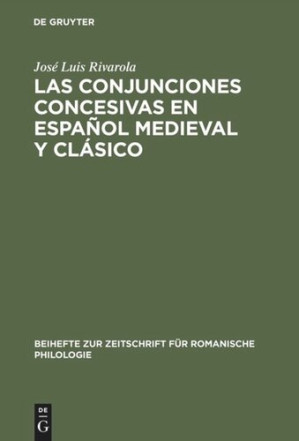
Spanish [es] · PDF · 16.6MB · 1976 · 📘 Book (non-fiction) · 🚀/lgli/lgrs/nexusstc/upload/zlib · Save
description
The book series Beihefte zur Zeitschrift für romanische Philologie, founded by Gustav Gröber in 1905, is among the most renowned publications in Romance Studies. It covers the entire field of Romance linguistics, including the national languages as well as the lesser studied Romance languages. The editors welcome submissions of high-quality monographs and collected volumes on all areas of linguistic research, on medieval literature and on textual criticism. The publication languages of the series are French, Spanish, Portuguese, Italian and Romanian as well as German and English. Each collected volume should be as uniform as possible in its contents and in the choice of languages. Erscheinungsdatum: 01.04.1976
nexusstc/Las conjunciones concesivas en español medieval y clásico: Contribución a la sintaxis histórica española/f71c0dbe8266a031036e0a6d4ad42ba0.pdf
Alternative filename
lgli/10.1515_9783111328294.pdf
Alternative filename
lgrsnf/10.1515_9783111328294.pdf
Alternative title
Las conjunciones concesivas en español medieval y clásico : contribución a la sintaxis histórica española / José Luis Rivarola. 1. Aufl
Alternative title
Las Conjunciones Cocensivas En Español Medieval Y Clásico: Contribución a La Sintaxis Histórica Española
Alternative publisher
Saur, K. G., Verlag. ein Imprint der Walter de Gruyter GmbH
Alternative publisher
düsseldorf university press. in Walter de Gruyter GmbH
Alternative publisher
de Gruyter, Walter, GmbH
Alternative publisher
de Gruyter GmbH, Walter
Alternative edition
Beihefte zur Zeitschrift für romanische Philologie ;, Bd. 154, Beihefte zur Zeitschrift für romanische Philologie ;, 154. Heft., 1. Aufl., Tübingen, Germany, 1976
Alternative edition
Beihefte zur Zeitschrift für romanische Philologie, Tübingen, 2015
Alternative edition
1. Aufl. Reprint 2014 ed., 1976
Alternative edition
De Gruyter, Tübingen, 1976
Alternative edition
Germany, Germany
Alternative edition
1, 2015-02-06
metadata comments
producers: iTextSharp 5.0.2 (c) 1T3XT BVBA
metadata comments
{"isbns":["3111328295","3484520590","9783111328294","9783484520592"],"last_page":182,"publisher":"DE GRUYTER","series":"Beihefte zur Zeitschrift für romanische Philologie; 154"}
metadata comments
Bibliography: p. 161-171.
Alternative description
Introducción 13 1 De los orígenes al siglo XIII 26 1.1 maguer(que) 30 1.1.1 maguer(que) + subjuntivo 32 1.1.2 maguer(que) + indicativo 34 1.1.3 maguer(que) sin verbo 35 1.1.4 Otros usos de maguer(que) 36 1.1.5 maguera(que) 38 1.2 Conjunciones compuestas por -quier(-e, -a) 40 1.2.1 quier que 40 1.2.2. siquier 43 1.2.3 Conjunciones surgidas de indefinidos generalizadores 46 1.3 que - aunque - encara que 54 1.3.1 que 54 1.3.2 aunque 57 1.3.3 encara que 63 1.4 ya sea (sia) que 64 1.5. pero - pero que - empero que 65 1.5.1 pero 67 1.5.2 pero que 68 1.5.3 empero que 70 1.6 porque 71 1.7 Excurso: por - que 74 1.8 puesto que 78 1.9 bien que 79 1.10 mas 79 1.11 corno 79 1.12 (aun)cuando 80 2 Siglos XIV y XV 81 2.1 maguer(que) 82 2.1.1 Otros usos de maguer(que) 83 2.1.2 maguera(que) 84 2.2 Conjunciones compuestas por -quier(e-, -a) 85 2.2.1 siquier 85 2.2.2 Conjunciones surgidas de indeflnidos generalizadores 87 2.3 que - aunque - encara que 91 2.3.1 que 91 2.3.2 aunque 92 2.3.3 encara que 95 2.4 ya sea (sia) que 96 2.5 pero - pero que - empero que 99 2.5.1 pero 99 2.5.2 pero que 99 2.5.3 empero que 100 2.6 porque 100 2.7 puesto que - puesto caso que 101 2.7.1 puesto que 101 2.7.2 puesto (el)/(por) caso que 104 2.8 (en) caso que 105 2.9 dado que 107 2.10 bien que 107 2.11 si bien 114 2.12 no embargante que - no contrastante que - no obstante que 119 2.12.1 no embargante que 119 2.12.2 no contrastant(e) que 122 2.12.3 no obstante que 123 2.13 como 127 2.14 aun cuando 127 2.15 pues(que) 128 2.16 con todo que 129 3 Siglos XVI y XVII 131 3.1 maguer(que) - maguera 131 3.2 Conjunciones compuestas por -quier(-e, -a) 133 3.2.1 siquiera 133 3.2.2 cuantoquiera que 134 3.2.3 comoquier(a) que 134 3.3 (mas) que - aunque 135 3.3.1 (mas) que 135 3.3.2 aunque 140 3.4 puesto que - supuesto que - puesto caso que 141 3.4.1 puesto que 141 3.4.2 supuesto que · 143 3.4.3. puesto caso que 145 3.5 caso que 146 3.6 dado que - dado caso que 147 3.6.1 dado que 147 3.6.2 dado caso que 147 3.7 bien que 148 3.7.1 bien que + subjuntivo 149 3.7.2 bien que + indicativo 149 3.7.3 bien que sin verbo 149 3.8 si - si bien 150 3.8.1 si 150 3.8.2 si bien 152 3.9 no embargante que - no obstante que 156 3.9.1 no embargante que 157 3.9.2 no obstante que 157 3.10 (aun) cuando (bien) 158 3.11 sin embargo (de) que 160 3.12 ya que 161 3.13 con que 163 3.14 como 164 3.15 pues 165 Apéndice 166 Textos 173 Bibliografía 180
Alternative description
Die im Jahre 1905 von Gustav Gröber ins Leben gerufene Reihe der Beihefte zur Zeitschrift für romanische Philologie zählt zu den renommiertesten Fachpublikationen der Romanistik. Die Beihefte pflegen ein gesamtromanisches Profil, das neben den Nationalsprachen auch die weniger im Fokus stehenden romanischen Sprachen mit einschließt. Zur Begutachtung können eingereicht werden: Monographien und Sammelbände zur Sprachwissenschaft in ihrer ganzen Breite, zur mediävistischen Literaturwissenschaft und zur Editionsphilologie. Mögliche Publikationssprachen sind Französisch, Spanisch, Portugiesisch, Italienisch und Rumänisch sowie Deutsch und Englisch. Sammelbände sollten thematisch und sprachlich in sich möglichst einheitlich gehalten sein.
Alternative description
<p>The book series Beihefte zur Zeitschrift für romanische Philologie, founded by Gustav Gröber in 1905, is among the most renowned publications in Romance Studies. It covers the entire field of Romance linguistics, including the national languages as well as the lesser studied Romance languages.<br></p><p>The editors welcome submissions of high-quality monographs and collected volumes on all areas of linguistic research, on medieval literature and on textual criticism. The publication languages of the series are French, Spanish, Portuguese, Italian and Romanian as well as German and English. Each collected volume should be as uniform as possible in its contents and in the choice of languages.<br></p>
Filepath:nexusstc/Las conjunciones concesivas en español medieval y clásico: Contribución a la sintaxis histórica española/f71c0dbe8266a031036e0a6d4ad42ba0.pdf
Browse collections using their original file paths (particularly 'upload' is interesting)
Filepath:upload/cgiym_more/PBooks Collection 2023/Classics Archive/De Gruyter Edition/Beihefte zur Zeitschrift für romanische Philologie/154. José Luis Rivarola - Las conjunciones concesivas en español medieval y clásico. Contribución a la sintaxis histórica española (Beihefte zur Zeitschrift für romanische Philologie)[Retail].pdf
Browse collections using their original file paths (particularly 'upload' is interesting)
Repository ID for the 'libgen' repository in Libgen.li. Directly taken from the 'libgen_id' field in the 'files' table. Corresponds to the 'thousands folder' torrents.
Repository ID for the non-fiction ('libgen') repository in Libgen.rs. Directly taken from the 'id' field in the 'updated' table. Corresponds to the 'thousands folder' torrents.
All download options have the same file, and should be safe to use. That said, always be cautious when downloading files from the internet, especially from sites external to Anna’s Archive. For example, be sure to keep your devices updated.
Support authors and libraries
✍️ If you like this and can afford it, consider buying the original, or supporting the authors directly.
📚 If this is available at your local library, consider borrowing it for free there.
📂 File quality
Help out the community by reporting the quality of this file! 🙌
A “file MD5” is a hash that gets computed from the file contents, and is reasonably unique based on that content. All shadow libraries that we have indexed on here primarily use MD5s to identify files.
A file might appear in multiple shadow libraries. For information about the various datasets that we have compiled, see the Datasets page.