English [en] · EPUB · 0.9MB · 2014 · 📘 Book (non-fiction) · 🚀/lgli/lgrs/nexusstc/upload/zlib · Save
description
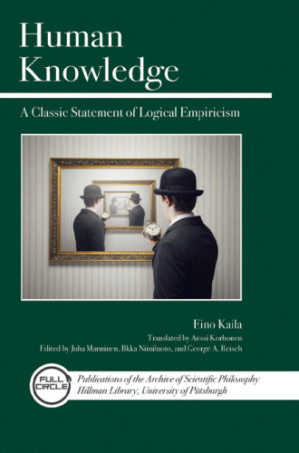
Translated by Anssi Korhonen Finnish philosopher Eino Kaila wrote a classic statement of logical empiricism. Having experienced the foundational debates of the Vienna Circle in 1929, Kaila was a keen follower of the further developments of the Circle. His synoptic presentation and analysis of the basic themes, or theses,” of the movement was based on his lectures as professor of theoretical philosophy at the University of Helsinki. The work appeared as a book in Finnish in 1939 and a Swedish translation by Georg Henrik von Wright followed immediately. Earlier, a translation of his philosophical essays from the original German, entitled __Reality and Experience__, appeared in 1979. However, this is the first translation of Kaila's major epistemological work, which remains a source for re-evaluations of Logical Empiricism.
Alternative filename
nexusstc/Human Knowledge: A Classic Statement of Logical Empiricism/f9fe6fdba74dd189509fd931d6863e6c.epub
Alternative filename
lgli/Human Knowledge 0812698487.epub
Alternative filename
lgrsnf/Human Knowledge 0812698487.epub
Alternative author
Kaila, Eino; Reisch, George A.; Korhonen, Anssi; Manninen, Juha; Niiniluoto, Ilkka
Alternative author
Eino Kaila, George A. Reisch, Anssi Korhonen, Juha Manninen, Ilkka Niiniluoto
Alternative author
Eino Kaila; George A. Reisch; Juha Manninen; Ilkka Niiniluoto; Anssi Korhonen
Alternative publisher
Cricket Books
Alternative edition
Publications of the Archive of Scientific Philosophy, Hillman Library, University Of Pittsburgh, Chicago, 2014
Alternative edition
Lightning Source Inc. (Tier 3), Chicago, Illinois, 2014
Alternative edition
Full circle, Volume 6, Chicago, Illinois, 2014
Alternative edition
United States, United States of America
Alternative edition
5, 20140421
Alternative edition
DE, 2014
metadata comments
0
metadata comments
lg1405657
metadata comments
sources: URN:ISBN:978-0-8126-9851-0
metadata comments
{"isbns":["0812698487","9780812698480"],"last_page":288,"publisher":"Open Court","series":"Full Circle Series"}
Alternative description
The Finnish philosopher Eino Kaila (1890-1958) wrote a classic statement of Logical Empiricism. He had experienced the foundational debates of the Vienna Circle, invited by Moritz Schlick, during the early summer of 1929. Kaila was a keen follower of the further developments of the Circle. His synoptic presentation and analysis of the basic themes, or "theses", of the movement was based on his lectures as professor of theoretical philosophy at the University of Helsinki. The work appeared as a book in Finnish in 1939. A Swedish translation by Georg Henrik von Wright followed immediately. Earlier, a translation of his philosophical essays from the original German, entitled Reality and Experience , edited by Robert S. Cohen, appeared in 1979. However, this is the first translation of Kaila's major epistemological work. Kaila's text remains a source for re-evaluations of Logical Empiricism
Repository ID for the 'libgen' repository in Libgen.li. Directly taken from the 'libgen_id' field in the 'files' table. Corresponds to the 'thousands folder' torrents.
Repository ID for the non-fiction ('libgen') repository in Libgen.rs. Directly taken from the 'id' field in the 'updated' table. Corresponds to the 'thousands folder' torrents.
All download options have the same file, and should be safe to use. That said, always be cautious when downloading files from the internet, especially from sites external to Anna’s Archive. For example, be sure to keep your devices updated.
Support authors and libraries
✍️ If you like this and can afford it, consider buying the original, or supporting the authors directly.
📚 If this is available at your local library, consider borrowing it for free there.
📂 File quality
Help out the community by reporting the quality of this file! 🙌
A “file MD5” is a hash that gets computed from the file contents, and is reasonably unique based on that content. All shadow libraries that we have indexed on here primarily use MD5s to identify files.
A file might appear in multiple shadow libraries. For information about the various datasets that we have compiled, see the Datasets page.