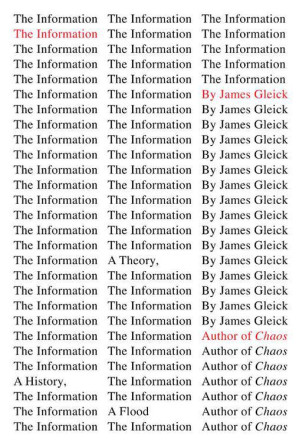
The Information : A History, a Theory, a Flood 🔍
James Gleick; OverDrive, Inc
Random House, Incorporated, Penguin Random House LLC, New York, 2011
English [en] · MOBI · 2.7MB · 2011 · 📗 Book (unknown) · 🚀/zlib · Save
description
From the bestselling author of the acclaimed Chaos and Genius comes a thoughtful and provocative exploration of the big ideas of the modern era: Information, communication, and information theory.
Acclaimed science writer James Gleick presents an eye-opening vision of how our relationship to information has transformed the very nature of human consciousness. A fascinating intellectual journey through the history of communication and information, from the language of Africa’s talking drums to the invention of written alphabets; from the electronic transmission of code to the origins of information theory, into the new information age and the current deluge of news, tweets, images, and blogs. Along the way, Gleick profiles key innovators, including Charles Babbage, Ada Lovelace, Samuel Morse, and Claude Shannon, and reveals how our understanding of information is transforming not only how we look at the world, but how we live.
A New York Times Notable Book
A Los Angeles Times and Cleveland Plain Dealer Best Book of the Year
Winner of the PEN/E. O. Wilson Literary Science Writing Award
Acclaimed science writer James Gleick presents an eye-opening vision of how our relationship to information has transformed the very nature of human consciousness. A fascinating intellectual journey through the history of communication and information, from the language of Africa’s talking drums to the invention of written alphabets; from the electronic transmission of code to the origins of information theory, into the new information age and the current deluge of news, tweets, images, and blogs. Along the way, Gleick profiles key innovators, including Charles Babbage, Ada Lovelace, Samuel Morse, and Claude Shannon, and reveals how our understanding of information is transforming not only how we look at the world, but how we live.
A New York Times Notable Book
A Los Angeles Times and Cleveland Plain Dealer Best Book of the Year
Winner of the PEN/E. O. Wilson Literary Science Writing Award
Alternative author
Gleick, James
Alternative publisher
Golden Books Publishing Company, Incorporated
Alternative publisher
Knopf Doubleday Publishing Group
Alternative publisher
Pantheon Books
Alternative publisher
Vintage Books
Alternative edition
United States, United States of America
Alternative edition
v3.1, New York, New York State, 2011
Alternative edition
Unabridged, New York, 2011
Alternative edition
1st ed, New York, ©2011
metadata comments
Includes bibliographical references and index.
Description based on print version record.
Description based on print version record.
Alternative description
The Information: A History, a Theory, a Flood begins with the tale of colonial European explorers and their fascination with African talking drums and their observed use to send complex and widely understood messages back and forth between villages far apart, and over even longer distances by relay. The book then covers informational implications of technologies from drum signaling to the long distance telephone.
Starting with symbolic written language, The Information examines the history of intellectual insights central to the development of information theory, detailing key figures responsible such as Claude Shannon, Charles Babbage (1791-1871), Ada Byron, Samuel Morse, Alan Turing, Stephen Hawking, Richard Dawkins and John Archibald Wheeler.
Starting with symbolic written language, The Information examines the history of intellectual insights central to the development of information theory, detailing key figures responsible such as Claude Shannon, Charles Babbage (1791-1871), Ada Byron, Samuel Morse, Alan Turing, Stephen Hawking, Richard Dawkins and John Archibald Wheeler.
Alternative description
From the invention of scripts and alphabets to the long misunderstood "talking drums" of Africa, James Gleick tells the story of information technologies that changed the very nature of human consciousness. He also provides portraits of the key figures contributing to the inexorable development of our modern understanding of information, including Charles Babbage, Ada Byron, Samuel Morse, Alan Turing, and Claude Shannon.
Alternative description
Drums that talk
Persistence of the word
Two wordbooks
To throw the powers of thought into wheel-work
A nervous system for the Earth
New wires, new logic
Information theory
The informational turn
Entropy and its demons
Life's own code
Into the meme pool
The sense of randomness
Information is physical
After the flood
New news every day.
Persistence of the word
Two wordbooks
To throw the powers of thought into wheel-work
A nervous system for the Earth
New wires, new logic
Information theory
The informational turn
Entropy and its demons
Life's own code
Into the meme pool
The sense of randomness
Information is physical
After the flood
New news every day.
date open sourced
2024-06-22
🚀 Fast downloads
Become a member to support the long-term preservation of books, papers, and more. To show our gratitude for your support, you get fast downloads. ❤️
- Fast Partner Server #1 (recommended)
- Fast Partner Server #2 (recommended)
- Fast Partner Server #3 (recommended)
- Fast Partner Server #4 (recommended)
- Fast Partner Server #5 (recommended)
- Fast Partner Server #6 (recommended)
- Fast Partner Server #7
- Fast Partner Server #8
- Fast Partner Server #9
- Fast Partner Server #10
- Fast Partner Server #11
- Fast Partner Server #12
🐢 Slow downloads
From trusted partners. More information in the FAQ. (might require browser verification — unlimited downloads!)
- Slow Partner Server #1 (slightly faster but with waitlist)
- Slow Partner Server #2 (slightly faster but with waitlist)
- Slow Partner Server #3 (slightly faster but with waitlist)
- Slow Partner Server #4 (slightly faster but with waitlist)
- Slow Partner Server #5 (no waitlist, but can be very slow)
- Slow Partner Server #6 (no waitlist, but can be very slow)
- Slow Partner Server #7 (no waitlist, but can be very slow)
- Slow Partner Server #8 (no waitlist, but can be very slow)
- Slow Partner Server #9 (no waitlist, but can be very slow)
- After downloading: Open in our viewer
All download options have the same file, and should be safe to use. That said, always be cautious when downloading files from the internet, especially from sites external to Anna’s Archive. For example, be sure to keep your devices updated.
External downloads
-
For large files, we recommend using a download manager to prevent interruptions.
Recommended download managers: JDownloader -
You will need an ebook or PDF reader to open the file, depending on the file format.
Recommended ebook readers: Anna’s Archive online viewer, ReadEra, and Calibre -
Use online tools to convert between formats.
Recommended conversion tools: CloudConvert and PrintFriendly -
You can send both PDF and EPUB files to your Kindle or Kobo eReader.
Recommended tools: Amazon‘s “Send to Kindle” and djazz‘s “Send to Kobo/Kindle” -
Support authors and libraries
✍️ If you like this and can afford it, consider buying the original, or supporting the authors directly.
📚 If this is available at your local library, consider borrowing it for free there.
Total downloads:
A “file MD5” is a hash that gets computed from the file contents, and is reasonably unique based on that content. All shadow libraries that we have indexed on here primarily use MD5s to identify files.
A file might appear in multiple shadow libraries. For information about the various datasets that we have compiled, see the Datasets page.
For information about this particular file, check out its JSON file. Live/debug JSON version. Live/debug page.